skip to main |
skip to sidebar
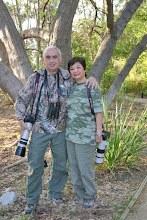
The ricefields inside IRRI in Los Banos is a haven for birds. However, it being a place for experimental rice farming, access is limited to their employees and their guests. Luckily our friend, Prof. Tirso Paris, has that access privilege. It was a beautiful, sunny Saturday morning when my wife and I together with friends, Irene and Bong, met up with Prof. Tirso at the IRRI gate.
All four of us were excited to go birding at this place because we hadn't done much birding for almost three months now. As I mentioned in my previous blog, blame the burning hot summer days then followed by the season of torrential rains for that. Prof. Tirso warned us not to expect too much because migration wasn't in full swing yet. Still, photographing any bird in the lush fields of IRRI would be enough for us.
Although we missed taking pictures of our target birds: the Greater Painted Snipe and the Barred Buttonquail, we were nevertheless thrilled at the birds we photographed. Foremost of these were the Wood Sandpipers which were practically all over the place. Irene counted almost a hundred of them!
Next would be the Zitting Cisticolas. Their incessant twittering filled the morning air.
As expected in any ricefield, both Chestnut and Scaly-breasted Munias were busy feeding at some of the ripening grains.
 |
| Chestnut Munia |
 |
| Scaly-breasted Munia |
The usually skittish Buff-banded Rails were sunning themselves, trying to get rid of the moisture from the early morning dew.
A surprise was a Pied Bush Chat.
Another surprise was when we saw a Cinnamon Bittern performing what we presumed to be a courtship display. Inasmuch as we didn't see the female maybe this was just its way of drying itself from the previous night's dampness.
The usual denizens of IRRI brightened up our morning. The Paddyfield Pipit was diligently hunting for food.
While the Oriental Skylark was already feeling the heat of the day as midmorning came.
It was a fruitful day of birding for us. We owe it all to Prof. Tirso who was our "guide" to the field birds of IRRI.
 |
| photo taken by Irene |
Any faint-hearted birder probably would not have gone through it. All the discouraging signs were there: target bird not seen the day before, heavy rain falling early in the morning, strange sounds coming from the car when driving over 80 kph, me not feeling too well…
But we had determination. We got faith. We pressed on towards our goal.
At seven in the morning our friend, Prof. Tirso Paris, was escorting us inside the fallowed grounds of the International Rice Research Institute (IRRI). He led us to the fields where the rare migrant, the Oriental Plover, had been seen and photographed. Tirso was telling us that just two days ago these uncommon birds were quite close to where they parked their cars. Today, so far, nothing. However, Oriental Skylarks seem to be everywhere! Cynthia and I have never seen so many of these tiny brown birds in a single place!
At the next stop, Prof. Tirso pointed out a tiny speck among the green grass. It was our target bird allright but unfortunately too far and too hidden for passable photographs. Looking through my binoculars I even discovered there were actually two of them, one still sporting traces of its breeding plumage.
Tirso decided to scout the nearby area to see if there would be more of these birds (there were supposed to be about seven of them) while we stayed put and photographed the more oblivious Wood Sandpipers.
Soon we got a call from our friend saying he found them. We rushed to where he was and there three Oriental Plovers were busy hunting for food. They stayed at a distance unlike in the past but still afforded us some good enough shots.
After having our fill of the Plovers we took a break to have a snack with our host and to enjoy the Birds of IRRI exhibit were most of the photographs on display were taken by our beloved Prof. Then we explored the lowland area where Oriental Pratincoles were quite plentiful. Today must have an "Oriental" theme, what with lots of Oriental Skylarks, Oriental Pratincoles and even a few Oriental Plovers.
Soon Tirso was pointing at a smaller wader mingling with a Black-winged Stilt. "Marsh Sandpiper" he informed us. It was somewhat unusual for this species which prefers coastal areas to be inland and even on a ricefield so we added that to our list of birds photographed that day.
Rain started to fall again so we all agreed that it was to time to go. Our heartfelt thanks goes to our dear friend, Prof. Tirso, not only for accompanying us inside IRRI but also for locating our target birds for us.
As irresistible as a cold drink on a hot muggy day - that's how the fields at IRRI (International Rice Research Institute) are to birders at the onset of autumn migration.
Inasmuch as IRRI is a research facility, access to its premises is strictly regulated. It was through the courtesy of Prof. Tirso Paris whose wife Thelma, works there that all four carloads of bird watchers/photographers were able to get in at that place early Saturday morning.
Thus began several hours of birding that padded our car-mates Peter and Irene's lifelists.
Indeed the paddyfields were teeming with migrants galore! I have never seen so many Wood Sandpipers before.
I was surprised and was even able to get a photograph of a lone Intermediate Egret.
And who could resist that cute, fluffy Cisticola that went zitting as it was sitting on top of a pole.
While the Cisticolas we were trying to follow, we noticed another bird on a stick - it was a lovely Barn Swallow.
How could you not write an ode to that Oriental Skylark insouciantly basking on the road?
After passing a corner and we made a turn, out in the open was an immature Cinnamon Bittern.
The stars of IRRI were of course the Greater Painted Snipes clothed in those quaint stripes, sometimes difficult to see with the naked eye for they so much resemble an icky, nasty cow pie.
Another surprise was a Swinhoe's Snipe, a skulking bird that always poses a challenge as to what type. Pintail, Common and Swinhoe's all look so much the same that makes identifying them quite a game. The reason I was certain of this snipe's name was because of Prof. Tirso's photo that showed in such great detail the tiny white feathers at the edge of the tail.
Even good times must come to an end. We bade goodbye to our friends - the birders (Doc Cha, Ruth and Chee-ann) were to meet other colleagues at the Botanic Garden.
The bird photographers (Steve and Paolo) decided to go home so they could see the results of their endeavors.
For us (me, my wife, Peter and Irene) and our host, Tirso, more irresistible goodies awaited ....and they were not just birds....