skip to main |
skip to sidebar
We still don't have a good picture of the Black-chinned Fruit Dove. Recently, there had been a spate of photos of this species in Facebook. Nice open shots even! So my wife and I visited La Mesa Ecopark early Saturday morning hoping to get a good shot ourselves.
There were already a group of bird photographers in the area. We introduced ourselves and while we were talking shop, the Black-chinned Fruit Dove showed up and began feeding on the red fruits of the MacArthur palm. Not even 30 minutes had passed and we already got our target bird.
After the dove left, one of our fellow photographers saw something not far from where we were. We all hurried next to him and he pointed to another surprise - a Spotted Wood Kingfisher was perched about a couple of meters away...and at eye level!
As if that wasn't enough, the other star bird of Ecopark, the White's Thrush, was seen by another bird photographer. We were all excited as we tried to get a better view of this uncommon migrant.
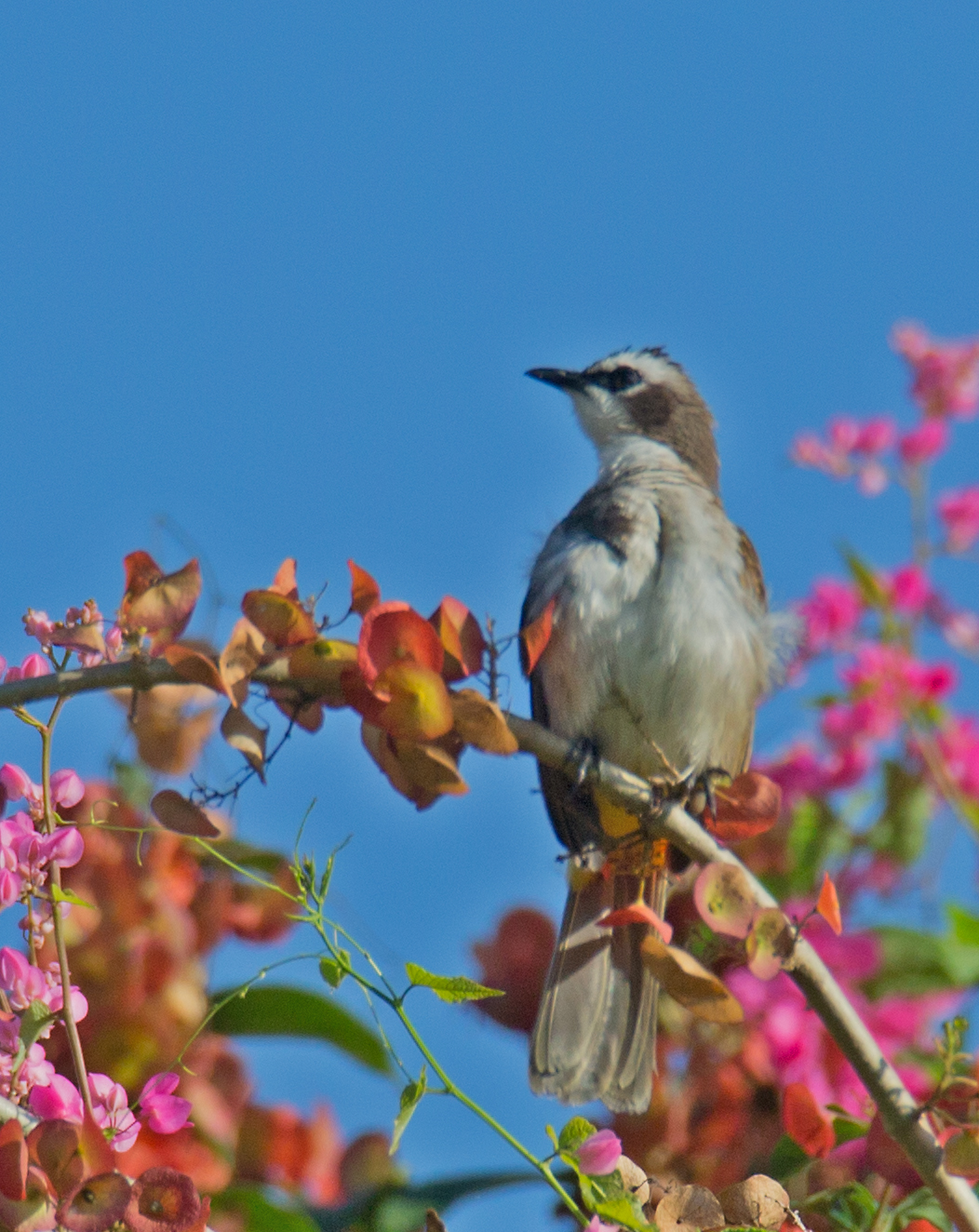
We told our new friends that we already met our "quota" and that was it for us. On the way out we took some obligatory shots of the Brown Shrike and Yellow-vented Bulbul.
A pair of noisy Black-naped Orioles was our grand finale.
That was one of the most productive and satisfying one-hour birding we had experienced.
The current attraction among birders and bird photographers is the White's Thrush at La Mesa Ecopark. Being an uncommon migrant, it drew a lot of attention among avian enthusiasts, at one time as many as 20 individuals who tried to a get a photo of this skulker.
Saturday morning, Cynthia and I decided to join the White's Thrush fan club. Not a lifer for us, as we've seen and even got good pictures of this species 6 years ago. We were there a little after 7 am and we joined fellow bird photographer Nes Santiago in the quest for the star bird. We also met young birder, Chet Chua, who took every effort to look for the legendary thrush for us. Unfortunately we were always too late getting to the place where Chet had seen the bird.
The Brown-headed Thrush, another uncommon migrant, however, was more cooperative since it enjoys feasting on the red fruits of the Mac Arthur palm trees.
Soon other bird photographers came, Rey Ibay, Marc Capistrano, and local birdman, Ferdie Llanes. Ferdie told us that to be able to see the White's Thrush, we have to wait patiently with minimal movement and talking. Half past ten, and my wife getting only a butt shot, we agreed to call it a day.
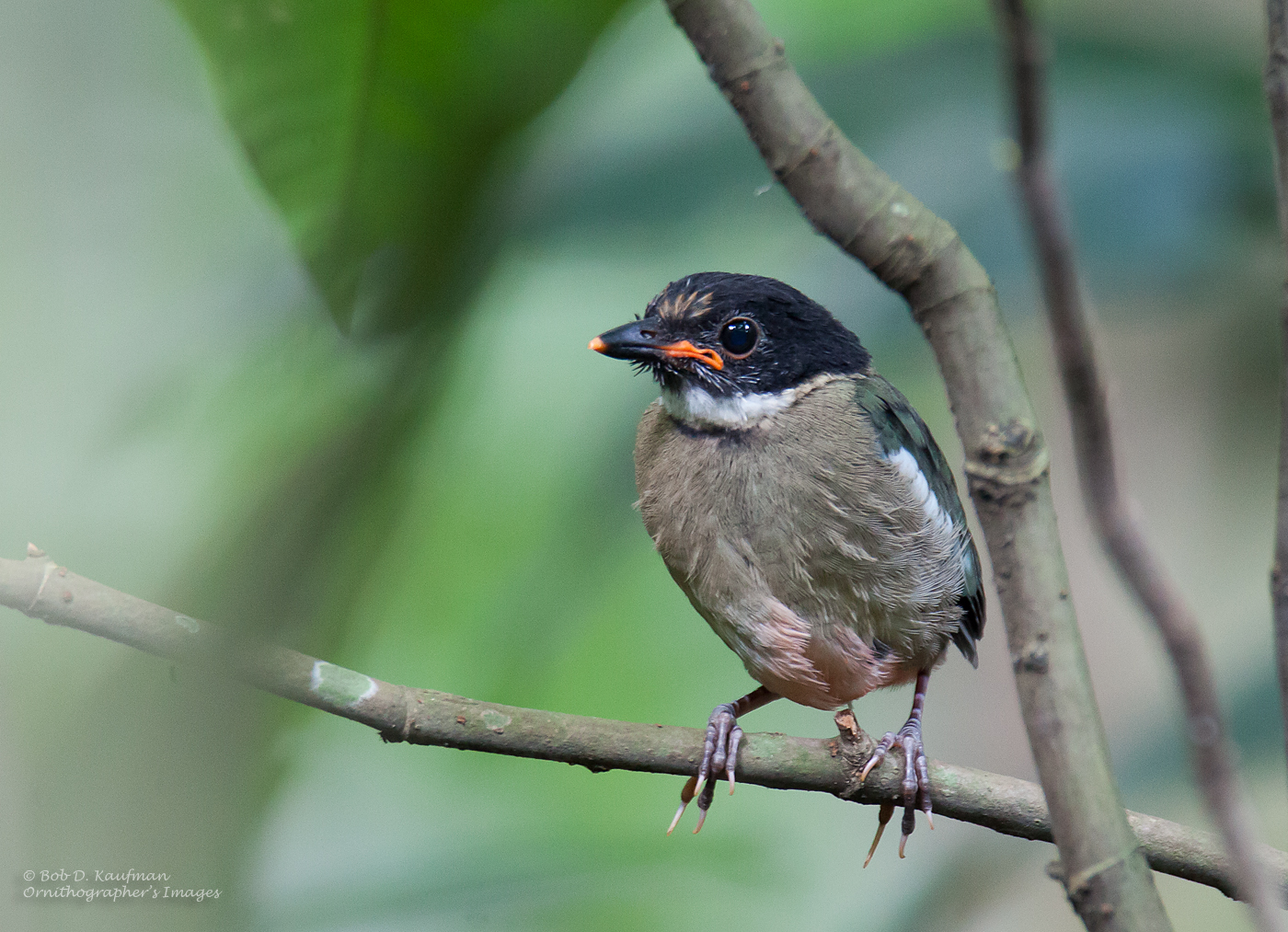
For more than two hours we waited. Two hours of being drenched in sweat and enduring the humidity of a summer. We were at the Mini Forest of the La Mesa Ecopark for a particular purpose: to photograph the Hooded Pitta and the Mangrove Blue Flycatcher. We sadly dipped on both.
But please show us no pity. The morning was not a total disaster. For one thing a Black-naped Oriole - a species that prefers to stay high among the branches of tall trees - came out in the open and posed for us for a few minutes.
Then a pair of Lowland White-eyes cavorted just above us.
An overstaying(?) Brown Shrike was still hanging around perhaps aware that it was still quite cold in its home in northern Asia.
A surprise was a Philippine Bulbul which have not been seen much in this area.
Also the morning was about people. As we were about to get into the mini forest we met a young guy. He was a campus missionary from our church (Victory Christian Fellowship) in Novaliches. They will be holding a youth ministry at the Ecopark he told us.
While waiting for the Pitta we met an old friend, and fellow birder, Jenny de Villa. We spent some time together catching up and sharing our birding experiences.
Finally, as we were already driving on our way out, I saw a guy dressed in camp and holding a camera with long lens. "Bird photographer!", I told my wife. I waved at him and parked the car. He came over and introduced himself and we did likewise. We just added a "lifer" to our birding friend list - Rey Ibay.
We were at the La Mesa Ecopark at 6:30 in the morning. At the parking lot we were greeted by the distinctive call of the Black-naped Oriole. We looked at the source of that call and saw the bird...but it was directly above us and the early morning sun was shining directly on it...which meant not good for photography.
We saw some commotion up in the trees. It turned out that there was an ongoing quarrel between a squirrel and a Large-billed Crow.
We then moved on to the mini forest. Other than the constant calling of the Orioles, there were no birds! Perhaps it was because of the raucous bunch of teenagers walking on the trails shouting and screaming all the time. Or some cyclists that came after them. A little after 8, peace and quiet finally came. No more hikers and bikers. Strangely, still no birds! We waited for the resident Ashy Thrush to show but it never did.
We tried the jogging trail. There were birds allright - those we regularly see in the vicinity of our condo - the Brown Shrike and the Yellow-vented Bulbul.
 |
| Brown Shrike |
 |
| Yellow-vented Bulbul |
One of the Orioles eventually showed up at a better photographic angle.
Cynthia, frustrated at not seeing more birds, suggested we go to the pond and maybe get to see the Common Kingfisher there. When we arrived at the pond, it being a holiday, there were people everywhere! The huts were all occupied! Yet, despite that, we saw more birds at that place. First there was the Pied Triller.
Not far away from where the Triller was, there was a flowering tree where a pair of Olive-backed Sunbirds were enjoying their breakfast.
 |
| male |
 |
| female |
My wife's sharp eyes spotted the kingfisher. It was perched under the shade of huge leaves as it waited for some unfortunate fish.
Then I saw some movement on a bare branch above the pond. I was surprised to see a Coppersmith Barbet enjoying the morning sun.
After the Barbet left, I saw another bird, a lot bigger than the barbet, land on a branch with a twig in its beak. It was a White-eared Brown Dove apparently building a nest. To get a better view, we moved to the "bridge". There we met fellow bird photographer Ferdie Llanes. We pointed the dove to him. He told us that he had been hearing the call of this bird from his house (he lives nearby) and wanted to find where it was.
We made a short stop at the spillway but it was now dry and covered with tall grass and no birds. It was almost 10 am so we decided to call it day. Normally, birds are more active early in the morning and their presence becoming more sparse as midday approaches. Today had been the opposite for us. As time went by, we saw more birds, despite the abundance of humans around them.
News about an Ashy Drongo seen at the La Mesa Ecopark spread throughout the birding community. This was the migrant subspecies salangensis which differs from the one seen in Palawan by its white face and grayer plumage. Although not a lifer for us - we've seen one in February 2015 near the main library building at U.P. Diliman (see my blog on that) - we still wanted to go find this one, hopefully to get better photos.
So I asked friends, Mon and Ferdie who had already taken pictures of that bird, for directions. They replied with text messages and gave the precise location of the drongo. Armed with this information, we went to the site at 6:30 in the morning. The climb up to the zip line station was exhausting for these two senior citizens. We staked out the acacia trees. Half an hour and the bird was still a no show. We called both our friends to confirm if we were indeed at the right place. Thankfully, Ferdie told us that a friend of us his, Mark, had just seen our target bird. He told us to come down and go to our friend Anthony's shop and Mark would meet us there. As soon as we reached the street we met two friends, Ben and Conrad, who obviously had the same purpose for coming to Ecopark. We proceeded to the Bungee jumping area and there we met Mark. He showed us a photo of the drongo which he took not more than 15 minutes ago. He then took us to where he got that shot and it wasn't long when the uncommon migrant showed up. Although a bit far, it was definitely a drongo I see. Finally our patience paid off when our beloved Ashy Drongo perched on a branch, out in the open, and close enough for us to get some good shots.


A happy group having just photographed the Drongo.
Satisfied that our mission had been accomplished, we bade goodbye to our friends. A short trip to the mini forest yielded absolutely zero birds! With the humidity becoming more and more unbearable and our stomachs grumbling (we haven't had breakfast yet) we indulged in a buffet brunch at Cafe Sweet Inspirations.
Two times I went to La Mesa Ecopark to look for the Luzon Hawk-Owl. Both times I failed. That was on a Tuesday and a Saturday. Then on Sunday afternoon fellow bird photographer Jonn Salvador posted a shot of the said species in Facebook. I immediately texted local bird expert, Anthony Balbin, asking him if the owl was still there. Yes, he texted back. It was 4 in the afternoon. I quickly consulted the Waze app to see how long it will take to get to the Ecopark. About 50 minutes it said. Without even bothering to put on our birding shoes, Cynthia and I jumped to our car and rushed to the park. An hour later we were at the mini-forest. Soon Anthony came and showed us where our target bird was perched. It was farther up now than where it had been previously sighted. The skies were gloomy, dusk was fast approaching, and the Hawk-Owl was beneath a huge palm leaf. Not the best circumstances for good photography. Nevertheless, we tried. Then the owl turned its face away from us. Prof. Reuel Aguila, who also joined us, and I, tried to negotiate the incline so we could get better views. Finally a tiny opening in the foliage allowed us to photograph our lifer at an angle we had hoped for. I quickly reviewed the results of my endeavor and was glad that at least a couple of shots were acceptable.


Satisfied that we had accomplished our mission we joined our birder friends who were hanging out at Mang Jose's restaurant. We heartily thanked Jonn and Anthony without whom we would not have been successful in getting our first lifer of the year. I told our friends Wins Tornado, Ed Santos, Gilbert and Wilma Go, Albert Tamayo, and Jonn, Prof. Reuel and Anthony of my two earlier unsuccessful efforts at finding the owl. But the third time's always a charm, I said smilingly.
Maybe it's because I don't have my good luck charm (aka my wife) with me. It was one of those rare occasions where I went birding without Cynthia. It was a mutual agreement anyway: I go birding in the morning while she house sits then she goes to a baby shower in the afternoon and my turn stay at home.
The day before I got a message from birding buddy, Bong, that a female Spotted Wood Kingfisher had been seen at the La Mesa Ecopark. Although not a lifer, it would a welcome break from my long hiatus in going out to take pictures of birds.
Saturday morning, Bong, Raymund, myself, and resident birder, Anthony, staked out the kingfisher. After two-and-a-half hours, the only kingfisher we saw was the Collared kind.
The weather wasn't cooperating either as the skies were blanketed with grey clouds. And the local birds - the Pied Trillers, Lowland White-eyes, Black-naped Orioles and Pied Fantails - frustratingly kept staying in the uppermost branches of the tall trees. Backlit photography all the way!
Around 9:30 I bade my friends farewell. As I turned my car around, I noticed my buddies frantically taking shots at something. "Cuckoo!" Raymund said. I unpacked my gear, jumped out of the car and joined the frenzy. The Rusty-breasted Cuckoo played with us as it perched on a branch, stayed for a couple of minutes, then fly to another branch, posed a bit then fly again, until it was out of sight.
And that was it. I renewed my farewell to my friends and drove home all the while thinking: Fie on you, Spotty bird! Disappointing four birders who were drenched in sweat on that humid morning. And thank you, Rusty-breasted bird, for giving those four birders the much needed thrill and driving them cuckoo with your antics.
Wenxing and I looked at each other. Tacitly, we agreed that it was time to call it a day. We were at the Mini Forest of La Mesa Ecopark since 6 in the morning. My friend was hoping to take some photos of the Hooded Pitta that had been seen here recently. For almost two hours we searched but only the Ashy Thrush was kind enough to show up.
Nearing 8 am, Wenxing heard the unmistakable call of the Pitta. He played it back for a few seconds and got an immediate response. We tried to locate the source of the calls but like a mischievous spirit we never even got a glimpse of our target bird. And then it was gone. As if a switch had been flicked that the pitta calls just stopped completely. Then came the reason for the sudden silence - a group of about 30 bikers passed the trails where we were searching for the Hooded Pitta. This group continued circling the trail over and over again. That was when we knew that our birding day was over.
A short stop by the horse stables and in between the swooshing of bikes, we were able to see and photograph an overstaying Grey-streaked Flycatcher and a White-eared Brown Dove.
And that was it.
One of the nicer things in going birding is meeting new friends who are also into the same passion.
The mini forest at La Mesa Ecopark was strangely quiet. Cynthia and I were wondering where the birds were when we saw a couple with cameras looking up at the treetops. "Birders" we both agreed. We introduced ourselves and we instantly became friends with Jo Lapuz and her husband, Bernard. They were new into the hobby and my wife and I happily volunteered to show them around.
As I said earlier, birds were few that morning. Since Jo and Bernard have just started into bird photography, both were happy taking pictures of even the common Zebra Doves. I tried to scout the area and luckily chanced upon an Ashy Thrush.
Unfortunately it was gone by the time our new friends arrived at the place where I saw it. Two hours slowly passed and still no birds showed up. We told Jo and Bernard that we're going to the Paintball area to try and look for the Violet Cuckoos and they're welcome to come along. Since the cuckoos would be a lifer for them, they enthusiastically agreed.
At first we thought that it was too late in the day because only the Golden-bellied Gerygones and the Yellow-vented Bulbuls were in the tree that Violet Cuckoos go to. Again it was Cynthia's sharp eyes that saw the male cuckoo foraging for insects at the back side of the tree. To our delight it eventually came out in the open and gave us photographic opportunities.
That's when the camera set that I brought with me tried my patience. Inasmuch as birding at Ecopark involves a lot of walking I decided to bring the lighter Tamron lens. Then as a second thought, instead of my usual 5D III camera body, I used the 7D instead. Big mistake! The camera body and the lens apparently were not communicating with each other. Auto-focusing was an exercise in futility. Even in the best lighting conditions! Who knew it would turn out this way? It was sheer luck that I was able to get a few acceptable images.
The good news was that our new confreres were able to get photos of their latest lifer. And that, for me, more than made up for my disappointment with the photographic gear that I brought with me.
It seemed like everybody and his uncle had seen - and photographed - the male and female Violet Cuckoos at the La Mesa Ecopark. We tried a couple of weeks ago and totally bombed. Since the recent sightings had been more frequent, I asked our friend, Mike Anton, when and where would be the best time and place to go. "Near the paintball area", he replied, "around 7:30 to 8:00 in the morning."
Six-thirty the following day, my wife and I were already at the Paintball area. It didn't take long when Cynthia started pointing to some movement on the tree in front us. My heart was jumping for joy because it was the male - my target bird! (I've seen and photographed the female several years ago in U.P.). For the next couple of hours the pair of cuckoos gave us lots of opportunities to take their pictures.
 |
| male |
 |
| female |
We were thankful that we got what we had hoped for, quite easily at that, and also because of bonus shots of two raptors: the Philippine Serpent Eagle and three Ospreys hovering over the spillway.
 |
| Philippine Serpent Eagle |
 |
| Osprey |
During one of those pauses when the cuckoos were inactive and hidden from view, we were joined by a group of foreign birders guided by members of the Haribon Foundation. They were so excited to see the Violet Cuckoos, the Serpent Eagle and the Ospreys and later on by a small flock of Lowland White-eyes.
Around 9:30 two newbie bird photographers came. Tim Calumpong and Fidel Sy also enjoyed the Cuckoos showing up just as they arrived. A little after ten and we all (including the foreigners) called it a day.
For Cynthia and myself this was one those hallelujah birding moments when everything just fell into place.
....and the bad luck continues...
In my last blog I mentioned our heartache at not seeing our target bird - the migrant Blue Rock Thrush at the University of the Philippines' campus. On my birthday even! Little did I know that such bad luck would still be with us three weeks later.
Bright and early this morning my wife and I were at the La Mesa Ecopark hoping to see the Violet Cuckoo and maybe even the Grey-faced Buzzard. Our friend, Maia, saw the cuckoo yesterday and happily posted her sighting in her blog. I contacted her for the directions and she said the bird usually frequents the trees near the fishing pond. "It usually perches above the balete tree," Maia said. Almost four hours later and the only birds that perched on the balete tree were the Yellow-vented Bulbuls.
Early on we were joined by another friend, Bong Nabong. He just came from the spillway looking for the Grey-faced Buzzard which was seen yesterday as well by another friend and neighbor, Chin Fernandez. "Never showed up," Bong informed us about the buzzard.
Cynthia and I eventually gave up on the cuckoo. The only consolation we got was me being able to photograph a Common Kingfisher and my wife a Pygmy Flowerpecker.
 |
| Common Kingfisher |
 |
| Pygmy Flowerpecker |
A short foray into the mini-forest yielded a total of zero sightings. You read that right: zero! as in nada! zilch!
We tried the spillway and got the exact same statistics: zero! nada! zilch! We asked the Security Guard in the area if he had seen the raptor. "It was here yesterday," he said, "up above those trees across the spillway." "Did not see it today though," he continued.
A Violet Cuckoo above the balete tree and a Grey-faced Buzzard above the trees across the spillway - and yet none showed up today. Not that they were lifers to be for us (although we have not seen a male Violet Cuckoo yet) but still the disappointment of lucking out on both species was quite hard to bear.
As I was reviewing our CF cards at home I was shocked to discover that we only took a total of 38 shots - 18 for Cynthia and 20 for me. Thirty eight shots in a span of four hours! This could be our worst birding day! Ever!
Saturday is trash day in our subdivision. It was the day the garbage collectors pick up the organic (non-recyclable) rubbish that we put outside our houses. For me and my wife this Saturday was trash day seen in a different perspective. It was one of those days when we wished we just stayed home languishing in the comfort of our airconditioned room. Because this particular Saturday we were at the La Mesa Ecopark drenched in unending sweat hoping to photograph the local celebrities named Mr. and Mrs. Spotty. Or maybe even any member of the Hoodie family. Alas after three long hours in the extremely humid mini forest not a single one of our target bird showed up. Not even one. This despite the diligent efforts of resident birder and super guide, Anthony.
Only because of Cynthia's meanderings that she was able to locate the "trash bird" of the park aka Ashy Thrush. At last we were able to get some documentary photographs of a bird. Just documentary shots, mind you. At least those photos somehow helped alleviate our frustrations that morning.
Another redeeming factor, aside from the Ashy Thrush, was that we were fortunate to make new friends. Arman and Sree from Singapore and Pan from China, we hope to see you again.
At half past nine we just couldn't take it anymore. We both agreed to call it a day.
P.S. We learned the following day that both Arman and Sree, who flew in from Singapore for the sole purpose of photographing the Spotted Wood Kingfisher, finally succeded in their mission at 4:40 that Saturday afternoon after enduring a heavy downpour.
I got a text message from my friend, Bong, asking me if I wanted to join him at La Mesa Ecopark Thursday morning. I consulted my wife and she readily gave me the go signal. I texted Bong back and told him I would be there.
In times past I would have been eagerly looking forward to such an outing with my birding buddies yet somehow, after my text message was sent, I did not feel the fire of enthusiasm at all. Perhaps it was due to the sad memories of my past three visits to the Ecopark that were pure disappointments (please see previous blogs). Then there were the thoughts that since we were expecting the handyman to arrive that Thursday to do some work in our house, I really did not want to leave Cynthia to deal with him by herself. She wouldn't be alone, though, inasmuch as we just got a house help recently. But still....
To make matters worse, it rained heavily that night causing some flooding on our basement. We had to stay up until 11 pm bailing out the waters that seeped in through the walls (one of the items that the handyman would be fixing the following day). We went to bed exhausted from all that work and went to sleep much later than our usual 9 pm bedtime.
Thursday morning, I woke up a little after 4 am. A few minutes later, my wife opened her eyes and saw me staring blankly in the darkness of our room. "Are you going to Ecopark?" she asked. I sighed deeply. "I have to go," was my determined reply.
I arrived at the Ecopark earlier than my appointed time with Bong. My meanderings only gave a quick glimpse of the Hooded Pitta. Soon Bong along with the park's bird expert, Anthony, came. We staked out the place where the male Spotted Wood Kingfisher usually hangs out. We were then joined by another bird photographer, and my Facebook friend, Ed. It didn't take long after that when Anthony called us and pointed to the kingfisher. But it flew away even before we could point our cameras at it. Anthony's keen eyes and perseverance finally paid off as we eventually got better views of the colorful male who was named "Spotty" by the local birders.

I told Anthony that I also wanted to get a photo of the male Hooded Pitta. He took me to where it is seen regularly but my bad luck still haunted me. When we returned to where Bong and Ed were still continuing their stake out and hoping for even better shots at the kingfisher, they told me that the Pitta showed up. They were not able to take photos because it came closer than the minimum focusing distance of their long lenses. I tried to hide the pain I felt at that moment with a mirthless smile. A few minutes later Anthony called me and told me he found the adult Pitta. I quickly followed him. He stopped by the trail and pointed at my target bird calling from a branch. "We can get closer," Anthony assured me. I left my tripod behind so that I can better negotiate through the vines and branches that would block our path. Finally, my hoped for Pitta shot had been fulfilled.

Once again I rejoined Bong and Ed. We passed the time resting and enduring the suffocating humidity. Our untiring "guide" came and announced that he saw the immature Pitta not that far from the trail. Then followed the most rewarding photo session bird photographers had always been dreaming of. The subject just sat there and posed for us even as we changed positions, tried various angles, and experimented on various settings.
A little after 10:30 I got a text message from my wife asking me to buy some material needed to help solve the flooding on our basement. I bade farewell to my friends and despite the sultry weather jauntily walked back to my car.
On my fourth try, I am now comforted and filled with joy.
Ah, the heartache as a result of being mocked by birds, how does one get over it?
I was all by myself, bathed in a torrent of sweat, searching for birds that I can photograph in the mini-forest of the La Mesa Ecopark.
There was a fleeting shadow among the leaves that promptly disappeared as I focused my eyes (my eyes! not even my camera!) on it. That was just about it.
A slight movement among the leaf litter. Ashy Thrush! I pointed my camera at it. It looked at me and then it moved as if saying to me "photograph me if you can". I followed, slowly, hiding behind a tree trunk. I can see it. I raise my camera. The thrush once again moved challenging me to follow it. Stealthily, I repositioned myself, once more seeing the bird. Before I was able to aim my camera at it, it flew. Out of sight. There was a mocking, laugh-like twitter. I sighed.
I walked along the trail. Then I heard it - the unmistakable call of the Hooded Pitta. I half-ran to where the mournful sound was coming from. The call got louder and louder. I stopped and gazed around. Then came the "uh-oooh". It was so loud, the Pitta could not be more than ten feet away. But where is it? I looked up, hoping it would be calling from a branch. Not there. I searched the grounds around me. No movements at all. And yet, the call was still loud and near. A flutter, a shadow quickly darting from the clump of leaves in front of me to....I couldn't tell where it landed. Again, came the call - now farther away. I followed. A bit louder now but still no sign of the hooded green bird that seemed to tease me, daring me to find it. Another fleeting shadow. Another call - this time emanating from a place even farther away. The call, the deriding laughter, echoed in the distance, taunting me, daring me to keep on pursuing the source of such scornful sound. But I, no longer desiring to be the patsy of such playful ploy, turned away and decided to look for other birds, perhaps those with a more cooperative nature.
I was meandering along the trail, my pride brought down a notch or two by the pesky, invisible pitta, when the Ashy Thrush flew across my path. I raised my camera only to see it merge among the low branches completely disappearing like an avian Houdini. I searched the adjacent area. Nothing. Suddenly a moving shadow and a jeering call. Then silence. Oh how I missed my expert spotter (aka my wife, Cynthia).
It was while I was mulling over this situation when a special-ops team of minuscule black ants made a coordinated assault on both of my legs. How those tiny dots could inflict so much pain puzzled me. I did a frantic rubbing on my legs accompanied by a fervent prayer that I would be able to get rid of all those that had attached themselves to my flesh. Thank God, the ant bites were gone after a few minutes.
It was just too much for my wounded pride to bear. I decided to end my birding day after spending only two hours in the suffocating humidity of the forest. I needed to be home and spend the rest of the day licking my wounded pride.
Host: Ladies and gentlemen, tonight's guest is none other than Bob Kaufman, bird photographer and blogger. Good evening, Bob, welcome to the show.
Bob: Good evening! Thanks for inviting me. Frankly I'm a bit nervous.
Host: Just relax, Bob. I heard that you finally went birding this morning. How long had it been since you last birded.....
Bob: Mid-April in Hongkong.
Host: .....in the Philippines?
Bob: Oh, sorry. If I remember correctly it was March 7th.
Host: Wow! That long ago already? You usually go birding with your wife, Cynthia. But this morning she wasn't with you. Why?
Bob: It's because of the heat. She just couldn't bear it. Actually even I was hesitant to go but the need to satisfy my birding itch finally overcame my vacillation.
Host: Where did you go?
Bob: At the La Mesa Ecopark.
Host: Did you see a lot of birds?
Bob: Sadly, no. Were it not for the help of some friends that I met there I would probably have seen even less.
Host: So nice of them. I also heard that the Hooded Pitta is now seen quite regularly there. Were you able to see it?
Bob: (Pause)
Host: Did you see the Hooded Pitta?
Bob: Next question please.
Host: (smiling) What birds did you see?
Bob: Well, there was a Barred Rail that hid behind the bushes before I could even raise my camera to my eyes, a flock of tiny Lowland White-eyes, an Ashy Thrush that wouldn't stop singing, and a hungry Guaiabero. That's about it.
Host: And you got pictures of those, I'm sure.
Bob: Well, yes. Except for the Barred Rail.
Host: Would you like to show them here?
Bob: (demurring) Ummm, not really. Honestly, it's because none of my shots turned out well. Let's just say that this morning's trip was all about my need to go birding after a long hiatus. And now I'm glad that that itch is over.
Host: There you have it, ladies and gentlemen, we learned something new tonight. In birding oftentimes it's the simple joy of fulfilling the need to pursue one's passion that really matters. Thank you, Bob Kaufman, for sharing your thoughts and experience with us.
Bob: My pleasure.
Perhaps it was because of habit that we woke up at 5 am. Normally at this time on Saturday mornings we are either already on the way to a birding destination or getting ready for one. Today, however, we did not have any plans to go birding at all. The reason for that is we will be attending a discipleship seminar at Ortigas Center at 10. We looked at each other and I subtly broached the subject of a quick sortie at the La Mesa Ecopark, after all it's just 15-20 minutes away sans trafic - to which my wife hastily agreed. We skipped breakfast (another deviation from the norm) and were at the park by 6:30.
Our primary targets were 1) the Indigo-banded Kingfisher and 2) Brown-headed Thrush. Although both species had already been seen and even photographed by us, the recent postings in Facebook by our friends sort of inspired us to make the same pursuit.
One look at the pond and I knew the kingfisher would be a no-show: the area "residents" had just awakened and were doing their morning ablutions and preparing breakfast. So I decided to pick on the thrush by positioning myself near the fruiting MacArthur Palm tree. Only to realize the vanity of it all. How could a self-respecting bird withstand the joggers, bikers and noisy crowds passing underneath the source of its breakfast?
Cynthia decided to roam around and try to look for other avian subjects. After an hour, she returned to where I was silently controlling my seething anger and told me that she got nada. Soon, our friend, Fr. Auckhs, came also with the intent of photographing the Indigo-banded Kingfisher. We apprised him of the situation but he had more confidence and patience than us.
At around 8, human activity waned to a tolerable level. I was still at the trail by the palm tree. I noticed some movement behind. It was the thrush I was hoping for. It was casing the joint, so to speak, trying to determine if it was already safe to pick some fruits. It was then that another boisterous crowd walked by and drove my target bird into hiding once again. Luckily I was able to get some shots, albeit a bit dark, before it was spooked.
At around 8:20, I told my wife that we have to go. We bade goodbye to Fr. Auckhs and informed him that we will go around the trail loop and head home from there. As I turned I saw the Brown-headed Thrush feeding on the palm tree! A short burst and then it flew off again. One shot turned out to be good enough.
We had a quick breakfast at nearby Jollibees and then an hour-long patience-trying, trauma-inducing drive back through a horrific traffic jam. Considering that we still have to go home, wash up and change our clothing, my wife and I did some thrush talking to alleviate our building anxieties (we're both punctual persons and getting late is something that we absolutely hate).
It was a miracle that we got to the seminar just in the nick of time.