Showing posts with label yellow bunting. Show all posts

Sunday, April 17, 2022

Baras-ing Up

My age has been catching up on me. This 75 year old senior is now having difficulties doing long drives. That was why we recently erased Baras as one of birding destinations. Although it is only about 40 kilometers away from our place, the traffic on the return trip was quite aggravating.

Friday Cynthia promised to meet up with her daughters (and their families) who were vacationing in Tanay. It being a holiday we were quite certain that traffic would be bearable. And since Baras would be along the way, my wife and I both agreed that we could go birding again at the Palo Alto Subdivision.

True enough there were fewer motorcyclists and bikers along the Marilaque Highway and we arrived at our destination just a little after 7 am. To our surprise the very first species we saw was the Balicassiao, several individuals even!


Right after that another surprise was a Scale-feathered Malkoha. This usual skulker was out in full view.


We moved on near the waterway where we saw a Green Sandpiper.


At the grassy area were the "regulars" - the Pied Bush Chats (both male and female) and the Paddyfield Pipit.

Pied Bush Chat - male

Pied Bush Chat - female

Paddyfield Pipit

Near Jerez Street (I think it was at Ybanez St) we encountered a very rare migrant - the Yellow Bunting. The only place where we saw this species before was in Laoag, Ilocos Norte.


On the sidewalk, I was able to get a shot of the White-breasted Waterhen before it hid behind the bushes.


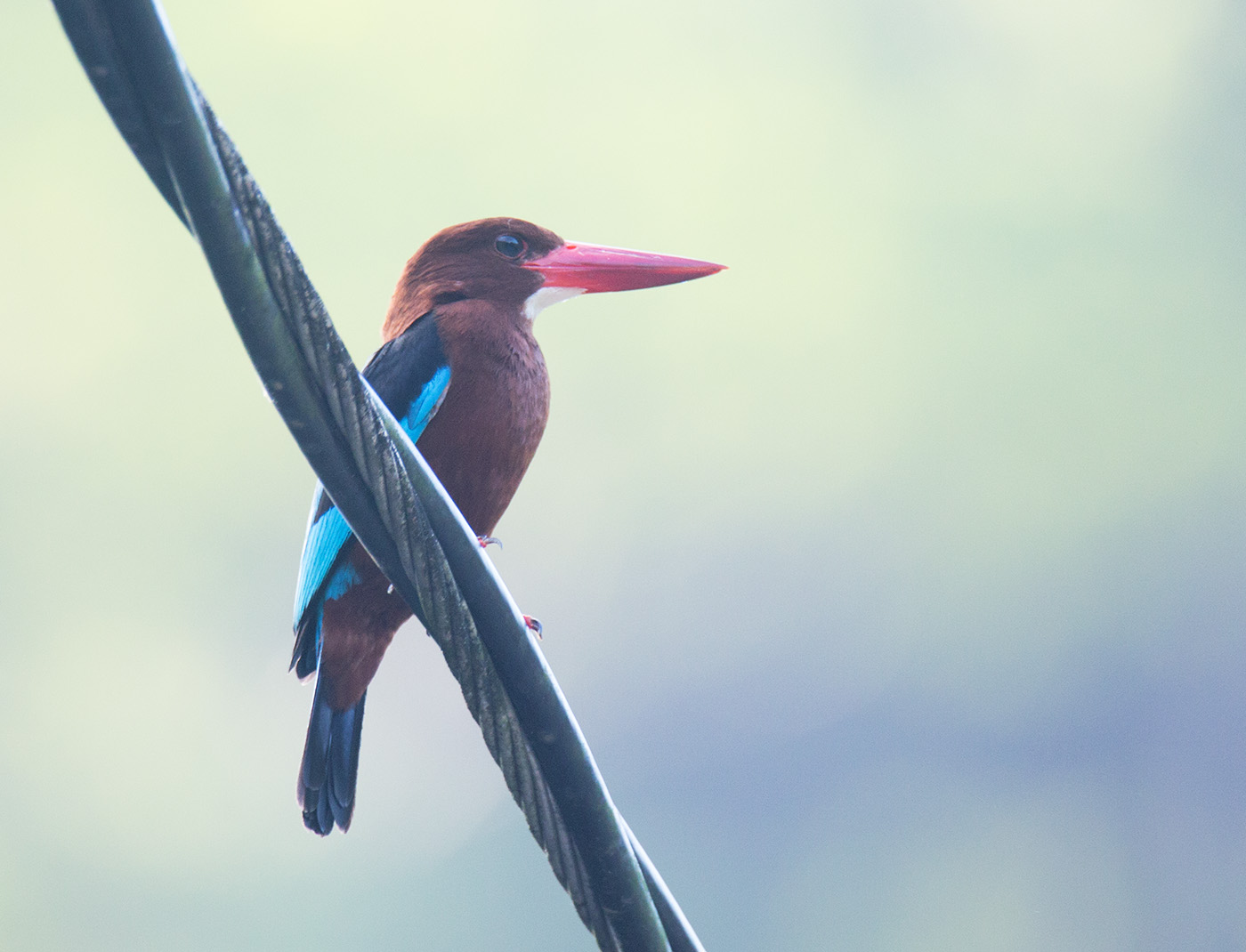
As we continued our drive, we saw two kinds of birds perched on an electric wire - A Grey Wagtail and a Brown-breasted Kingfisher.

Grey Wagtail

Brown-breasted Kingfisher

There were zero birds near the water tank in Cancun Street except for a couple of White-eared Brown Doves feeding on the road.


From there we saw another bird perched on an electric wire - a Collared Kingfisher.


We then headed to Frontera where the Long-tailed Shrike is sure to be seen. Along the way we checked Striated Grassbird and Eastern Cattle Egret on our list.

Striated Grassbird

Eastern Cattle Egret

Of course, the Long-tailed Shrike didn't disappoint.


On the way back from Frontera, we got two kinds of Munias - Chesnut and Scaly-breasted.

Chestnut Munia

Scaly-breasted Munia

Passing another area of the waterway we saw a Little Ringed Plover albeit at quite a distance.


The White-breasted Woodswallows were quite active.


The Savanna Nightjar was still at its usual hangout.


To end our birding day, we got a documentary shot of the migrant Grey-streaked Flycatcher.


It was about half past ten am so it was time to go the family meeting in Tanay. We were so thankful that our Baras birding was quite fruitful. Honestly I am not sure if we would go back to that place again. Maybe on a another holiday?

Thursday, January 02, 2014

A-Bunting We Will Go

It was a spur of the moment decision. 

We had our car serviced (oil change, tune up and replaced all four brake pads) so my wife asked, "Shall we go to Candaba tomorrow?" 

"I thought you said you wanted to go to Laoag" I replied half-jokingly.

"Then Laoag, it is." she said - to my surprise.

Preparations were made: hotel room booked, and contacted Richard Ruiz, the local birder of Laoag.

Early morning of December 30, we were off. Eleven hours later we checked in at the Java Hotel. Exhausted from the long, stressful drive - the last six hours even more so because of all those tricycles and motorcyclists hogging the main road - we promptly fell asleep as soon as we checked in. We woke up a couple of hours later just in time for our date with fellow birders Irene, Kitty, Mel and Rob at the La Preciosa restaurant. Dinner was superb (the funny sounding "poqui-poqui" is a must-try) and even made better by great company.

Bright and early on New Year's eve we met up with Richard at McDonalds. Soon we were on our way to Gabu Sur a district of the city of Laoag.

"What are your target birds?" Richard wanted to know.

"Yellow Bunting and Spot-billed Duck," was my reply. 

Perhaps Richard was surprised at our short list, after all there were other unusual birds that had been seen here recently, but he kept that to himself.

The very first of these unusual birds that we saw was the Black-necked Grebe (perhaps only the second sighting record in the Philippines). It was all by its lonesome self in one of the ponds.


A quick look at the flock of ducks only showed a single Northern Pintail and a lone female Eurasian Teal among the Philippine Ducks. The super uncommon Mandarin Duck was nowhere to be found. No Spot-billeds either.

Then Richard took us to where the Yellow Bunting had been seen almost regularly. Of course it was there! However it stayed for only a few minutes and flew off afterwards. We were about to leave when Richard shouted, "They're back!" I thought "they"? True enough there were two, then three. Our final tally was nine Yellow Buntings all in all!


"Let's go see the gulls" Richard suggested. As we were getting back to the car we saw a pair of Brahminy Kites basking in the morning sun.


At the grassy area going to the beach several Paddyfield Pipits and Yellow Wagtails were hunting for insects. Alas, no Red-throated Pipit joined them. The beach itself was quiet and devoid of birdlife, except for a small group of Kentish Plovers on a distant sandbar. Thirty minutes later, Richard proposed that we come back in the afternoon - that was the time Rob and company saw them yesterday, he said. I was about to pick up my gear when I saw a bird flying towards us.

"Gull!" I yelled. Then another very likely of a different species (lighter in color and smaller in size) flew alongside the first one.


The first one eventually landed and Richard told us that it was the Black-tailed Gull. The other one could be the Slaty-backed we surmised.


On our way out there were several Little-ringed Plovers still in breeding plumage scurrying about the grassy area.


A short trip to Paoay Lake was unfruitful only because the birds were about 2 kilometers away. The only consolation was when Cynthia was able to photograph a male Olive-backed Sunbird.


Lunch at Saramsam was splendid. After that we bade goodbye to our friend Richard who had been a great help in finding the birds for us. Three lifers to add to our list before the year ended was all because of his knowledge of the local avifauna.

Cynthia and I returned to the beach that afternoon. Unfortunately it was very windy and no gulls were in sight.

We returned to our hotel, had a light snack and crashed for the night. Tomorrow will be another long, exhausting drive.