Showing posts with label san joaquin wildlife sanctuary. Show all posts

Sunday, April 03, 2016

Water Low

"The Boy" was supposed to bring a lot of rainfall to Southern California. El Nino is a climate cycle in the Pacific Ocean that supposedly causes drought in eastern Asia and Australia and wetter winters in western North America. However since it is now spring, the rain apparently had abated and gave way to a warmer-than-usual weather. The absence of precipitation caused the water levels in the ponds and wetlands to drop significantly.

That was how it was when we visited the two prime birding spots in Orange County: the San Joaquin Wildlife Sanctuary (SJWS) and the Bolsa Chica Wetlands. Thankfully, and despite the low water levels, there were still quite a number of birds in these places.

At the SJWS all three species of teals were represented.


Blue-winged Teal
Green-winged Teal
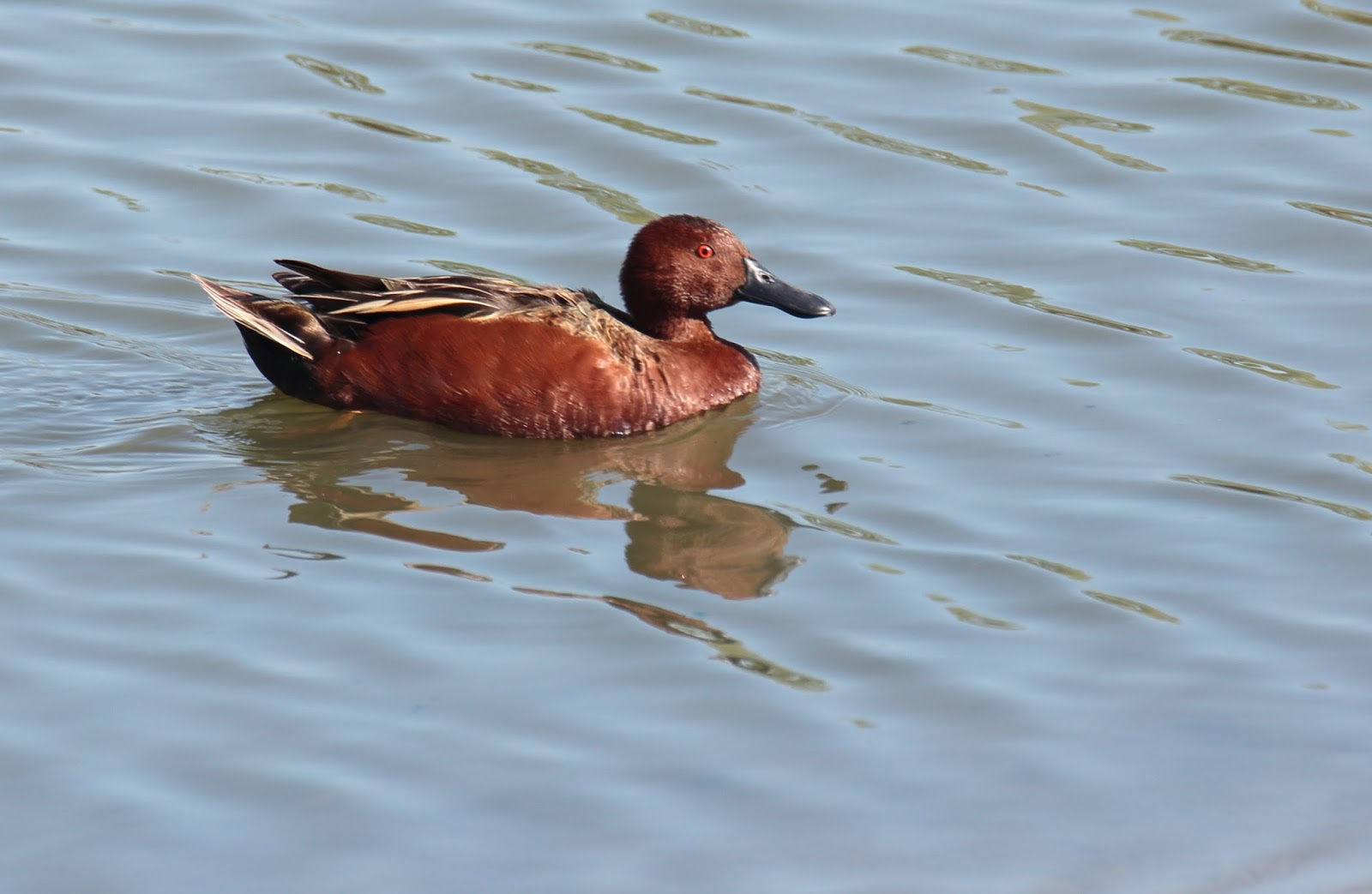
Cinnamon Teal
The long-legged waders were up and about.


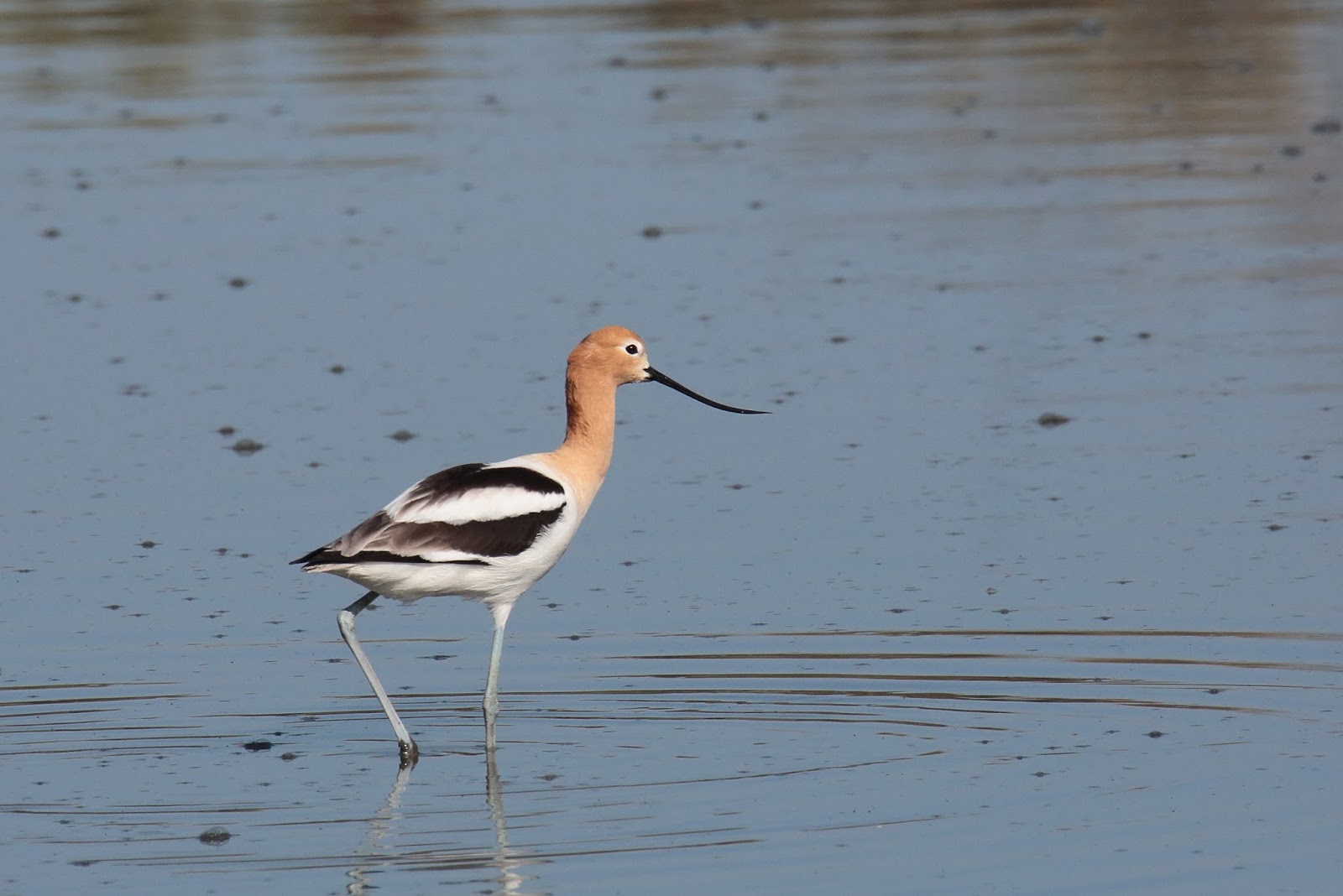
American Avocet
Black-necked Stilt
There were fewer birds than usual at Bolsa Chica because most of the migrants have returned to their breeding grounds way up north.

The uncommon Reddish Egret was performing its fishing dance.


The long-billed birds were already busy pursuing their morning meals.


Long-billed Curlew
Long-billed Dowitcher
Marbled Godwit
The Belding's subspecies of the Savannah Sparrow is a sure sighting here.


The absence of the migratory duck species were compensated by these crested swimmers.


Horned Grebe
Red-breasted Merganser
It was spring break, so to speak, in terms of bird migration. That was why there weren't that many birds compared to the colder months of the year. 

All in all, we had a good birding experience, low water level notwithstanding.

Monday, March 23, 2015

Once Was Lost.....

Imagine my horror when not a single photo showed up when I was uploading my CF card to the laptop! And to think that the photos I took were of the birds of two of our favorite spots in Orange County - San Joaquin Wildlife Sanctuary and Bolsa Chica - and also those from our first day in Arizona! My mind raced to what caused such mishap. Perhaps it was when I reset the date in the camera settings. It was still in Philippine time so I changed it to U.S. Pacific Coast time. Or I might have pushed a wrong button. In a state of panic I asked for help via Facebook. Friends responded quickly. Two of them, Jun Osano and Micky Lim, even offered the codes needed to access the data using a specific software. I tried those but somehow it didn't work. Possibly it was because the software was designed for the Sandisk brand whereas my CF card's was Lexar.

Days passed and my heart still couldn't bear the fact that I might have lost my shots for good. Not that there were any photo lifers there, or that Cynthia also took pictures of practically the same birds using her own camera. Still......

I took the CF card to Samy's Camera who quoted me $35 for the recovery process. That afternoon I got a call from them saying they were not able to recover even a single shot from the card. So we went to the store and picked up my damaged CF. Since Cynthia and I are planning to go to Costa Rica in a couple of weeks, I bought a 64GB Lexar CF card which was on sale. At home when I opened the package, voila! there was a code provided should I need to recover a damaged card! After downloading the recovery software we (with my son, Kurt's, help) tried to work it out. Yes, we managed to get some raw files but they were from an earlier session and not those from the Orange County foray.

It was after our trip to Costa Rica and with a lot of time in our hands that I tried to run the software again. This time it was a complete success! What were once lost, now are found!

Here are some of those recovered shots:


American Avocet
Black-necked Stilt
Allen's Hummingbird
Savannah Sparrow
White-crowned Sparrow

Monday, June 01, 2009

Doozy Goosey

In the beginning was darkness. Gray clouds blanketed the early morning skies. Undeterred, two birders were on the go. Our mission - of which we were deadset to accomplish - was to observe the Yellow-throated Vireo at Huntington Central Park in Orange County. It will be a daunting task, we both agreed – the subject bird being quite small, greenish, constantly on the move and frequents the canopies of tall trees.


It was still gloomy when we arrived. Icy breezes sent chills that seemed to penetrate our very being. People and their dogs were everywhere. Another reason not to raise our expectations of ever seeing the vireo. A hundred yards into the park and we saw three birders all looking up at the towering trees.


“Have you seen the vireo?” Cynthia asked one of them.


“It’s here”, he said, pointing to the top of a tree before them.


Then she heard it. Soon we were getting glimpses of the hyperactive bird. Finally it flew across the paved trails and landed on the leafless branch of a shorter tree. We got looks and were even able to take some frustratingly bad photographs of it.


For us it all happened within fifteen minutes of our arrival. That was to be the best luck we would have all day. Another target bird, the Gull-billed Tern, was a no-show at the Upper Newport Bay area. A visit at the San Joaquin Wildlife Sanctuary would have been a complete disaster were it not for a pair of Egyptian Geese nonchalantly munching some grass at Pond E. Even the Red-breasted Sapsucker that birder friend, Pat Thelen, said he saw earlier at Pond 4 seemed to have vanished into thin air.


When we were approaching the parking lot, the sycamore tree next to it yielded in quick succession: a Western Wood Peewee, a Pacific Slope Flycatcher and what appeared to be some kind of Vireo, probably a Warbling. None of which stayed long enough for a chance to be included in our photographic archives.


In the end there was light and the sun was shining brightly, but for us our birding day was over. It was time to return to the more mundane things in life. Like having lunch.

Friday, April 24, 2009

A Sight for Soras

There are those days in birding when you see a species that a) you're not really looking for and b) you don't expect to find out in the open on a hot morning.

It started out quite inauspiciously as we started out at Pond C at the San Joaquin Wildlife Sanctuary in Irvine. Spread along the water's edge where a bunch of photographers brandishing a wide array of camera equipment all of which were trained at some avocets nonchalantly going about their business. When we returned three hours later, the same photographers were still at it, steadfast in their desire to capture the avocets doing their "thing". You know, the "thing" that avocets in particular, and birds in general, do in spring to ensure the perpetuation of their species.

Cynthia and I, on the other hand, preferred to roam around and see what birds are available to be photographed (aside from romantically-inclined avocets). And it was at the adjoining pond, Pond D, that we had a serendipituous encounter with a bird seldom seen in the open. The Sora. At first it was just a single bird, cautiously venturing away from the protective covering of the reeds. Soon it was calmly feeding on the muddy soil. Sensing the confidence this bird had on its surroundings, two more Soras emerged from hiding and frolicked at the farther end of the pond.


It must have been a holiday in the Sora calendar because after meandering around the sanctuary until noon, the Sora (this time it was by itself) was still at it, unmindful of the scorching weather. When we reported our sightings at the Nature Center, Pat Thelen, a new birder (he started only about six months ago) got excited and wanted to see the bird as it will be a lifer for him. We gladly took him to Pond D. Our hearts sank because the Sora was no longer there. But then, after a while, it reappeared albeit at the other end of the pond. Pat got good looks nonetheless and was so ecstatic at getting a life bird.

It was also quite a fruitful day for us. Aside from the Soras, we saw seven species of warblers: (Orange-crowned, Yellow-rumped, Black-throated Gray, Wilsons, Nashville, Yellow and Hermit!) and a couple of Vireos (Hutton's and Warbling). Today's birding foray upped our yearlist to 240.

And oh, here's a gratuitous shot of an Avocet, sans l'amour


Thursday, January 22, 2009

"You know how to pish, don't you?" *

"You put your lips together and go psssh!

Well, no matter how I tried, my pishing efforts were never successful. Last year I bought Pete Dunne’s “The Art of Pishing” which included a CD of how correct pishing sounds like. I followed all his instructions, from plain pishing to imitating the sound of an owl. All that happened was that the front of my shirt became drenched from all that spewing from my lips.

Last Monday at San Joaquin Wildlife Santuary in Irvine, through my feeble attempts at pishing, I tried to coax the following to show themselves out in the open: a Common Yellowthroat, a Marsh Wren and a few Song Sparrows. Yes, I did the “pssssh!” sound and the “lu-lu-lu-lu!” of an owl. No response. I saw some fluttering behind the tall reeds, but that’s about it. Thankfully I was the only one there, otherwise people might get curious why I was so frantically wiping off my binoculars which was hanging from my neck.

So I moved on. Catching a glimpse of some movement behind a tall brush, I took a deep breath and was about so burst forth in an ear-splitting pish when an Anna’s Hummingbird suddenly alit on a branch just a few feet away. It stared curiously at me and then flashed me with the most gorgeous shining gorget I have ever seen.


Satisfied that it succeeded in preventing me from puckering my lips and making a fool of myself, the tiny angel of a bird flew off.

Things got a lot better after that. Rounding a corner, I was surprised to see a Northern Harrier perched on a bare branch. At about 30 feet, that was the closest I was able to get to this raptor species.


The ponds were full of ducks and all three species of Teals were well represented: Blue-winged,


Green-winged


and Cinnamon.


After lunch, I visited Bolsa Chica and easily refound the White-winged Scoter. This time it was much closer and I got even better shots than the last time.

* To Have and Have Not, 1944

Wednesday, October 08, 2008

0 to 80 in 8 hours

Like the Pavlovian dog, mention "Solitary Sandpiper" and I salivate. Ears pricked, tongue hanging, I await for the directions where that bird was last seen. Upon obtaining that information I scamper over to that particular place to eagerly search for my potential lifer.

So when someone posted seeing a Solitary Sandpiper at Pond D at the San Joaquin Wildlife Sanctuary in Irvine, I was there bright and early the following day. Soon I was joined by my birding buddy, Tom Starcic (he was the one who told me about the sighting) and then a bit later on by two more birders - all of us looking for the elusive shorebird. Three-and-a-half hours later, the uncommon sandpiper was still a no-show. By noon we all gave up. My only consolation that morning was getting a picture of the reclusive Virginia Rail as it made its rare appearance around 10 am, venturing out in the open for a few fleeting moments.


Tom and I had a quick bite at the local McDonalds and decided to take a shot at the Bald Eagle recently sighted at Peter's Canyon Regional Park not too far from where we were. There we met Tim Rhoades, another birder/photographer. All three of us stood on a hill overlooking the dam enduring the blistering noonday sun while watching numerous Turkey Vultures and Ospreys flying overhead and waiting for the majestic raptor to honor us with its presence. After an hour-and-a-half, the eagle still hasn't made its much awaited appearance. 

Due to commitments to pick-up our respective wives, Tom and I reluctantly left Tim behind and bade him the best of luck.

After I picked up Cynthia from her work, we passed by Von's Grocery in South Pasadena for some needed household supplies. My wife lent me a sympathetic ear as I related to her how Tom and I zeroed out on our target birds. Just as we were getting to our Jeep, we heard some raucous calls overhead. Looking up, we saw a flock of parakeets fly by and headed towards nearby Garfield Park. We jumped into our vehicle and tried to follow the green-colored birds. A few blocks later, we saw them land on the trees at the parking lot behind the Rite-aid Drugstore. I parked immediately, grabbed my camera and binoculars and ran towards the trees hosting the parakeet flock. Through my binos, I identified the birds as Mitred Parakeets. Although we have seen parakeets fly overhead here in South Pasadena on several ocassions, this is the first time that I have positively identified them and was even able to take some good pictures of these exotic birds. Which would now officially make them my 80th lifer of the year.


Who knew that in a span of eight hours, my luck would change from 0 sightings from a place 50 miles away, to getting a lifer just a few blocks from where I live.

Thursday, September 11, 2008

A Pectoral Pictorial

I returned to San Joaquin Wildlife Sanctuary last Tuesday, Sept. 9th, to hopefully find and photograph the Solitary Sandpiper. Luck was not with me as once again I dipped on that bird. It never showed up in the whole 5 hours I was there!

Fortunately, another uncommon species, the Pectoral Sandpiper, has been the epitome of avian cooperation. The moment I arrived at the eastern end of Pond C, this lovely bird showed up and proceeded to hunt for food about 25 feet away from me.


When I have had my fill of the Pectoral, I continued to scan the pond with the hope that the Solitary would somehow pop up. Through this endeavor, I was to have good looks at the other feathered occupants of the pond. Of particular interest was the strange fishing habit of a Black-crowned Night Heron. Normally, a heron would stand almost motionless by the banks of a pond or river and wait patiently for a tiny fish to swim close. It would then suddenly strike with its long beak to grab the unfortunate victim. This particular one however, swims or rather floats, on the pond and watches for an approaching fish. Then it would jump off the water, and then dive for the fish, much like how the pelicans would catch their prey.

A little after 2 pm, with the Solitary Sandpiper doing a no-show, I decided to pack it up. I guess that species will be my new grail bird. It took me four years to finally get a picture of the Elegant Trogon - my very first grail bird. Hopefully it won't take that long for me to finally get a shot at the Solitary Sandpiper.

Wednesday, September 03, 2008

An Accidental Tern

On the last day of the three-day weekend, we finally got to go birding. We originally intended to go to Morongo Valley but the 120 mile drive in hot weather with no guarantee of a lifer made me cancel that plan. Instead we went to San Joaquin Wildlife Sanctuary (SJWS) in Irvine which was half the distance to Morongo, and where there was the possibility of seeing a Solitary Sandpiper. Which, of course, would be a lifer for us.

Whenever we leave the house early (before 7 am) to go birding, we almost always make it a point to stop by a McDonalds for breakfast. This has become more or less a ritual for us. After being misled by our GPS which directed us to a non-existent McDs at Michelson St (which was about a couple of blocks from SJWS), we finally found another one about two miles away.

After breakfast we decided to visit the San Diego Creek behind the Irvine Civic Center where a Solitary Sandpiper has also been found. The place was quite birdy: a Great Blue Heron, both kinds of Egrets (Snowy and Great) and a White-faced Ibis were there. But no Solitary Sandpiper. Interestingly, there were Lesser Yellowlegs and Spotted Sandpipers in the creek. If by some miracle these two species would mate, the result would look exactly like a Solitary Sandpiper - yellow legs, dark brown back and a disposition for bobbing.

At around 8:30 we proceeded to SJWS where the ponds yielded nothing unusual. Generally, sandpipers are tiny shorebirds that look alike particularly in their non-breeding plumage - as they were this time of year. So much so that they are collectively known as "peeps". In hopes of locating our sought after Solitary Sandpiper, I had to scan flocks of these constantly moving birds and try to look at each one to detect the telltale sign that would differentiate the Solitary from the Westerns and the Leasts.

A handful of birders came and went, each one asking the question of the day: "Did you see the Solitary Sandpiper?" And each time the reply was in the negative. At least some of us were lucky enough to see the Sora Rail, a very secretive and skulking bird, come out in the open. At around half past eleven our hopes of ever seeing our target bird were dwindling fast.

Just as we were about to leave, there was a bird that joined the group of barn swallows hawking for insects above Pond C. It was behaving like a swallow but it was almost twice as big. A tern! But unlike the usual terns that sometimes visit SJWS, this one had dark wings and a dark underside. I know I've seen this kind before....until it finally dawned on me..this was a Black Tern! Certainly unusual in this part of California. Soon other birders were alerted to its presence.


Of course, Cynthia always has a better shot. Did I mention that she is real good at photographing BIFs (Birds in Flight)?


The Black Tern, though not a lifer, certainly made up for the disappointment of not seeing the Solitary Sandpiper. Not just for us, but for the other birders as well.

Monday, May 19, 2008

Walking San Joaquin

The San Joaquin Wildlife Sanctuary in Irvine is one of my favorite birding spots. It has a very well maintained restroom facility, it doesn't allow dogs, and most of all, it is a birdy place.

We visited San Joaquin early Saturday morning. The parking lot, which occasionally delivers a bird surprise, was unusually quiet. We started our trek at the butterfly garden and enjoying the white flowers of the bower was an Allen's Hummingbird.

Mention San Joaquin to any birder and immediately the Tree Swallow would come to mind. These acrobatic flyers were everywhere. The staff at the Sea and Sage Audubon have placed dozens of nest boxes all throughout the sanctuary specifically for these birds. And in Spring all these boxes were occupied as they were today.


As we rounded Pond 1, an Anna's Hummingbird were staring at us. Other than Song Sparrows and Marsh Wrens that were always heard but seldom seen, there were not much at Ponds 1 and 2. Pond D, however, was a different story. Killdeers patrolled the banks.


Cinnamon Teals and Ruddy Ducks were dozing while Avocets patiently sifted the water with their upturned bills searching for some tiny morsels.

Then I saw them. Phalaropes. In their breeding plumage! In winter these birds are just drab grays with black lines over their eyes, but in spring, they put on chestnut and orange and brown. And what is even surprising (and lucky for us) there were two species of Phalaropes in the same pond - both doing seemingly tireless dipping of their bills into the waters trying to catch an unwary insect. The Wilson's, with it's white crown and cheek and deep rust colored nape competed with the Red-necked, with it's tell-tale red neck and white throat in sheer beauty.


Reluctantly, we moved on to search for other species. Soon an American Goldfinch peeped among the leaves. By the stream, Wilson's and Yellow Warblers took turns in enjoying a quick bath. Warbling Vireos would drop by to check out the action below.

Soon the sun was almost directly above us and the sweltering heat was becoming unbearable. We headed back to the parking lot when I noticed a White-faced Ibis feeding in Pond C. The light from the midday sun shining on it's plumage produced spectacular glowing colors that were a feast for the eyes!


That awesome beauty was a perfect ending to our birding day.

Sunday, March 30, 2008

Going Gnats

Cynthia had a one day seminar at Costa Mesa. We both agreed that driving back 50 miles to Pasadena and then returning in the afternoon to pick her up would be economically unwise with the price of gasoline as it was. Not to mention exhausting on my part. To pass away the waiting time I drove over to San Joaquin Wildlife Sanctuary about eight miles away from the hotel where she was attending the seminar. The sanctuary would be a perfect place for me to further my skills at using my 40D.

A singing Song Sparrow greeted me as I parked the Jeep. He was in the shadows so it presented an opportunity to work up on what I learned about taking photographs in such situations. Although I know the appropriate settings on different lighting conditions, only the 40D with its much more capabilities gave me the challenge to actually put into action such photographic principles.


I was soon hitting the trails and the first thing I noticed were the gnats. Millions of them! They were all gathered flying in perfect unison at the middle of the trail. And there was no way of getting around them! I walked through this cloud of tiny flying insects, flailing my arm like an out-of-control windshield wiper. I had to repeat this maneuver hundreds of times over the next four hours. The gnat clouds were present on all the trails like the plague in Exodus 8:16 (NIV).

Fortunately, birds were quite plentiful too. Tree Swallows have begun staking their claims to the many nest boxes along the various trails. I was photographing these beautiful birds when I noticed that one of the swallows perched on top of a nest box looked different. Slowly and with the stealth of a hungry predator I inched closer and closer to the odd-looking bird. It had a chestnut neck, black cap and a white forehead, unlike the glossy blue-green of the Tree Swallows. Its identification escaped me until I got home when I looked it up and discovered that I got myself a picture of a Cliff Swallow! It may not be rare but it was a lifer for me.


As I walked along Pond C, I saw some Cinnamon Teals. What made me look twice was that one of the birds was darker with a more pointy beak and a yellow streak of feathers behind the eyes. Eared Grebe in breeding plumage! I exclaimed to myself. This is one of the most strikingly colored waterbirds in spring.


Not far from Pond C rises a very tall electric tower and there perched majestically a Red-tailed Hawk. As I aimed my camera at it, it took off and proceeded to glide effortlessly above me. A chance for me to try for BIF (birds in flight) shots and see how the 40D responds. Magnificently, it turned out, as I looked at the pictures that night.


On my way back to the parking lot a Great Blue Heron, oblivious of my presence, was hunting by the side of the pond. Suddenly it grabbed a prawn and consumed it right before my appreciative eyes (and camera).


Noon and I took my lunch at a very crowded In-N-Out close to UCI. After my repast I went back to San Joaquin but the birds were probably all out taking a nap. Sighing, I decided it was time that I do an errand that my wife had so sweetly requested me to do.

Off to Dollar a Book I went where as the name says, all books there are being sold at one dollar apiece regardless of its condition, or whether it was hardbound or softcover, a classic or trashy romance stories. After more than an hour of looking over hundreds of thousands of books, I ended up with fifteen books by Mary Higgins Clark. Fifteen! I didn't even know she was that prolific a writer, considering we already had four of her books at home and that I bypassed buying probably four more.


There was a big grin on my face as I picked up Cynthia from her seminar that afternoon.

"Did you get me some books by Mary Higgins Clark?", she asked with eyes wide open like a child expecting a birthday present.

"As plentiful as a plague of gnats", I replied smiling.

Monday, March 03, 2008

When it Rains It's Poor

We always suspected that TV weathermen (they call themselves "Meteorologists") are so much like Astrologists...they make predictions based on what they see from the sky. Most of the time these are just wild conjectures purported as "science".

Friday night when the "meterologists" said that Saturday will begin as cloudy but will become sunny by midday, we planned our birding trip accordingly. We did our errands early Saturday morning, took a leisurely lunch, and then proceeded to San Joaquin Wildlife Sanctuary in Irvine to search for the Tropical Kingbird. It would be a lifer for us.
It was a little after twelve and the skies were still overcast. Nevertheless, we went to the area between Ponds 1 and 2 where the rare Kingbird was seen as recently as 9 o'clock that morning. When we saw a kingbird-like silhoutte hawking insects, I thought we found our quarry. But then a closer view only revealed a very active Say's Phoebe. As if adding insult to disappointment, it drizzled a bit.

Undaunted, we trekked the trails surrounding the other ponds to see if we would find some other interesting species. Unfortunately, only the usual suspects - Song Sparrows and Yellow-rumped Warblers - were there and even then because of the poor light, photographing them was next to impossible.
Having gone full circle, we decided to give to kingbird locale one more try. We saw a couple taking photographs in that particular spot. Encouraged, we hurried over and discovered that the couple was Glenn and Felicia, bird photographer and birder/blogger respectively. We have met this lovely and friendly couple several times before in our Orange County forays. It turned out that Glenn was photographing an American Kestrel and no, they haven't seen the Tropical Kingbird either.


Tired and cold, we drove home vowing not to take weathermen's forecasts seriously ever again.

Friday, January 04, 2008

Dream Weaver

When I read Neil's Gilbert's Blog regarding a beautiful yellow bird with a red face found at the San Joaquin Wildlife Sanctuary, I thought it was a dream. But when I saw Toan Thang's pictures of the same bird from the same place, then I knew it had to be real.

Now I always have a weak spot for exotic birds and I was determined to see and possibly photograph this bird. After dropping Cynthia off at her work I drove to the Sanctuary. Thankfully, traffic was light Wednesday morning and I arrived at around 8:30 am. To my dismay, no yellow bird showed up.

It was still early and the weather was nice so I thought I'd give the place a walking tour and photograph any bird that I chance upon and would be cooperative enough. So I got me an Allen's Hummingbird stretching out. Common Yellowhthroats were busy working the vegetation next to (and on) the ponds. Two Spotted Towhees were playing follow-the-leader as they flew from bush to bush. Song Sparrows were everywhere I could almost step on them. Egrets would hunt for food 5 feet away from me. White Pelicans and Turkey Vultures were trying to outdo each other in who could soar longest without flapping their wings. Northern Harriers did some fly-overs while Red-tailed Hawks just perched and watched.

Around 10:30, I got hungry. I returned to the Jeep and nibbled on a rice krispy bar. As I was washing it off with bottled water, I glimpsed some yellow movement by the fence. Quickly grabbing my camera, I leaned against a tree that gave me a full view of the fence (with camouflage clothes on I'm practically invisible to the wild creatures in the area. Yeah, right!). Anyway, it wasn't long before my target bird warily emerged from the deep bushes. For an escaped cage bird, this is one shy weaver. When it finally concluded that the coast was clear, it began feeding on the seeds on the ground. With bated breath, I started shooting, all the while praying that there would be enough light to produce a quality picture. Suddenly a great egret noisily flew over the fence. And just like that my lovely golden weaver vanished into thin air.

I don't know but the new year probably instilled more patience in me than what I usually have. I remained at my post like a military sentinel. Soon, Peter, a birder from Orange County joined me. I described to him in great detail my encounter with the mystic bird. For about half-an-hour Peter and I talked about birds and birding, all the while keeping an eye out for a furtive yellow ball of feathers. In a most unexpected move, we both saw the weaver fly to a tree in front of us. It was quite high up and was obviously casing the joint. Noticing two elderly gentlemen pointing binoculars at it, it once again dove into the safety of the underbrush. Peter was satisfied that he had at last seen the golden weaver and bade me goodbye. I, patient and determined that I am, remained at my post.

Another half hour passed and this time the bird repeated its earlier routine: first hopping on a low branch looking this way and that and when assured that there wasn't any potential danger, flew to the ground to feed. Again I was ready. But then, after a few pecks it once more disappeared, spooked by some imaginary predator.


Thirty minutes after twelve and bird activity ceased almost completely. Even the ubiquituous Song Sparrows were gone. It must be siesta time, I thought. Time to have one of my own.

At home, after researching the true identity of my dream weaver, I discovered that it was a Taveta Golden Weaver, a native of east Africa.

My birding new year started off like a dream.

Monday, December 03, 2007

Ibiseeing you


Battling with neck and shoulder pain, (ah, the travails of getting old) I still asked Cynthia that we go birding Saturday afternoon. I wanted to see the reported Wilson's Snipes at the Irvine Civic Center as it would be a lifer for us.

I don't know what happened, but plans changed when we exited Jamboree Ave in Irvine. We ended up at the San Joaquin Wildlife Sanctuary instead. After looking at the various duck species at the ponds, we checked out San Diego Creek (afterall it was in this creek that the snipes were seen, albeit further upstream). Down below was a White-faced Ibis nonchalantly feeding among the Killdeers. We saw this bird as we drove in but when I got off to get a better look at it, it was spooked by a low-flying Red-tailed Hawk. Which prompted my wife to declare that it was a "scared" Ibis - an intended pun against the Sacred Ibis of Asia. Witty, my wife is.

Having gotten some good shots of the wader, we proceeded to Upper Newport Bay to look for the Short-eared Owl. Dipped on that one (although some birders saw it a few minutes after we left). Oh well, c'est la vie. At least we got eye-level shots of an American Kestrel and a very busy Say's Phoebe.

We passed by San Joaquin again on the way home where we met fellow photographer and Blogger Glenn Price & Felicia Lee, respectively, who were just about ready to leave, too.

That evening at Wal-mart (a good place to end a birding day, at least according to my wife), we met fellow photographer Jimmy Chen and his wife Susan. We may not have been that successful in seeing our target birds but meeting friends definitely added nice memories for the day.

Monday, October 08, 2007

Turn the Twitch on?


Our destination Saturday was Orange County. But first tradition must be fulfilled. That means breakfast at MacDonalds. After enjoying our morning repast at Warner and Bolsa, we then proceeded to Bolsa Chica where it was uncharacteristically un-birdy. Even the usual mob of photographers with their tripods and big lenses were absent.

We swung by Upper Newport Bay and again we didn't even bother to unload our cameras. We did see our FOS (First-of-Season) White-crowned Sparrows and the Song Sparrow that had a thing with side mirrors. Every time we parked at UNB, without fail, this particular bird would hop onto our side mirror and would begin to challenge its reflection there. Other than this tragi-comic side show, Upper Newport Bay did not have much to offer.

But then, perhaps it was because my heart was set on going to San Joaquin Wildlife Area that I did not bother to explore the two places we visited earlier. Perhaps it was the posted sighting there of a Pectoral Sandpiper on Friday night that conditioned my senses to chase after it. Sure enough, as soon as we have parked the Jeep, I half-dragged my wife to Pond D where the uncommon peep was last seen. The sighting was further confirmed by a couple we met as they were returning from the ponds.

Heart beating in anticipation I scanned the almost dried up habitat, looking at each and every shorebird, trying to find the telltale streaks on the breast that would confirm its identity. Finally with a yell of triumph that startled Cynthia who was standing next to me, I located my lifer! But it was still too far to be photgraphed even with my 500 + 1.4 lens.

"Look, there's a path through the reeds and the ground there seems dry enough", my wife helpfully suggested as she pointed downward.

"Gung Ho!" I shouted as I almost jumped the 20-foot slope. On solid ground close to the reeds (but far enough so as not to disturb the various birds enjoying the water), I positioned myself and waited....

As if by Divine providence (or maybe it was), the Pectoral Sandpiper moved away from the flock of other peeps and walked towards me! There it fed at just the right distance for my big lens to focus on it properly. Satisfied that I have taken the sandpiper's pictures from every conceivable angle, I bade it goodbye, thanked the birding gods and clambered back to the trail.

Everything was anti-climactic after that. Well, almost. My wife and I were preparing to leave when we heard a screeching noise coming from above. Valkyries? Banshees? In the middle of the day? Our curiosity was soon answered when a very young Red-tailed Hawk came flying in and landed on a branch maybe 50 feet directly above us. There it sat and screeched inviting the attention of newly arriving birders (this was right at the parking lot). Needless to say, we took advantage of this photo-op until we had cricks on our necks.

Reflecting on the events of the morning while having lunch at Sizzler's, the unsettling thought came to me that I might be turning into a twitcher. A twitcher, of course, is a birder who will go after (twitch) a rarity or a lifer at the drop of a hat and by all means possible. Knowing also that I will soon have a lot of time in my hands, chasing never-before-seen birds would not be a far-fetched activity after all. It could be fun, too, but sobriety still reigns, I think. I will probably go after a lifer, but only if it is convenient, and never as a consuming passion.