Showing posts with label photography. antipolo. Show all posts

Saturday, December 10, 2011

The Tail Continues....

Tis the season for wagtails. Everywhere we went there were wagtails. Whites and Greys at the Ecopark spillway, then Yellows at the Agripark in Los Banos. And now the tale continues again with a Grey Wagtail in Antipolo!


It was just a side-birding trip so no bazookas were brought along, only rifles, you know, just in case. Cynthia and I visited our friends, the Webbs, at their home in Palos Verdes and since we had good birding experiences in this small, forested subdivision (remember the Slaty-legged Crakes?) we thought we would just mosey around before we go home and see what birds we would find this time. There were the usual suspects of course: the Eurasian Tree Sparrows, Brown Shrikes, even some Olive-backed Sunbirds! Pied Trillers and Golden-bellied Gerygones were well represented. Zebra and Spotted Doves populated the quiet streets. A White-breasted Waterhen made a brief appearance. The White-throated Kingfisher was as skittish as usual, so unlike a completely insouciant Long-tailed Shrike that modeled for us from just a few feet away.


The real story of the day was when we saw a Grey Wagtail. The first thing that came to mind was, what was it doing here? There isn't a flowing stream anywhere nearby. Although the place was lushly wooded,  we are still inside a subdivision and a house was not that far away. 


Observe. Take notes.


The bird was hunting for insects close to a trickle of water flowing towards a storm drain. Looking at the bird itself we noticed that it was constantly bobbing its tail. It was brownish grey in color with a slight yellow wash underneath. A white stripe runs over its eyes and there were also some white on its wing feathers. The throat was whitish. The vent and rump areas were bright yellow. All contributing to the fact that this bird was a Grey Wagtail.


Make a sketch and show the pertinent details needed for a positive identification.


After fulfilling the duties of a puristic birder, we then turned to photography. 


As bird photographers we observe and take mental notes on our subjects, too, just like any self-respecting birder. Then we document such information with the aid of pictures, showing as much as possible the colors, habits and habitats of the birds we encounter in our birding trips.


Birding and bird photography complement each other and that is an undeniable fact.

Monday, October 10, 2011

Confessions of a pea-shooter

Call me lazy. Call me unadventurous. Call me whatever. I admit I am one of them pea-shooters. Or to be more technically precise, a "P-shooter". The "P" of course, stands for the Program mode setting of modern DSLR (Digital Single Lens Reflex) cameras. In this setting the camera automatically sets everything by itself - the aperture and the shutter speed. With this, a person just basically points the camera at the subject and then takes the shot. That person is a P-shooter. And that's what I am. In other words, I am your typical, albeit a little glorified, point-and-shoot picture taker (at this point, it seems rather inappropriate to refer to myself as a photographer). My rationale for being so is that I wouldn't want to twiddle with the camera settings when my intended subject could disappear at any moment. Despite this amateurish stance on taking pictures of birds, I did get some pretty good results of which I am quite satisfied. I am happy and contented as a P-shooter.


Until recently.


A bird photographer friend of mine posted this on Facebook:


Not surprisingly, this taunting illustration elicited a barrage of comments. One particular comment from another bird photographer friend of mine got my attention. In effect, he said that what's the use of having an expensive camera and lens if they are on P mode all the time. A cellphone camera could have gotten similar results, he said.


Ouch!


I was hurt! I was shocked! I was embarrassed! It was as if a knife had been plunged into my photographic soul. I know for sure that this friend of mine never intended his comment as a personal attack on me (we haven't done any bird photography together yet, so he couldn't have known my camera settings while in the field). 


After the pain of self-humiliation subsided, I once again began to think rationally. I recalled the time when I first got started in photography many decades ago. Of course I was using film then. With fixed ISOs. In those days cameras still don't have any automatic settings in them. Which means I knew how to adjust the apertures and shutter speeds in order to obtain decent pictures. But then, I wasn't taking pictures of birds yet. Manual settings were easier to manipulate with my favorite subjects then, which were: People (I can always tell them to stop moving) and Landscapes (I can change aperture openings and shutter speeds and the majestic mountain would still be there in front of me). Now that I'm into birds, I resolved to accept the challenge that presented itself to me. Going back to manual settings - it's just like riding a bike, right?


Saturday, my wife and I decided to go to Antipolo to check on the status of the Slaty-legged Crake family. It was a drizzly morning - a perfect opportunity to once again hone my skills in photography. To make the challenge even more formidable, I opted to bring my aging Canon 40D instead of the better light-responding 5D MkII.


It wasn't very birdy that morning - the Crakes were even a no-show - but I was able to take pictures of some birds, using manual settings, under a dark and gloomy uncooperative weather.


Pied Bush Chat - manual setting and exposure, ambient natural light: 1/125, f5.6, ISO-1250, partial metering


Spotted Dove - manual setting and exposure, ambient natural light: 1/320, f5.6, ISO-400, spot metering


White-throated Kingfisher - manual setting and exposure, ambient natural light: 1/100, f6.3 ISO-400, spot metering


I was pretty happy with the results of my "experimentation", if I may say so myself. Perhaps now I can say that I am no longer just a P shooter. I am into M too!

Wednesday, October 05, 2011

As Munias You Can See

Finally recovering from the adrenalin rush better known as the Dumaguete trip, Cynthia and I inserted a birding trip in between typhoons.


Our friend Boboy Francisco took us inside the Beverly Hills subdivision in Antipolo and acted as our birding guide. Gray skies and an abbreviated sortie did not yield the species we hoped to find.


We started off by meeting Henry Calilung, a biologist from the University of the Philippines and his band of young volunteers, including Boboy's daughter, Moira. Henry and company were doing a monthly mist netting of the birds found in the subdivision for census and DNA analysis purposes. They haven't caught anything yet when we met them early that morning but when we saw them again after our birding sortie, he informed me that they just caught a Mangrove Blue Flycatcher.


Birding the forested areas of Beverly Hills yielded nothing much except Brown Shrikes which can be seen every 500 meters or so. Every so often we would catch glimpses of a large brown birds - at different places. We presumed them to be cuckoos of some sort. One of those was a bigger than most skulker which Boboy concluded to be a Scale-feathered Malkoha. Too bad it didn't show itself even when we waited patiently and motionlessly for a good 15 minutes.


What was rather common were the munias. They were just everywhere! The Scaly-breasteds were feasting on the fruiting grass stalks while the White-bellieds were surprisingly up in the trees. 


A puzzle was an active brownish olive bird which was busily hunting for insects. For now, I would say that it was an Arctic Warbler although I hope that it would be one of those less common species.


Finishing the loop in about two hours, we were all sweating from the humidity and from the strain of walking the undulating roads of this subdivision. We bade Boboy goodbye and assured him that we will be back and try our luck once more. Maybe when the rains finally stopped coming.


Tuesday, September 20, 2011

An Empty Nest - the Epilogue

We went back to the Slaty-legged Crake nest this morning. The adult was still sitting on it. But then we noticed tiny black heads pop-up every now and then. The chicks, it seemed, were getting restless. The hen (we presumed it was the Mom) however, was not budging. Neon set up his gear and waited. Meanwhile, Cynthia and I took her 7 year old grandson to look for the reported "bayawak" (monitor lizard) that had been seen in the neighborhood. Just as we were about to reach the site of the lizard sighting, Neon called and excitedly announced that the chicks had jumped the nest. I hurried back. Panting and gasping for air I looked and saw an already empty nest.


Neon informed me that the family was still nearby skulking among the greenery surrounding the nest area.   So we decided to stake out the place - Neon standing close to the pond and me near the nest. We waited for what seemed like an eternity. Occasionally we would catch glimpses of the adult and one or two chicks. But that was it. At half past eleven, I approached Neon to tell him that I would be calling it a day. He was bargaining for a few more minutes when we saw BOTH adults escorting their brood towards our direction. With bated breaths we waited for them to reappear. Several minutes passed and the Crake family still remained unseen.


Leaving Neon behind, I proceeded to walk back to get ready to go home. It was then that I saw all four chicks across the street frantically trying to hurdle the 5 inches of cement to get over to the sidewalk and go where their Mom was constantly urging them on. 


"Neon, the chicks are here!" I yelled waving like crazy at him to get his attention. When I looked back, there were only 3 chicks left. I assumed one of them made it safely over the "wall". The mother crake was "tuk-tuk"ing at the embankment next to the sidewalk encouraging her babies to follow her. When Neon joined me, one of the chicks got through some vegetation over the sidewalk. We couldn't see it after that. Neon placed some ramps and asked me to shoo the chicks towards them so that they could use it to climb. One chick made it. The last one, which we assumed to be the weakest, missed the ramp. Looking at it closely, we noticed that it had been swarmed by vicious ants. At first we were afraid to touch the chick lest the human smell would cause the parent to abandon it. But we couldn't let ants torture the poor, day-old crake. Neon gingerly picked it up and patiently removed every ant from its legs and body. Having been assured that no ant was left behind, Neon then placed the chick on the ground where the Mom was pacing back and forth still calling for her babies.


Notice the ants on the feet (above photo) and thigh (below photo)


Neon and I could not leave the place. We were worried about what happened to the first three chicks that were able to get on the sidewalk on their own. Were they able to rejoin their parents? Or were they themselves attacked by ants? 


It was only after we could no longer hear the "tuk-tuk" of the adult that we decided to leave. But then another thought bothered us. What if the parents decided to bring their brood to the pond, which means they have to cross the street again. And encounter the elevated sidewalk once more. 


With heavy hearts we left the nesting place. We both agreed to just let nature take its course. I was in near tears when I told Cynthia about this totally unexpected event (she was in our host's house while all this was happening).


I just hope and pray that this episode will not end tragically.


Now for further observations on the nesting habits of the Slaty-legged Crake:


1) The empty nest does not have eggshells left on it. The adults presumably ate them after the chicks have hatched.


2) The chicks leave the nest on the 21st day. They are precocial. They are black all over including legs and beak. The tip of the beak is lighter though.

Monday, September 19, 2011

And the nest, they say, is history

"Today, we are witnessing a Philippine ornithology historical event!", I proudly declared to my wife, Cynthia, and to our birding buddy, Neon.


When we first heard the news a couple of weeks ago from John and Vivette, our friends from church, that an unusual bird has laid some eggs in their neighbor's garden, we were very intrigued. Our curiosity was even more stoked when Vivette sent photos of the bird and the eggs through her cellphone. First and foremost in our minds was, what bird was it? Inasmuch as the nest was found in a gated subdivision in Antipolo City, we had to arrange for the our friends to inform the gate guards to let us in. As soon as we arrived at their house, Vivette immediately took us to the residence of Leoncio and Linda. Linda was very excited as she ushered us to where the nest was, which surprisingly, was on one of her flower pots located about a meter from the ground and about two meters away from the street!


We peered into it and were dumbfounded to see a dark-colored bird with a bright rufous head, neck and breast. I quickly pulled out my Kennedy guide. Leafing through the pages, we narrowed down the identity of the mysterious bird to three possibilities: Red-legged Crake, Ruddy-breasted Crake and Slaty-legged Crake. Since the crake in question is sitting on the nest, we couldn't see the color of the legs. Red-legged Crake is  very rare, so that couldn't be it. The book says the Ruddy-breasted is about 7 1/2 inches in length. The bird we're looking at is definitely bigger than that. We concluded that our nesting waterbird was a Slaty-legged Crake. Continuing my perusal of the description of this species, I was suddenly speechless as I repeatedly pointed to my wife the line that says "Nest and eggs not described from Philippines"!


That was the start of our regular pilgrimage to this reverent place as we monitored the progress of the nesting habits of Rallina eurizonoides, now that we have become aware of the importance of what was happening right before our very eyes. This was Philippine ornithological history in the making.


And today, 20 days after the hen started sitting on her four eggs, they hatched. Mom and chicks were all doing well. Dad was nearby, waiting for his brood to join him as they forage for food.


Based on our observations, here are some data that describes the nesting behavior of the Slaty-legged Crake:


1) The nest was about a meter above ground and consisted of dried grass, dried leaves and pine needles. It was quite shallow, only about two inches deep.


2) There were a total of four eggs which were plain white in color (no spots nor streaks). They were laid one egg per day. On the fourth day, after all the eggs had been laid, the crake started sitting on them.


3) Total incubation period was 20 days. There were times when the eggs were left unattended while the parent(s) hunted for food. We were not 100% sure if both parents took turns at sitting on the eggs.


4) The newly-hatched chicks were blackish in color. We expect them to be out of the nest by tomorrow (the 21st day).


Wednesday, September 14, 2011

Hidden Eden

A mountainside covered with lush greenery just a few minutes from where we live. A mere dot in the map yet hosting quite a number of bird species. In the few mornings that we spent there we were serenaded by Black-naped Orioles and Olive-backed sunbirds. White-breasted Woodswallows put on such breathtaking aerial displays. Flocks of between ten and twenty Lowland White-eyes would pass through the treetops sometimes followed by a group of Golden-bellied Flyeaters. Long-tailed Shrikes seemed to be everywhere while Pied Fantails and Pied Trillers would occasionally drop by. Early migrants Brown Shrikes and Arctic Warblers were welcome sights. Glimpses of an Elegant Tit and a Philippine Magpie Robin gave us a thrill. Both Collared and White-throated Kingfishers played hide-and-seek with us.


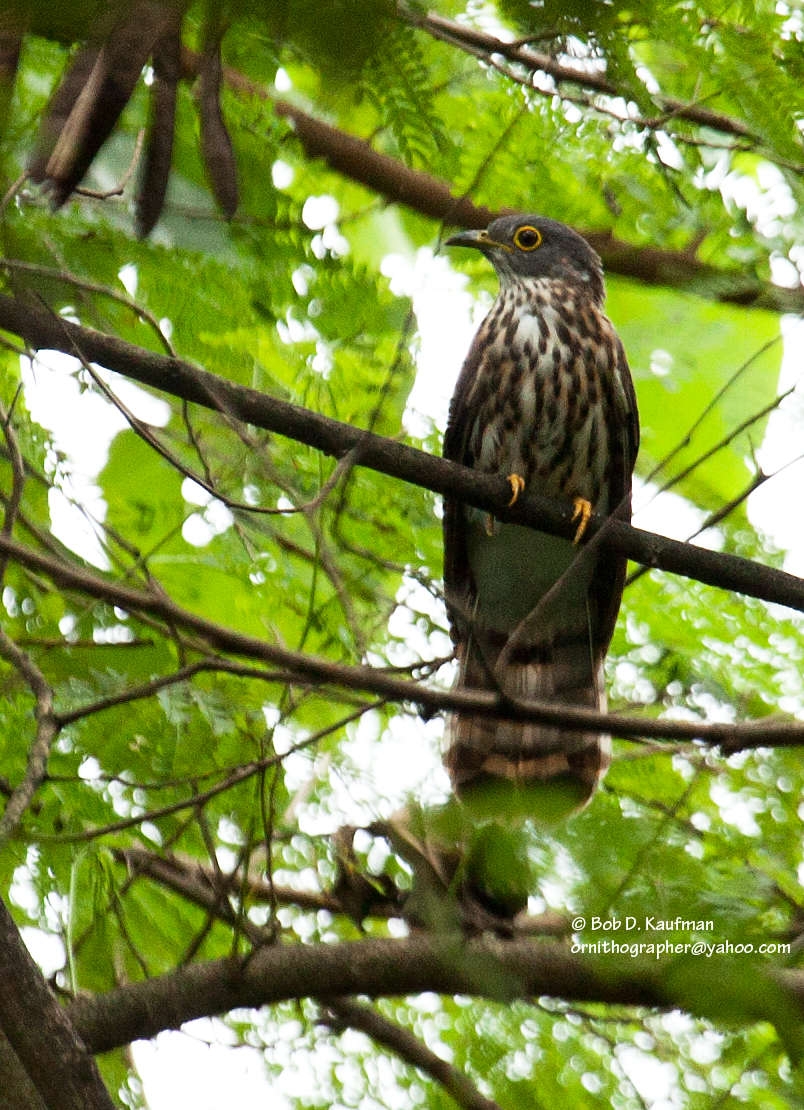
Surprises were Barred Rails and White-breasted Waterhens walking along the road (isn't this supposed to be a mountain? so what are waterbirds doing here?). Even more surprising were the sightings of the uncommon immature Philippine Hawk Cuckoo and immature Mangrove Blue Flycatcher.


All in all we counted 23 species in three days of leisurely birding. To say that these birds inhabit the wooded areas of a private subdivision in Antipolo borders on incredibility. It was a pleasant surprise to discover this hidden eden not too far from home. Ah, but paradise would not be paradise if it does not harbor some deep secret. A secret that had been shared with us by the local residents. A secret that could further advance Philippine ornithology. A secret that for now shall remain hidden in eden.