Showing posts with label philippine nightjar. Show all posts

Sunday, January 31, 2016

Owl of the Above

Even before Cynthia and I went to the University of the Philippines' campus in Diliman, we already inquired from friends Bim and Jonas the exact spot where the Philippine Scops Owl family could be found. At 6:30 am on Saturday, the 30th of January, we met up with our birding buddy Peter and new friend Wenxing at the parking lot of the Marine Science Institute (MSI) Building. From there we immediately proceeded to the "frogs" area where we were told the owls were.

Look for the white droppings, we were told, but as we searched the place there were droppings everywhere! Then from Jonas' advice all four of us looked up at the group of bamboos beside the blue water tank until we got cricks on our necks and still unable to find even a single owl. That these nocturnal birds were a pain in the neck became literal. Although we were all looking up, ironically things were not really looking up. My wife and I took a break and said some quick prayers. It was then when we met fellow birder Allan Fernando who also said that the owls were supposed to be on that bamboo clump. He also said that there was also a Spotted Wood Kingfisher in the area. Not to mention a Rusty-breasted Cuckoo by the opposite end of the paved trail. Encouraged by this report we once again began to search above the tangle of bamboo stalks. 

"There it is!" yelled my better half with eagle-sharp eyes. "But there's only one and it's the baby!"
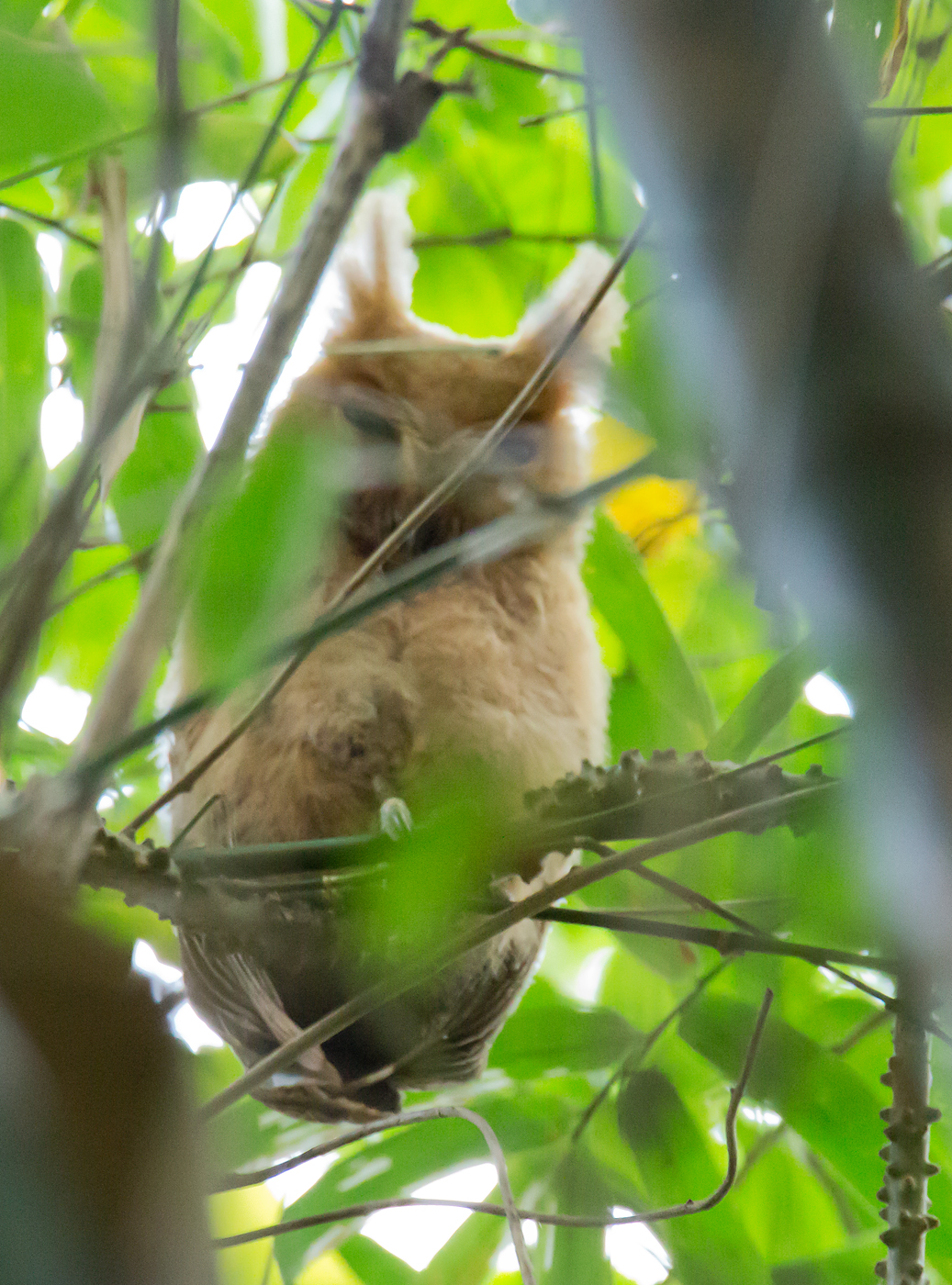

There high above the bamboo on a branch and practically covered by twig and leaves was our quarry fast asleep. Nevertheless we all took turns at (it can only be seen from a very limited vantage point) at photographing the slumbering bundle of cuteness.


While Peter and Wenxing were taking turns, Cynthia as was her wont went exploring the surrounding areas. Soon she was motioning to us and silently pointed at something in front of her.  We all hurried to where she was and were totally flabbergasted at the sight of the friendliest and most cooperative Spotted Wood Kingfisher ever born on this earth!


Having fulfilled its mission of appeasing the owl frustration of four bird photographers, the kingfisher flew off. We all returned to the bamboo area. This time the baby owl was a bit more in the open but was still off in dreamland. 


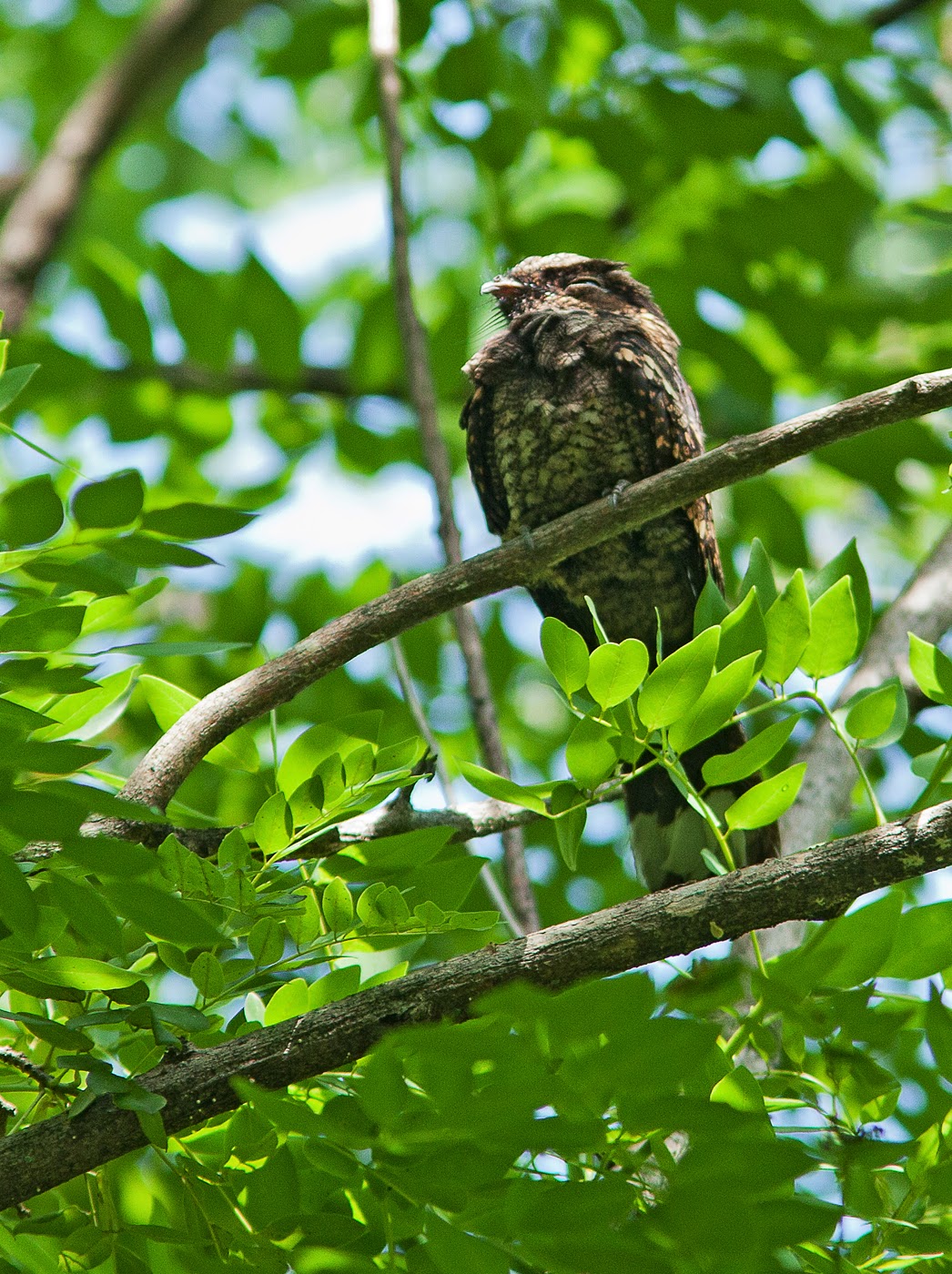
Our next mission was to look for the  Blue Rock Thrush at Miranda Hall and the Philippine Nightjar at the Faculty Building. Scratch the Blue Rock Thrush because there were some guys working on the roof of the Miranda Hall...you know, where the thrush usually hangs out. The nightjar was as its usual roost in front of the Landbank ATM.


A quick trip to the Main Library for the Java Sparrows but they were at their usual habitat which was on the topmost ledge of the building. Way too far even for our friends' long lenses.

Once again we were back at the "frogs" area. After all, (or shall I say, after owl?) the owls were our main purpose for coming to U.P. that morning. We looked up and lo and behold the baby's eyes were now wide open as it stared down at the three people staring back at it (Wenxing left earlier for some personal matters).


"There's the other owl!" it was my wife, as expected, who first saw it and pointed at the adult sleeping way above the bamboo grove. "There's the other baby next to it!" she exclaimed a few minutes later.  Again, taking turns at photographing both, we finally achieved our goal. We got owl of the above.


Monday, January 11, 2016

Blue Rock Year Continues…..

Cynthia and I went birding at the campus of the University of the Philippines in Diliman. It was sort of a last minute decision. I did not want to go to Candaba because our vehicle still has this strange noise emanating from the front left wheel whenever I step on the brakes. It breaking down in a middle-of-nowhere place like the Candaba Wetlands would be a nightmare.

So to U.P. we went with not much expectations. Things did not augur well because as we were skirting the sides of the Marine Science Institute (MSI) building, I saw a big (a relative term, considering it was bigger than the usual birds in the area) bird fly by and stop for a short while on a branch across from us. Since it was still dark at a little after six am, I couldn't make a definite ID of this species. I knew it was a cuckoo of some sort, but that was as much as I could tell.

With nothing much to see at the MSI area, we decided to go to the vicinity of the Vargas Museum. 

"Let's go to Miranda Hall first," my wife suggested, "and maybe see a Blue Rock Thrush?"

I, of course, agreed. As we were about to park, Cynthia saw it right away! She took some quick shots. I parked the car and as we got off, some delivery guy came and parked his bike right beneath where the thrush was perched. That naturally spooked our favorite bird. 


With the colorful migrant gone, we proceeded to the Vargas Museum. It was unusually quiet. We asked the security guard if the Philippine Nightjar was still in the area. He replied in the negative. From there we went to Beta Way which was also devoid of any birdlife. We walked towards the pond at the sunken garden. It is now safe to say it was "once a pond a time". The place was just a muddy area filled with grass and lotus plants. Needless to say the hoped for kingfishers were no longer there.  


It was the Main Library next. Not much there either, except for a pair of Java Sparrows perched high up on the ledge. Luckily, one of the two flew to a nearby pine tree to gather what I believe to be nesting materials. 


Also nearby were a cooperative pair of Pied Trillers.


male. the female was foraging nearby
Lowland White-eyes were plentiful. However they were so hyperactive, so tiny, and preferred the upper portion of the trees that despite a barrage of shots from me and my wife, none came out acceptable. Not even what we would consider as a "documentary" photo.

Our return to Miranda Hall was luckier this time around. The young male Blue Rock Thrush stayed long enough for us to be able to get good pictures.


A foray at the parking lot of the Chemistry building yielded the resident Long-tailed Shrike.


Back at MSI, we met fellow birders Doc Mando and Jonas Liwag. We told them about the Blue Rock Thrush at Miranda Hall and in return Doc Mando showed me an excellent photo of the Rusty-breasted Cuckoo he got a little earlier. We scouted the area where he said he saw it but found nothing. Our friends also said that they saw the Philippine Nightjar sleeping on a mango tree branch right across the Landbank ATM. We checked out the place and couldn't find the nocturnal bird. Thankfully, Doc Mando came and noticed the frustration in our faces. He showed us the exact location of the nightjar and indeed there it was peacefully snoozing the day away. 


After we got some shots of the endemic bird, we thanked our friend profusely and bade our farewell.

We had been fasting for the past five days so now as we headed home, we were looking forward to having a sumptuous lunch and also to celebrate our second sighting of a Blue Rock Thrush in such a short span of time.

Monday, October 26, 2015

Happy Birdday

I already have a blog title in mind even before we went birding last Saturday morning: Happy BRT Day! (sounds like happy birthday, right?). BRT stands for Blue Rock Thrush, an uncommon migrant to the Philippines. Our friend, Bert Madrigal, posted a photo of one taken at the campus of the University of the Philippines (U.P.) in Diliman, Quezon City - a place close to our residence. He saw three of them according to Bert. That was our incentive to go birding on my birthday.

My wife and I were at the Science Complex (where the BRTs were seen) at 6:30 am. Three hours later and I had to accept the fact that my planned blog title would never be used after all. Not a single Blue Rock Thrush showed up!

But it was my birthday and I would not let minor disappointments ruin it for me. Cynthia and I made lemonade out of lemons, so to speak. We saw quite a number of birds, albeit the usual suspects found in U.P., but the Lord in His graciousness showed us two species that were rarely seen here: A Rusty-breasted Cuckoo and a Black-chinned Fruit Dove - both still in the immature stage.


Immature Rusty-breasted Cuckoo
Immature Black-chinned Fruit Dove
The good old reliable Philippine Nightjar was still in its usual roosting place.


There were other birds that we saw and photographed too but these were the highlights of our day. 

Despite not seeing our target species, my birthday birding trip to U.P. was still an enjoyable one considering that I wasn't feeling well the day before. This was definitely a great tasting lemonade.

Saturday, July 12, 2014

After a Doughnut, Why Not?

The association in our village sponsors a semi-annual medical check-up for the local residents at a very reasonable price. We always availed of that, of course, and for the past three years it usually took us almost two hours to finish the routine. So today's thirty minutes was a real surprise. The queues were not that long and as senior citizens my wife and I were given priority - something that wasn't practiced previously.

Inasmuch as we had fasted the night before in preparation for this, Cynthia and I decided to try something sweet for breakfast. Off we went to J.Co's at the U.P. Town Center. They were still closed when we arrived so we waited some 15 minutes until they opened. We ordered half a dozen of their famous donuts (to take home) and then I had the iced hazelnut chocolate and a glazed donut. My wife ordered hot chocolate and the cheezy rich donut sandwich. They were so yummy that I couldn't help but grab one of the Oreologys that we ordered.

Before going to J.Co's Cynthia suggested that I bring along the camera+300mm lens combo. 

"We can go to U.P. after breakfast and do some birding," she suggested.

To which I eagerly replied, "Why not?"

Our initial attempt at locating the Scops Owl was a total failure. I texted our friend, Bert Madrigal, and asked for directions. He replied promptly giving minute details on how to find the owls. Before proceeding to that site however, we passed by the Faculty building hoping to see the Philippine Nightjar that roosts in the nearby mango tree. Nada. Thankfully, Eric, a friend of Bert, saw us and brought us to where the nightjars had apparently relocated. And yes, there were two of these birds peacefully sleeping on the branches.


We half-heartedly tried going to where the nesting Coppersmith Barbets were (again, Bert provided very precise directions) but decided not to follow through since we already had photos of them taken in 2010. We went back to the "Frogs" area. I stood in front of the water tank, looked for droppings as per Bert's instructions, but didn't find any. My wife and I developed cricks on our respective necks trying to detect any movements in the canopy above us. It was then that the local mosquito brigade staged an assault on my uncovered legs (note to self: never wear shorts when looking for owls at U.P.) We deemed it prudent to leave as quickly as possible because we can not tolerate more blood being sucked from our bodies for the second time that morning.

On our way home, Cynthia and I both agreed that good things come in boxes and in jars, donuts and nightjars, respectively.

Sunday, October 13, 2013

Santi Pause

Typhoon Santi slammed into Central Luzon very early Saturday morning. "There goes our birding plans," I told my wife. Earlier in the week we planned to visit the Candaba Wetlands with the hope of seeing some migrants. Now as heavy rain came down from the dark skies that idea was unceremoniously shelved.

At around three in the afternoon, the downpour surprisingly came to a halt and the firmament lightened up somewhat. Immediately I got a text from our birding buddy, Peter Ting (who was supposed to go with us to Candaba) asking if it would be OK to go birding in UP (University of the Philippines). I replied "sure, why not?" and informed him that we may not be able to join him (because I wasn't sure if the current pause in the stormy weather would last long enough). He wanted to know where to find the nightjar and the  blue rock thrush so I gave him the directions.

Somehow I felt a little guilty on not giving a precise description of the whereabouts of these two birds that he wanted to see. I discussed the situation with Cynthia and she suggested we go meet up with Peter. I texted him right away and told him we were on our way there.

We met up across Miranda Hall where I last saw the Blue Rock Thrush. Unfortunately, the janitor was cleaning the roof at the very spot where the migrant likes to stay. "Scratch the thrush, " I told our friend, "and let's go see the Nightjar instead." That endeavor was more successful. The nocturnal bird was exactly at the same spot where my wife and I saw it one week ago.


We returned to Miranda Hall. Peter saw a very cooperative female Olive-backed Sunbird perched unperturbed at eye level.


We did a quick foray at the MSI (Marine Science Institute) grounds where the only photographable birds were the Shrikes - the bully Brown and the lovely Long-tailed.


Ominous dark clouds covered the skies and it wasn't long before we felt the cold, tiny drops. Peter wanted to stay a bit longer so we bade our goodbyes.

It was during Santi's pause that we were able to accomplish our good deed. It felt good.


Saturday, October 05, 2013

To Health and Back

"For breakfast, instead of cereal with milk, why don't you try coconut milk and pinipig (pounded and toasted glutinous rice flakes). It is healthier and more beneficial to your digestive system."

That was the advice my wife and I got from a respected albulario (folk medicine man). I had been feeling physically down in the dumps lately and my enthusiasm for birding was at a dismal low. The meeting with the albulario lifted up my spirits and I felt a little better after undergoing a hilot (massage) treatment.

That evening as Cynthia and I mulled on the suggested breakfast for the following morning. We looked at each other in an intense mental communication trying to merge our brain waves into one.

"Guinumis!" we both shouted simultaneously.

"Cafe Via Mare!" we chorused.

The plan was set: Go birding at U.P. (University of the Philippines) in the morning then head to our favorite breakfast place in that area afterwards.

Early Saturday morning we were there. We were greeted by fellow bird photographer Steve Albano who had been hoping for the migrant Blue Rock Thrush to show up. Soon we were joined by "local" (he teaches at the University) birder, Bert Madrigal. So far nothing but Yellow-vented Bulbuls and Brown Shrikes were present. After a while, we were joined by another fellow bird photographer, Crisnick Lorenzo who imformed us that the Philippine Nightjar was at its usual roost. Inasmuch as this would be a lifer for Steve, we hurried over. It didn't take long for Bert to locate the nocturnal bird peacefully sleeping on a branch.


"We last saw the Blue Rock Thrush near the Miranda Hall not too far from here," Bert informed us. "But it hadn't been seen lately, though."

Nevertheless we wanted to try our luck. The tree where the thrush was last seen was indeed teeming with birds - the usual Yellow-vented Bulbuls and Brown Shrikes. Then I saw something whitish.

"Pied Triller!" I told my companions.


While we were taking pictures of the Triller, a noisy Coppersmith Barbet called attention to itself. 


Then a chunky reddish bird flew from that tree and landed on the roof of the Miranda Hall.

"Blue Rock Thrush!" I yelled.


Bert couldn't believe our luck in so easily finding this uncommon migrant as Steve and I kept on clicking our shutters excitedly. The Thrush eventually flew off. My wife and I bade goodbye to our friends.

Time to have that coconut milk with pinipig breakfast to nourish me back to health.


Sunday, May 16, 2010

Brada Pitta

Nothing creates a sense of brotherhood among bird photographers than taking pictures of a local avian celebrity. I have been through this experience a couple of times before in California. When news of an Arctic Warbler inhabiting the trees in Galileo Hills became known to one and sundry, all self-respecting bird photographers in Southern California came to take a shot at this rarity. In between appearances of the sought after warbler, we bird photographers shared a kindred spirit while bonding and even foregoing lunch. That was repeated when a young Roseate Spoonbill stayed in Irvine for some R & R.

Although I am a bona fide member of the Philippine Bird Photographers group, I am still a "newcomer" having just recently moved back here. As such I have not yet fully bonded with the locals even when I have been with some of them during various sorties. But when news came about that a Red-bellied Pitta was seen in nearby University of the Philippines' Diliman campus, I met fellow bird photographers Bong, Rey and DocChito. It was here in a small spot behind the Biology building that I became a part of the brotherhood that shared whispered stories all the while sweating profusely as we patiently waited for our shy quarry to appear. And when the Pitta slowly emerged from the shadows, only the sound of the clicking camera shutters shattered the silence.


I wanted to stay longer with my friends but my wife and I had to attend a lunch party hosted by a high school classmate and also I wanted to add a second lifer of the day by photographing the Philippine Nightjar snoozing peacefully just a block away from the Pitta place.


As I reminisced the events of that sultry Saturday morning, I smiled. Not only because I got my two lifers but more importantly, I now have a feeling of belonging. I would like to believe that I am now one of the certified local "birdnuts".


P.S. I have been "absent" for a couple of weeks because we visited Singapore. For our stories on birding that City-Nation please visit my earlier blogs: See Mynas and Feeling Buloh. Thanks!


For other birding blogs and photographs please visit: