Showing posts with label bird photography. Show all posts

Sunday, August 02, 2020

She Saw

We started the month of August by doing some birding at the campus of U.P. Diliman. We saw most of the birds we've seen 7 days ago at the same places. What was interesting was that my wife saw (and got pictures, of course) a couple of species that I didn't. Not that we were birding separately, but it was her keen hearing and quick eyes that caused both incidents. First, it was the juvenile Olive-backed Sunbird. After parking at the MSI parking lot, she followed some chirping that she kept hearing. When I got to the place where she was, somehow the Sunbird was already gone.


Then later, Cynthia got some photos of a juvenile Crested Myna. She pointed the bird to me but by the time I was able to raise my camera the black bird went inside the thick greenery and completely disappeared.


Other than that we pretty much saw quite a number of birds. Moi, being the more "obligating" one, took pictures of the "trash" birds which my wife preferred to pass over. Like the Eurasian Tree Sparrow,


the Yellow-Vented Bulbul,


and the Zebra Dove.


There were still a number of birds that visited the bare tree by the roadside but lesser than what we've seen the week before. Besides, as I said earlier, the weather was not that cooperative. So we only got documentary shots of the Golden-bellied Gerygone and the Philippine Pygmy Woodpecker..


..and a better shot of the Pied Triller.


The parking lot area of the MSI Building gave us better results in photographing the Black-naped Oriole.


Behind the Chemistry Building, or as we prefer to call it, the Long-tailed Shrike's place, naturally gave us good shots of the eponymous bird.


Although we again failed on getting a shot of the Striated Grassbird, we were thankful that the flock of the Scaly-breasted Munias was still there having a feeding frenzy.


And as bonus, a family of Coppersmith Barbets showed up unexpectedly at this place.


Sunday, April 21, 2019

Francis of Assist See

We kept hearing the "cu-cu-cu" coming from behind the trees. We looked at where that sound was supposedly coming from but didn't see anything. After a while it came out and for a couple of minutes dried itself in the sun. The Philippine Coucal was our first bird that morning along the road going to Infanta. 


From there we stopped by the places where the hagimit trees were. The fruit of this tree is a favorite food of several species of birds. Unfortunately, summer had come and the fruits were all gone at the areas we visited. Except for one place. We saw friends Conrad and Ralf inside a compound as we were driving by. We quickly joined them and they introduced us to Francis, the overseer of that place. Close to their lawn was a huge hagimit tree with lots of fruits still. While we were catching up with our friends, Francis pointed at the tree, "Buzzing Flowerpeckers," he said. Indeed a pair of that species came and started feeding on the red berries. 


There was a lull after the flowerpeckers left. Then, "Philippine Pygmy Woodpecker!" Francis once again pointed to the fruiting tree.


This routine had become the norm of that morning. Francis, who was lounging on a hammock, would get up when he hears some bird call, look for the source of that call, and assist us to see the bird that would appear in the area. Two more species were shown to us: the Elegant Tit..


and the colorful Olive-backed Flowerpecker.


Around 9 am Cynthia and I decided to go visit the area where the Paddyfield Pipits are sure sightings. We promised to be back by 10:30 as that was the usual time that the Philippine Hanging Parrot was supposed to come to the fruiting tree.

Unfortunately, there were some "tourists" at the Pipit domain. We did see the bird but it was a bit skittish, unlike before, and I never got a good photo of it. On the other hand, farther down the road, a Striated Grassbird posed for us.


By 10:30 we were back at Francis' place. But the Parakeet never showed up. Only the Buzzing and Olive-backed Flowerpecker returned. Conrad told us that about 3 minutes after we left, a Stripe-headed Rhabdornis came, followed later by a Flaming Sunbird. Ah, if only we had stayed and benefited some more from Francis' assistance at seeing the birds in his neighborhood.

Sunday, November 18, 2018

A Drongo Ashy

News about an Ashy Drongo seen at the La Mesa Ecopark spread throughout the birding community. This was the migrant subspecies salangensis which differs from the one seen in Palawan by its white face and grayer plumage. Although not a lifer for us - we've seen one in February 2015 near the main library building at U.P. Diliman (see my blog on that) - we still wanted to go find this one, hopefully to get better photos.

So I asked friends, Mon and Ferdie who had already taken pictures of that bird, for directions. They replied with text messages and gave the precise location of the drongo. Armed with this information, we went to the site at 6:30 in the morning. The climb up to the zip line station was exhausting for these two senior citizens. We staked out the acacia trees. Half an hour and the bird was still a no show. We called both our friends to confirm if we were indeed at the right place. Thankfully, Ferdie told us that a friend of us his, Mark, had just seen our target bird. He told us to come down and go to our friend Anthony's shop and Mark would meet us there. As soon as we reached the street we met two friends, Ben and Conrad, who obviously had the same purpose for coming to Ecopark. We proceeded to the Bungee jumping area and there we met Mark. He showed us a photo of the drongo which he took not more than 15 minutes ago. He then took us to where he got that shot and it wasn't long when the uncommon migrant showed up. Although a bit far, it was definitely a drongo I see. Finally our patience paid off when our beloved Ashy Drongo perched on a branch, out in the open, and close enough for us to get some good shots.


A happy group having just photographed the Drongo.


Satisfied that our mission had been accomplished, we bade goodbye to our friends. A short trip to the mini forest yielded absolutely zero birds! With the humidity becoming more and more unbearable and our stomachs grumbling (we haven't had breakfast yet) we indulged in a buffet brunch at Cafe Sweet Inspirations.

Monday, July 02, 2018

Thanks to the Parrots

It was a short unproductive trip to Infanta last Saturday. The skies were gloomy and the birds were scarce. Despite that we still had some good encounters. There was this Sulphur-billed Nuthatch that kept on creeping and hopping all over the branches looking for insects.


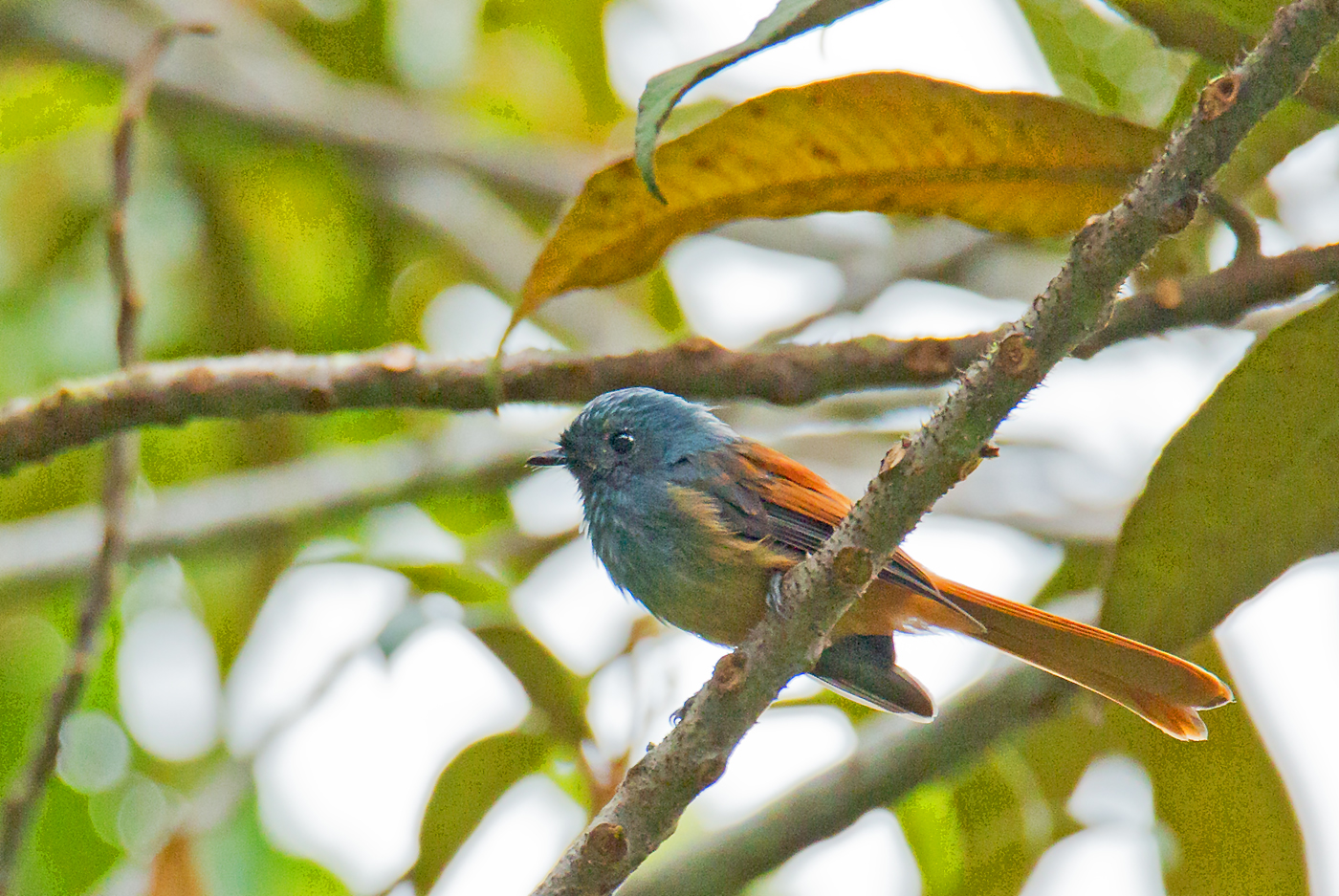
Then a mixed flock flew by but we only had a good shot of the Blue-headed Fantail. The Elegant Tits and Yellowish white-eyes were just so quick or behind the leaves most of the time.


We finally got to the place where the hagimit tree was fruiting. I set up my tripod and waited for the birds to come. It seemed that the Orange-bellied Flowerpecker bullied the others because it was the only flowerpecker we saw.


A flash of green and a Colasisi flew in and feasted on the red berries.


Cynthia then waved at me and pointed to another green bird on her side of the tree. It was a guaiabero also enjoying the bountiful fruits.


Then rain fell. We stood under an umbrella hoping it would soon abate. After 30 minutes it even became a heavy downpour. It only made sense to call it a day. It was still raining heavily when we reached the town of Tanay so we both agreed that we made the right decision.

It would have been a disappointing birding trip but thanks to the bright green colors of two endemic parrots that saved our day.

Friday, March 16, 2018

Chilly Bonelli

The Frank G. Bonelli Regional Park in San Dimas is one of our favourite birding spots in Southern California. For the past several years we came to the U.S. around mid-March and stayed for about a month. This year, my wife and I decided to come a month earlier. Being winter, the weather was naturally chilly.

The air was nippy the day we visited Bonelli Park. Although most of the birds we encountered were those familiar ones we've seen the prior years, this time there were some surprises. One of those was the Least Sandpiper. Somehow they were more in number than the more common Spotted Sandpiper.


Another unexpected sighting was that of the Buff-bellied Pipit. There were about a dozen of them flocked together foraging the rocks by the lakeside. Even though we've this species here before, this was the first time we saw so many individuals hunting for food together.


The California Scrub Jay seem to be growing in population and expanding their territories. We've never seen them in Bonelli before. And now they're here.


Finally as we were about to leave, a huge flock (!) of Band-tailed Pigeons flew in and fed on the ground. Again, this species wasn't as plentiful before when we only saw a few at Eaton Canyon in Pasadena. 


We're glad that many of the local birds are proliferating.

The highlight of the day was when we saw some Turkey Vultures feeding on a carcass of what I believe to be a Raccoon. It was an unexpected, even shall I say, chilly, experience. It was as if we were in an African savanna watching nature in action in a most gory way.


Tuesday, October 31, 2017

Sweet Inspirations

It's been a while since we visited this place. 

Since I've been feeling somewhat lethargic lately plus the thought of going through horrendous traffic induced me to go someplace nearer than our usual forays. So off to U.P. Diliman we went. 

This was perhaps one of the least productive birding we had. We only managed to photograph five species, two of which were not even worth posting. So here are the results of 2 hours roaming around the campus:

Brown Shrike
Philippine Pied Fantail


White-breasted Waterhen
But allow me to let you in some secret. The trip to U.P. was basically just an excuse. Our real purpose was to indulge in a breakfast buffet at one of our favorite restaurants located not that far from U.P. Cafe Sweet Inspirations offered more choices for us than the Diliman campus did birdwise.

And...

It's been a while since we visited this place.

Monday, October 23, 2017

Yes, No, and Not Yet

The dark gloomy skies of my recent heartbreaking experiences (see my previous blogs) continued to darken whatever enthusiasm I have for bird photography. The most recent one was our failure to see the migrant Chestnut-cheeked Starlings at the premises of the Avilon Zoo. Those birds were seen and photographed the before we came. The day after our visit, friends were once again able to capture the images of those starlings. I was in that kind of funk when I got a PM Thursday night from Mhark Gee, the guide at Avilon. He said that the starlings were now in a different area, are more plentiful, and can easily be seen as they feed on the fruits of the ficus tree. I took a deep breath, murmured a silent prayer and then consulted my wife. Cynthia agreed to go the next day. I quickly replied to Mhark telling him that we will try our luck again.

Friday morning we were at Avilon even before they opened. A little before 8 am, Mhark came and took us to the "site". He pointed at the ficus tree and assured me that our target birds will soon be there. After a few minutes, a female appeared, at some distance, and behind some leaves. Again, Mhark gave us the assurance that they will come closer and more in the open. After about an hour that seemed like an eternity, the female once again appeared, and as our friend said, was out in the open.


Then came a few boisterous Crested Mynas that caused the shy starlings to lie low for a while.


After the Mynas left, the emboldened Chestnut-cheeked birds continued their feeding on the red fruits. This time we were able to capture the image of the more colorful male.


Elated that we had finally overcame the pall of gloom over my bird photography, we consented to Mhark's suggestion that we look for the other "stars" of this place: the Spotted Wood Kingfisher and the Indigo Banded Kingfisher. We did see "Spotty" but it was partly covered and in a dark area and Indigo was a no-show. Although we missed both, it was not a disappointment for us since we already had good photos of the two species of kingfishers.

Around 11 am, we said goodbye to our friend and thanked him profusely for helping us - me, more so - to get over my miseries.

Spurred by the apparent turn of events, Cynthia and I agreed to re-visit the Infanta road the next day. It was drizzling when we left the house early Saturday morning. It even poured hard as we were having breakfast at Pico de Pino in Tanay. Eventually, the skies cleared up a bit when we reached our destination. There were moments when mist covered the hillside where the birds usually frolic. However, despite the help of friends Tonji and Sylvia, our target species - the Olive-backed Flowerpecker once again failed to appear. It was deja vu as none of our hoped for lifer still remained unticked in our list. It wasn't a complete disaster because thanks to another friend, Anthony, we saw a Changeable Hawk-Eagle high up on the hillside. This was the first sighting of this species in this area, as far as we know. 

As we endured the horrendous traffic going home, I remembered one of the preachings I heard at Victory Ortigas. The Pastor said that God answers our prayers in three different ways: Yes, No, and Not Yet. To me that explained the experiences I had the past couple of months. My heart is now at peace.

Thursday, October 12, 2017

Reflections

It happened again. An impromptu twitch that resulted in another heartache. We saw our target bird alright, I even got a photo, albeit not even close to a "documentary" shot. Still the seemingly unending frustrating experiences lately had me reflecting deeply.

Our trip to the Avilon Zoo premises actually wasn't bad. Thanks to fellow birder and guide, Mhark Gee, we got a good harvest of bird photographs. The highlight of which was some close shots of an immature Rusty-breasted Cuckoo.


There were the usual birds that fed on the fruiting ficus tree.


Crested Myna
Immature Black-naped Oriole
Coleto
Lowland White-eye
Red-keeled Flowerpecker
And of course, the "trash bird"..


Yellow-vented Bulbul
However, those uncommon migrants - the Chestnut-cheeked Starlings preferred the fruits behind the leaves and at a farther distance. Even Mhark was baffled by such behavior since they were out in the open just the day before.


Trust me that is a Chestnut-cheeked Starling.
And that was the reason for my self-reflection. This morning while I was doing my daily devotional, one Bible verse stood out prominently. It was God's answer to my introspections.


"give thanks in all circumstances; for this is God's will for you in Christ Jesus." - 1st Thessalonians 5:18 (NIV)

Monday, October 09, 2017

Acquiring Migrants

It was another disappointing trip to Infanta. The reason I could think of was that the fruits and the flowers were now gone. And the surprisingly late rainy season.

Our very first bird though was seen and photographed while we were still halfway to our destination. Rather the usual Barred Rails, it was the comparatively more shy Plain Bush Hen that posed at the roadside.


Although the usual wave of mixed flocks did appear around 10 am, they were now farther than where they used to gather and therefore much more difficult to photograph.

Thankfully, the migrants were more cooperative. Of course, one can never miss the Brown Shrike.


This Grey Wagtail kept flying over the road ahead if us then suddenly stopped and perched on a boulder. We wondered why it had one foot raised up all the while it was resting on the said boulder.


And finally, we were rewarded with some good views of a colorful male Blue Rock Thrush. We saw a female earlier, but it was on a tall tree branch and was terribly backlit.


Again, just like last week, our birding trip was cut short by a downpour.

Sunday, October 01, 2017

Nothing New

Honestly, I had my expectations at zero level even before we arrived at Infanta. The past 5 visits to this place had been sadly disappointing. To dip so badly while others enjoyed good views, some even quite close, of uncommon birds, of species that would have been lifers for me and my wife was heartbreaking. And now the promise of another potential addition to our list brought us back here.

As if our previous torturous experiences were not enough, not seeing our target bird for today added to our misfortunes. Perhaps it was due to the inclement weather that only a few birds showed up. The sunbirds were nowhere to be found and the usual wave of mixed flocks never happened.

There were birds alright, but nothing new - two species of flowerpeckers, the Buzzing and the Pygmy and a couple of endemic raptors, both of which were either backlit or simply too far for good photos. Remember, the weather was gloomy and even had drizzles, so photography was really a challenge.

Buzzing Flowerpecker
Pygmy Flowerpecker
Philippine Serpent Eagle
Philippine Falconet
At around 11 the drizzle turned into rain. As we drove through the downpour, I pondered on what just happened again. My inner self whispered: It's nothing new.