Showing posts with label bulbul. Show all posts

Monday, February 25, 2013

Malaysia Birding, Day 1 - Part 1, Garden Angels

As my wife and I were getting ready to turn in for the night, we reflected on the awesome experience we had on our first day of birding in Malaysia. One of the primary reasons for this was because of the people we met. In all of our eight years or so of going after birds we were showered with blessings from people: friends and even strangers who helped us locate our quarry or help us identify those that were completely new to us. Cynthia calls these people "angels". If there is an "archangel" among these, then that should be applied to our new Malaysian friend, Weefar Wee. He picked us up from the airport last night, let us sleep in his house, treated us to dinner and breakfast and then drove us to two great birding destinations the following day.

We left Kuala Lumpur while it was still dark. A couple of hours later we were climbing towards Bukit Tinggi. A few feet past the guard's post at Berjaya Resort, we saw our very first lifer: A Green-billed Malkoha feasting on an unfortunate butterfly.


That was the start of an exciting day as we chalked up lifer after lifer. Near the entrance of the Japanese garden we met four Singaporean bird photographers (Albert Tan, Vincent Ng, Sunny Lwee and Khng Eu Meng). After the usual introductions we discovered that while researching for information on birds in Coron, they stumbled upon my blog. They found it quite useful, they said, when they visited the place last month. It was while we were exchanging pleasantries that our group was rewarded by incredible open views first of one, then followed by the other, of the two star birds of Bukit Tinggi: the Silver-breasted Broadbill and the Orange-breasted Trogon.


Silver-breasted Broadbill
Orange-breasted Trogon
After these birds left to pursue their own scheduled activities for the day, we all went to the Japanese Garden, where another "angel", the in-house guide, pointed us to a fruiting tree. "Wait, and they will come", the Kevin Costner of Bukit Tinggi assured us. Come they did, three kinds of Bulbuls took turns in enjoying the ripe berries: Black-crested, Ashy and Stripe-throated.


Black-crested Bulbul
Ashy Bulbul
Stripe-throated Bulbul
A Greater Green Leafbird also joined the fray.


Around noon, the bird activity slowed down somewhat and we were finally able to breathe normally. We said goodbye to the Singaporean quartet and started on the long trip to Fraser's Hill.

with our garden angels -Photo courtesy of Albert Tan


Thursday, August 23, 2012

What's in a name?

In the Shakespearean play Romeo and Juliet, the lovelorn young lady asked, "What's in a name? That which we call a rose by any other name would smell as sweet."

And indeed, what's in a name?

This seemingly innocent query came to the forefront in a recent discussion I had with some friends in Facebook. Naturally it was about birds. The point of contention had been what would be the English name of a Bulbul found nowhere else in the Philippines except in the island of Palawan. We all agreed on the scientific name: Alophoixus frater (Although even this evolved from Criniger bres). 


The English name though was another matter. Consider these: 

Avibase, the world bird database in the internet calls this species Palawan Bulbul (but they retained the Genus Criniger). Their database's last update was Aug. 14, 2012.

Clements, 6th edition version 6.6 dated 2011 gives it the name Gray-throated Bulbul

Howard and Moore, 3rd edition, still calls it Grey-cheeked Bulbul and considers the Palawan bird a subspecies (Criniger bres frater)

The Handbook of the Birds of the World also considers it a subspecies of Grey-cheeked Bulbul but updated the Genus (Alophoixus bres frater)

Finally, the IOC - International Ornithological Congress World Bird List, in its  version 3:1 dated April 2012, calls it Palawan Bulbul (Alophoixus frater).

Now which one of these is correct? What name shall I call this bird? If I were to be really controversial about this, I'd call it any name I want...for who would question me when even the renowned scientists cannot even agree on one single appellation for this poor creature.

May I then posit the following alternative: Brother's Bulbul.
After all the species name frater, which all scientists agree on, means brother.

Sometimes I am perplexed as to how people arrive at the English names of birds. I once emailed worldbirdnames.org, reputedly the final authority when it comes to establishing the English names of all the birds of the world. I asked them if there had been an unintended switch on the names of the Laughing Gull and the Black-headed Gull. My point was based on the scientific names of both seabirds. Laughing Gull is known as Larus atricilla while the Black-headed Gull is Chroicocephalus ridibundus. I found it strange that ridibundus which is translated as "laughing" was given an English name Black-headed, whereas atricilla which means "black-eyebrowed" was dubbed as Laughing Gull!

The explanation I received was, I must admit, rather disappointing: 

"Interesting. Certainly not a recent mistake. If so, it goes a long way back in history."

It was signed by Frank Gill, the man behind the IOC's efforts to standardize the English names to be used on every single one of the world's birds.

Again, let's go back to the original question: What's in a name?

For now I am following the IOC list (and therefore calling the bird in question Palawan Bulbul). 

Even if they would not (could not?) change what was an apparent mistake in the historical nomenclature regarding the gulls mentioned earlier, I very much appreciate their ongoing efforts to establish a norm for naming birds in English. They are also one of the most up-to-date among the internet bird lists. Their guiding principle says it all:

"Wisdom begins with putting the right name on a thing." - Old Chinese Proverb.


Saturday, June 30, 2012

Puerto Princesa Birding - Day 1

Carlos "Angel"


Cynthia and I checked in at Palo Alto Bed & Breakfast at around 2 pm. The vicinity around the hotel was forested and looked promising bird-wise. Since we had nothing planned for that afternoon and the sun was shining gloriously, we decided to explore the surrounding areas. 


The very first bird we saw was a female Olive-backed Sunbird enjoying the gumamela blooms. And where there's a female could the male be far behind? 


There was an empty lot nearby except that it was not "empty" in the fullest sense of the word. For trees abound on it - avocado, star apple, mango and a flowering tree which we couldn't identify. Beneath were low shrubs competing for the sliver of sunlight that filters through the leaves of the tall trees. Among these shrubs dwell a juvenile White-vented Shama.


Cynthia heard some chirping coming from the trees inside a compound. The gate was ajar so we sort of sneaked in to locate the source of that sound. That's when a young man came out of the house perhaps suspicious of these two elderly people who were pointing their cameras at their residence area. We told him that we were looking for birds.


"Can you hear that call?" Cynthia asked him.


"Tamsi", was his curt response.


"Sunbird", was my short explanation to my wife.


We asked him his name.


"Carlos", he replied tersely.


For the rest of the afternoon Carlos guided us around his neighborhood, listening and then pointing the birds to us. Thanks to him we saw and photographed the Brown-throated Sunbird, also known as Plain-throated Sunbird, also known as NOT-the-Copper-throated-you were-hoping-for Sunbird. 


male
female
Aside from the sunbirds, a flock of Palawan Flowerpeckers also joined them in picking at the tiny flowers. These birds were so small and active that we had a difficult time taking their picture.


He also pointed to us some Ashy-fronted Bulbuls also known as Olive-winged Bulbuls. As we discovered during our stay in Puerto Princesa, Ashy-fronteds were the equivalent of the Yellow-vented Bulbuls here in terms of ubiquity. We also had fleeting glimpses of the Black-naped Monarch. 


Ashy-fronted Bulbul

We were chasing a Drongo when it rained. Hard driving rain that lasted about 30 minutes. When it let up a little bit Carlos borrowed an umbrella from their neighbor (in whose premises we got caught in the rain). He let us use the umbrella and accompanied us as we returned to the hotel.
While Cynthia was drying up at the hotel room, I wandered over to the deck. The rain finally stopped and the sun was slowly emerging from the dark clouds. I was looking at some movements below the deck and was surprised to see a Rufous-tailed Tailorbird! I sprinted back to our room with the speed of a fleeing antelope, grabbed my camera and dashed back to the deck. But the Tailorbird was gone! I waited for a few more minutes - still nothing. Just as I was preparing to go back to our room to get ready for our trip to the Badjao restaurant, it returned to where I first saw it.


We went to the restaurant around 5:30 while there's still light so we can hopefully see the Copper-throated Sunbird. It's a sure thing there, our friends assured us. But there was no Sunbird. Only a very busy Pied Fantail. 


We went inside the restaurant and asked one of the waiters if they have seen any kingfishers nearby. Only Stork-billed was his reply. We were excited since this would be a lifer for us as well (like the Copper-throated Sunbird). We waited for the food we ordered and kept an eye on the mangrove trees around us. Darkness soon fell and no Stork-billed ever came. At least the food arrived right on time. And it was delicious!


Friday, April 06, 2012

Up, Up and Hawaii, Part I

Hawaii. The mere mention of that word conjures up visions of white sandy beaches, of lounging by the shore sipping mai tais and enjoying the cool ocean breeze while lovely wahines in grass skirts dance the hula to the accompaniment of ukeleles. Or watching various Polynesian tribal dances while partaking of a sumptuous luau on a warm tropical night under star-studded skies.


Did we do any of these?


No.


The last time Cynthia and I visited the Big Island of Hawaii was in September of 2005.  It was an all-expense paid trip that my company gave me as a reward for my 10 years of loyalty. That was when we did all the beach lounging and luau feasting, with only some birding on the side.


This time however, we took off our tourist's hats and put on our birding caps. The bird photographs that I had taken in 2005 were saved in the external hard drive that was stolen from our home early last year. I already have photographs of some Oahu birds taken during our two previous visits there but now I wanted to compile a Big Island bird gallery inasmuch as there are some birds here that are not found in Oahu.


Birding in an Airport?


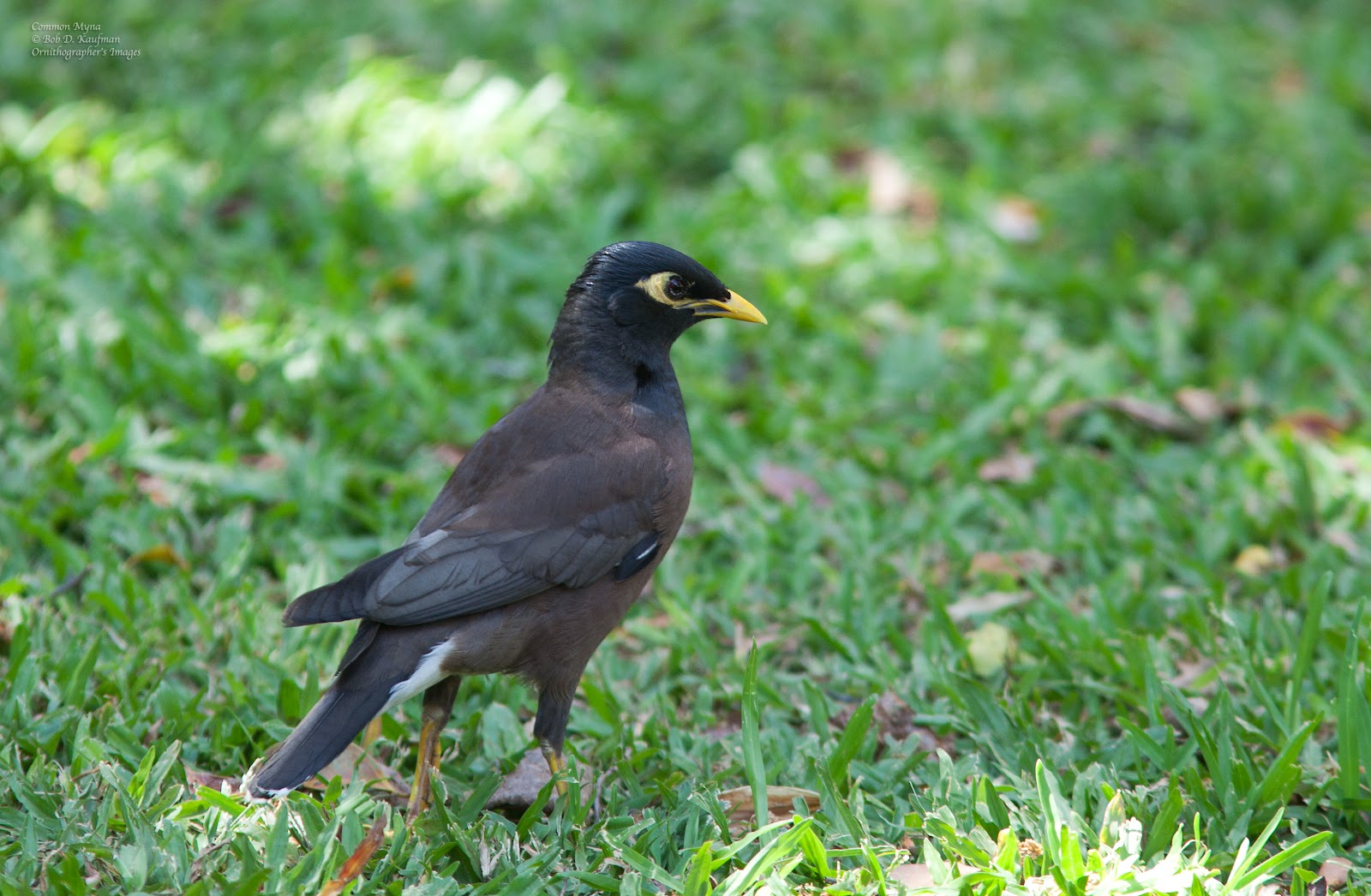
Actually, our birding began, quite unplanned, I might add, at the Honolulu Airport. We were on a 5 hour layover while waiting for our flight to Hilo. We just had lunch and Cynthia and I were conditioning ourselves for a long, boring wait (wi-fi is not free and I have no desire of putting in my credit card information in a public place like this) when a Spotted Dove walked nonchalantly towards my feet! It kept on walking and only flew off when it was almost stepped on by someone unaware of its presence. My wife, out of curiosity, wanted to know where the wild dove went. A few minutes later she came rushing and practically hauled me (and our carry-on luggage) to an open air area within the airport where there were trees and plants and bushes. It was a small park complete with concrete benches! And even better, it had birds! Wild, free-flying birds! We counted a total of 7 species in all: Spotted Dove, Zebra Dove, House Sparrow, Common Myna, Japanese White-eye, Red-whiskered Bulbul and Red-vented Bulbul. 


And then it was time to board our plane to Hilo. We were so happy that we were able to enjoy our waiting time at the airport watching all these birds.


Spotted Dove
Common Myna
Japanese White-eye
Red-whiskered Bulbul
Red-vented Bulbul


Tuesday, July 28, 2009

A Walk in the Crowds

I am perhaps the Silas Marner of birders. I mean I watch my wallet in the same unwavering passion as I do in watching birds. And so when I discovered that the Los Angeles Arboretum will not be charging any entrance fees on the third Tuesday of the month, I was ecstatic! A whopping $5 savings right there!

I was one of the first in line at the gates when they opened at 9 am. As I meandered along enjoying the butterflies flitting among the lovely flowers, I saw a Red-whiskered Bulbul. This exotic bird was one of the main reasons I visit the Arboretum. They are quite common and have been known to breed here. This one however was perched far too high in the treetop for a good photograph. Confident that I would have more encounters with it as the day progressed, I moved on to observe the other avian denizens of the park. Which wasn't much, sad to say. Summer birding doldrums is still in full effect as temperatures were already in the high 90's at ten in the morning.

Then came the crowds. It turns out that I wasn't alone in availing of a "freebie". Families of  varying sizes were everywhere. With them came children. Loud, noisy, exuberant children. Now don't get me wrong - I have nothing against kids, I have 4 grandchildren of my own - but when you are intent on trying to photograph a bird, it is not a good idea to be surrounded by a shrieking throng of young ones.

My hopes at ever seeing my favorite bulbul were fading fast with each minute that passed by. In almost abject resignation, I just contented myself at photographing the various flowers in the Arboretum. One of the places where there is a proliferation of some colorful blooms were at the top of the man-made watefalls. It was while I was taking a breather after negotiating the steep stairs that led to my destination that I heard a rustle and warble close to me. A Red-whiskered Bulbul was peeping through the leaves calling "kink-a-jou". I quickly aimed my telephoto lens and fired off a quick shot, knowing fully well that it will be just one of those "documentary" photos. Then as if obeying a divine command, the bird flew to an open branch just close enough to be at my lens' minimum focusing distance. It gave me a curious look, hopped to another branch, gave me another look and then flew away.


After that encounter, I was happy to be walking with the crowd of people out to enjoy a glorious summer day. If it were not for fear of being thought that I had gone off of my rockers, I'd be skipping and yelling among the children in a celebration of joy.


For more bird photographs and stories, please visit: