skip to main |
skip to sidebar
Gone are the ponds. The place can no longer be referred to as "wetlands". In its place are ricefields, as far as the eye can see. Because of that thousands of migrant ducks and waders no longer come here. This is Candaba now.
In fairness, there were still birds. Chestnut Munias, Red Turtledoves, and Zebra Doves were plentiful.
Our trip with birding buddies Peter Ting and Wenxing Pan last Saturday was like a roller coaster ride. There were ups and downs. The downside being the absence of the ducks and waders I mentioned earlier. The whole time we were there, we only saw two Wandering Whistling Ducks, two Black-winged Stilts, one Long-toed Stint and one Common Greenshank. Wood Sandpipers, on the other hand, seemed to be more in numbers. Perhaps it was because now they tended to flock closer together in the watery gaps between the rice crops.
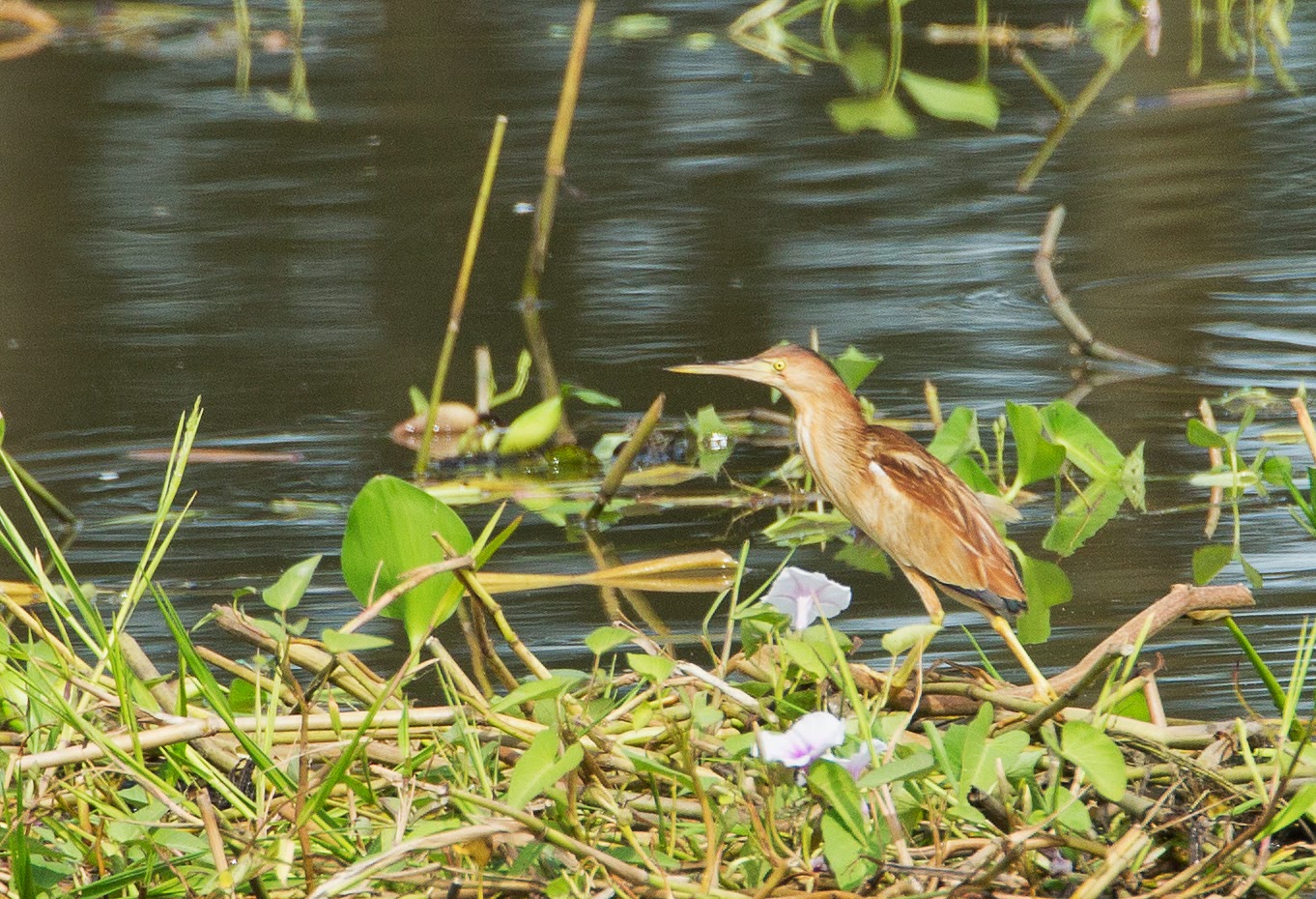
The upside was being rewarded with really close views of two kinds of bitterns: The Yellow as we were entering the site and the Cinnamon as we were leaving.
 |
| Yellow Bittern |
 |
| Cinnamon Bittern |
Then we had the up-and-down experience of trying to photograph birds in flight. First was a pair of Eastern Marsh Harriers. Each time we saw them they tended to fly farther away from us. We had to either wait for them to fly back or we leave the place then return when the raptors felt that there were no more people around and got more confident to fly closer.
The other challenge was the Oriental Pratincole. Surprisingly, there were lots of them, maybe close to a hundred, all ceaselessly flying overhead. Trying to focus on an individual is a test of patience and skills.
Without the ducks and waders, we had to cut our trip short. It was about this time last year when we twitched some rarities here: the Baikal Teal, Falcated Duck and Spot-billed Duck all seen at the pond close to the Mayor's house. Now there were just ricefields. Is it going to be like this forever?
Notice those dark spots on your skin? They're blackheads and they are quite frustrating. Thankfully, the internet offers some remedies to restore your skin to its regular smoothness.
(http://www.wikihow.com/Remove-Blackheads)
Now if you're a birder and you are looking for a bird - a single bird - with a black head among thousands in a pond more than a hundred meters away, that can be really frustrating! That is why I relegated that task to my very patient, sharp-eyed wife, Cynthia. So with commendable tenacity she scoured the pond looking through my long lens at each individual bird present to see which one had that distinctive black-head that would identify it as the uber-rare Baer's Pochard.
"I got it!" she called my attention. I peeped and sighed.
"But it's a Eurasian Coot," I stated with extreme caution, "It is still an uncommon migrant here in the Philippines, but sadly, it's not the Baer's"
She resumed looking at the pond going through it with a fine-tooth comb.
"There it is!" she said as she pulled me over to my camera.
"Ummm, errrrr, I think that is a Tufted Duck. See the white body? And the other one is a female." She gave me a look that made me regret the day I was born. I wanted to remind her that it was Valentine's Day and love should be the prevailing mood but a mouth kept shut, I believe, would be the better option.
Then came the heroes who saved our day (and possibly my life). Alex and Cel, using a pair of super binoculars, were able to see a different kind of black head - one with bluish eyes and a dark body. It was there all along but was slumbering peacefully (and unseen) behind some broad-leafed plants. Only when an inconsiderate Philippine Duck flew over it splashing the sleeping rare migrant with water that it lifted up its black head in full view. My wife was now able to put the Pochard in our camera's crosshairs and of course took a shot.
But wait! Having been rudely awakened by an unwelcome splashing, our beloved Baer's started shaking off the moisture from its body. Indeed back is black.
During those times that Cynthia was dealing with black heads I was focused on (and trying to focus on - photography wise) the Eastern Marsh Harrier that kept flying over, occasionally spooking the more jittery kind among the hundreds of birds on the ponds. I have not gotten a satisfactory shot of this raptor in the last three times we visited Candaba. So it is kind of all-or-nothing now because the probability of us returning here in the near future is quite slim. Well, the photo I got may not be the harriest, but it definitely is harrier than the ones I had before.
At around 10:30 we agreed to call it a day. Somehow my wife got sleepy after peering through my camera for what seemed like an eternity. And oh, we did something strange for lunch. Bypassing our normal choices of restaurants we unexplainably settled for the place of the golden arches. Ah, what black heads had done to us!
"We won't leave this place until we see it" was the agreement Peter, Cynthia, and I had that nippy Saturday morning. "This place" was a few meters to the left of the entrance to the Candaba Wetlands Sanctuary. "It" was the Eastern Marsh Harrier.
And it came! A little more than half an hour of waiting and the raptor flew into view! Not only did we see it, we got pictures, too! Not great photos (the skies were brooding grey) but the pictures were good enough for us as it showed unmistakably what we've been waiting for. We let out our breaths as the bird flew away from view.
We agreed to wait some more hoping that the Harrier would make another fly by. My wife, on the other hand, wanted to explore the surroundings to see what else can be photographed. Thirty minutes later, it was Cynthia who yelled "raptor!" as our beloved Harrier once again made a grand entrance. This time, however, the ducks which were still sleeping during its first appearance, were now fully awake and panicked at the sight of a would be predator. Ducks and herons filled the air in frantic flight forcing our Harrier to soar higher and farther away.
By 9:30 am, we all decided to abandon our stake out and just concentrate on photographing the other denizens of the wetlands. Unfortunately, the ducks preferred to stay at some distance preventing us from finding the uncommon Gadwall, female Mallard and the Eurasian Wigeon from among the floating flock.
It was, however, the Yellow Bitterns that were the most common species that day. At every turn we make, there would be one presenting itself.
Fittingly, a Yellow Bittern was the last bird we saw. We were already on our way out when I saw one out in the open, unperturbed by the farmers tilling the soil not that far from it.
The trip around the wetlands yielded the usual inhabitants including the colorful Common Kingfisher and Blue-tailed Bee-eater.
The Columbidae family were well represented by the plentiful Red Turtledoves and Zebra Doves.
From Rallidae were a Barred Rail and and a White-browed Crake.
As we were enjoying a sumptuous lunch later that day at Max's, the conversation went something like...
Peter: "This was the first time we stayed this long in Candaba!"
Cynthia: "Yes, and we had fruitful birding session!"
Me: (not saying much because my mouth was perpetually full).