Tuesday, April 18, 2023
GPS Location
Sunday, October 10, 2021
When Things Don't Go As Expected
Saturday morning Cynthia and I planned to go birding in Infanta. It's been a while since we've been there so we were expecting to see some species that we have not seen for quite some time. As we approached Baras the skies were dark and looked like it would be raining soon. So we decided to just go to Palo Alto - our usual birding spot in Baras. At the gate, the guard informed us that birdwatching is no longer allowed there. There had been complaints from the local residents he said without specifying what the complaints were about. He was very apologetic about it and requested us to turn around. With that unexpected situation my wife and I both agreed to continue going to Infanta inasmuch as the sun was beginning to peep through the clouds. As we approached the town of Tanay, we were surprised at the long line of vehicles. Was there an accident ahead? was our initial thought. As we inched closer to the front of the line we realized that there was checkpoint and the military was asking the drivers the reason for going to Infanta. Apparently "pleasure trips" were not being allowed to go through. Another unexpected snag to our birding plans. As we drove back I told Cynthia that our only option would be Taytay.
When we arrived at the usual bird stop in Taytay, we were glad to see fellow bird photographers Mon Quisumbing, Joel Dayao and his wife, Gemma. With them was Bing Santos and her husband Arnel. They were all waiting for the resident Black Bittern to appear. Since the said species was still a no show, my wife and I photographed the birds in the area.
Whiskered Terns, surprisingly, were quite plentiful.
There were also some Intermediate Egrets and Little Egrets.

Intermediate Egret

Little Egret
All of a sudden a Black Bittern did a very short fly by. It disappeared among the tall grass before we could point our cameras at it. Again, we concentrated on the "friendlier" birds. One of which was a White-browed Crake.
Another surprise was when a Purple Heron flew over and landed at some distance.
We then saw another bird fly at a distance and landed on a banana tree. At first we thought it was our target species but it turned out to be a Yellow Bittern. And we only got a documentary shot at it because it was so far away.
Then a single Wandering Whistling Duck flew by but unfortunately we were unable to get a good shot at it.
Around 9:30 am and the hoped for Black Bittern still not appearing, we decided to call it a day. It wasn't that fruitful birding trip since we had some unexpected glitches in our plan but just having the opportunity to be out in fields was refreshing for me and Cynthia.
Sunday, October 27, 2019
Candaback
The very first bird we encountered was the Purple Heron. As it turned out this would be the bird of the day - having encountered it at different places.
As I negotiated the challenging deeply rutted dirt road, we were frustrated by surprising skittishnesss of both the Zebra Doves and Red Turtledoves. We would see them feeding on the grounds ahead of us but everytime we stopped to take their photos they would fly away. And this happened a lot of times! Rather surprising because in our previous trips here both species would remain on the ground unperturbed by our presence.
At least one of their cousins, a Spotted Dove, posed long enough for us to be able to take a shot at it.
The area near the entrance was a fallowed farmland and completely devoid of avian population. As we neared the "wetlands" the Whiskered Terns were as usual flying around. Again, we only saw a few individuals where there used to be hundreds of them before.
Good thing a family of Common Moorhens were out searching for food.
We also encountered three species of bitterns but only managed to get photos of two: the Cinnamon and the Yellow. The Black Bittern made a quick flyby, landed on a clump of tall grass and completely disappeared from view.
![]() |
| Cinnamon Bittern |
![]() |
| Yellow Bittern |
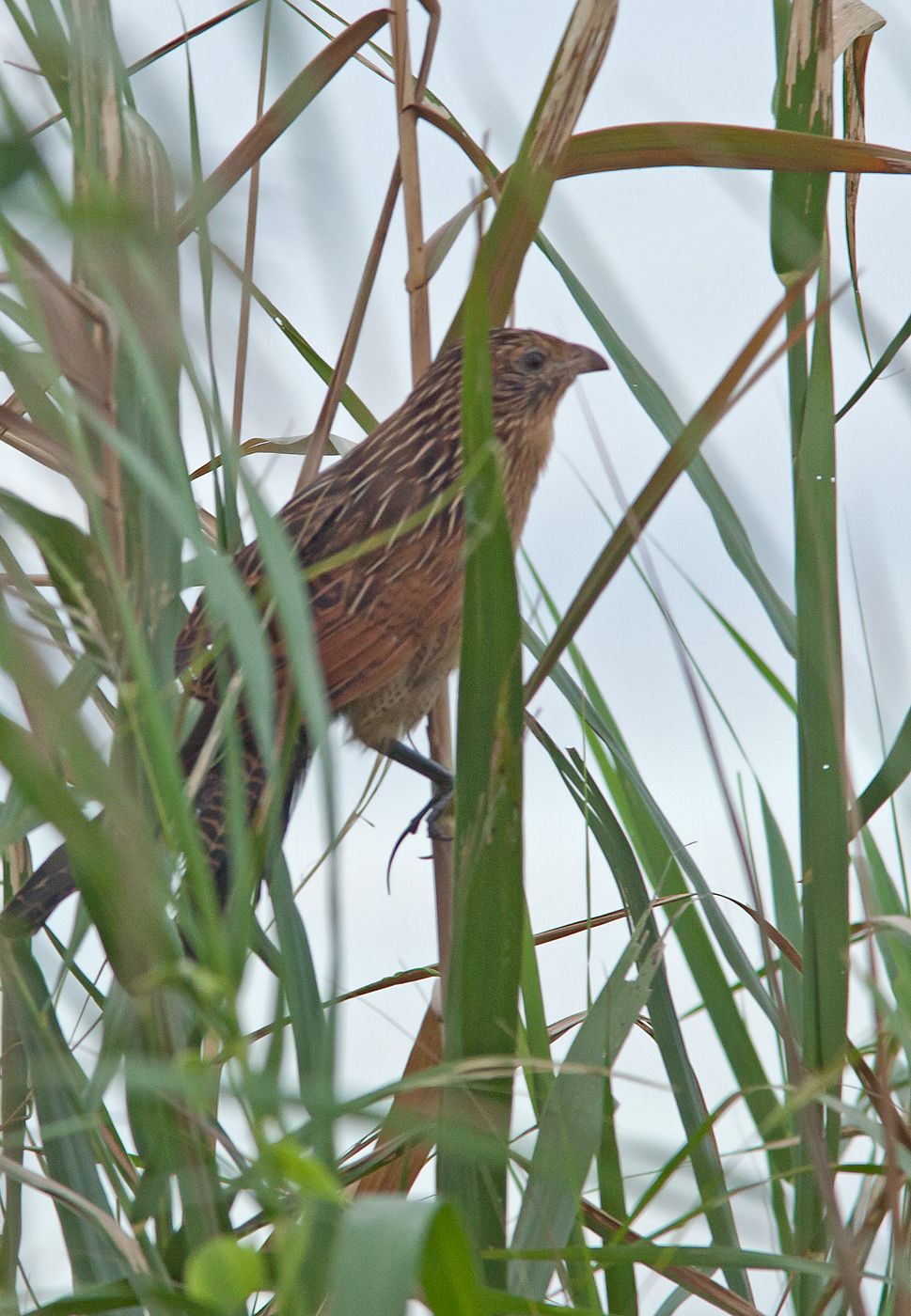
A little further up the road, Cynthia noticed some movement by the tall grass. "Coucal!" she said softly. Unfortunately, the large bird skulked behind the reeds and never showed itself in full view.
As we approached the pond which was now almost dry, we were glad to see several members of the Ardeidae family: the Cattle Egret, Little Egret, and Intermediate Egret.
![]() |
| Cattle Egret |
![]() |
| Little Egret |
![]() |
| Intermediate Egret |
When we were just about to get to the "mayor's house" I noticed that the ruts on the road was definitely not accessible, especially since our car isn't a 4-wheel drive. So we thought it prudent to just turn around.
At the provincial road, we got photos (and not so good ones even) of two of four regulars usually seen here: the Striated Grassbird and the Long-tailed Shrike. Unlike before, the Pied Bush Chat and Chestnut Munias were too far off for us to even get a decent shot.
![]() |
| Striated Grassbird |
![]() |
| Long-tailed Shrike |
![]() |
| Marsh Sanpiper |
![]() |
| Wood Sandpiper |
![]() |
| Black-winged Stilt |
![]() |
| Long-toed Stint |
From our home to this place took us about an hour-and-a-half when we left at around 4:30 in the morning. The return home took almost five hours as we had to endured the horrendous traffic situation in MetroManila, particularly along EDSA. It was such a traumatic experience that we probably would never come back to Candaba again.
Monday, February 27, 2017
Ricefields Forever?
In fairness, there were still birds. Chestnut Munias, Red Turtledoves, and Zebra Doves were plentiful.
Our trip with birding buddies Peter Ting and Wenxing Pan last Saturday was like a roller coaster ride. There were ups and downs. The downside being the absence of the ducks and waders I mentioned earlier. The whole time we were there, we only saw two Wandering Whistling Ducks, two Black-winged Stilts, one Long-toed Stint and one Common Greenshank. Wood Sandpipers, on the other hand, seemed to be more in numbers. Perhaps it was because now they tended to flock closer together in the watery gaps between the rice crops.
The upside was being rewarded with really close views of two kinds of bitterns: The Yellow as we were entering the site and the Cinnamon as we were leaving.
![]() |
| Yellow Bittern |
![]() |
| Cinnamon Bittern |
The other challenge was the Oriental Pratincole. Surprisingly, there were lots of them, maybe close to a hundred, all ceaselessly flying overhead. Trying to focus on an individual is a test of patience and skills.
Without the ducks and waders, we had to cut our trip short. It was about this time last year when we twitched some rarities here: the Baikal Teal, Falcated Duck and Spot-billed Duck all seen at the pond close to the Mayor's house. Now there were just ricefields. Is it going to be like this forever?
Sunday, July 24, 2016
JIF
At 6:30 we were there. Jonet gave us a detailed description of what to expect, where to look, and the best time to photograph our target species. For the next hour and a half we endured the scorching sun as we attempted (most of the time unsuccessfully) to get our JIF shot. I said unsuccessfully because the long-tailed birds were so unpredictable in their movements. You'll never know when they will decide to fly and if they did it was only for a short distance - oftentimes too short for our cameras to focus properly on the fast moving subject.
Thankfully, there were some passable photos that would be good enough to be included in the JIF posting in Facebook.
In between lulls when the Pheasant-tailed Jacanas were not up in the air, other species provided a respite, thankfully so. Interestingly, we were provided with BIF opportunities. Normally, BIF would mean "Bird In Flight" however, in our case that morning, BIF turned out to be Bittern In Flight. All three species went flying by, albeit at varying distances and at different times.
![]() |
| Black Bittern |
![]() |
| Cinnamon Bittern |
![]() |
| Yellow Bittern |
At 9:30 with the heat becoming unbearable, we bade goodbye to our new friends and to our host. Our deepest gratitude goes to Jonet who took time off from his schedule to show us where the jacanas were and providing very important information about birds in the area and even setting up a hide for us photographers.
One of the slogans for the famous peanut butter I mentioned above goes: "it's terif!" That's exactly how we would describe our experience with our version of JIF.
Monday, November 30, 2015
Driving me Mad
The Candaba Wetlands is one of the prime birding areas in the Philippines. Or I should now say, "used to be". Whereas before hundreds, if not thousands, of migrant waders and ducks can easily be seen here, now there was an obvious disparity since the birds we saw yesterday were much lower in number. Sure, there were hundreds of Black-winged Stilts but that's just about it. A few Wood Sandpipers here and there, fewer Long-toed Stints and a couple of Grey and Purple Herons. We did not even see a single Common Kingfisher! There were ducks, mostly the endemic Philippine, but they were too far off for a decent photograph. Good thing some Wandering Whistling Ducks found a place to settle that was within photographic range.
The primary reason for this, I believe, was because the watery area where these migrants settle are now rice fields, newly planted even. The local Black-crowned Night Heron colony population seemed to have dwindled as well.
Thankfully, the local avifauna was thriving well. The most ubiquitous among these were the Pied Bush Chat, Striated Grassbird, Chestnut Munia and Long-tailed Shrike.
![]() |
| Pied Bush Chat |
![]() |
| Chestnut Munia |
![]() |
| Long-tailed Shrike |
![]() |
| Striated Grassbird |
![]() |
| Barred Rail |
![]() |
| Buff-banded Rail |
![]() |
| Philippine Swamphen |
![]() |
| White-browed Crake |
![]() |
| White-breasted Waterhen |
![]() |
| Blue-tailed Bee-eater |
![]() |
| Yellow Bittern |
When we finally arrived home my wife was so exasperated. She told me that this could be our last birding trip because we don't want to go through this nightmare again. "It's for your own sake," she said, "because you're the one driving." I'm afraid I had to agree with her. At my age - a year less than 70 - my physical endurance is no longer what it used to be. Considering that we had to wake up early, go birding (which involves standing for long periods, walking while carrying my heavy camera equipment, and sometimes even trudging over uneven trails) then having to sit for seemingly countless hours inside our vehicle waiting for the traffic to move inch-by-inch towards home, I don't think I can handle that on a regular basis. And that drives me mad.