Prologue:
We were having a heat wave in Southern California. The
temperature has been soaring into 3 digits for the past week or so. Mind you
California heat is not humid where you sweat a lot, but rather dry and piercing
that it literally hurts the skin. It will be the same weather condition
this weekend said the all-knowing weatherperson. To bird or not to bird?..that
was now the question. First, a little story:
Birder's Wife: Darling, would you please take out the
trash.
Birder Husband: What? Don't you know how hot it is out
there? Why you could even fry an egg on the sidewalk!
A few minutes later...
Birder's Wife: Honey, look, the newspaper says they just
saw a Lesser Roadrunner near Death Valley!
Birder Husband: So what are you standing there for? Get
dressed and let's go! Oh, hand me the trash, I'll throw it before we get into
the car.
Birders are not ordinary people. They will cross the
burning desert, climb the highest mountain, sail the seven seas just for a
glimpse of some feathered creature. And thus plans were prepared for a birding
foray this Saturday – heat wave be darned.
Part I. A Walk With Butterflies.
Our plan was to go to Malibu Lagoon, 22 acres of marsh
and tidewater pools close to the famous Malibu Beach, playground of dudes and
dudettes. Along the way was Malibu Creek State Park, a bit of wilderness amidst
the Santa Monica mountains a thousand feet above the Malibu coast. We decided
to pass by this patch of forest and see what it had to offer, bird-wise. We
arrived early, a little before 8 am, and walked along a trail with the creek to
which the place was named for on one side, and a meadow-like slope, dotted with
a few trees and bushes on the other side. What made this scene even more
beautiful was the proliferation of butterflies - different kinds from the
yellow tiger swallowtail, to the tiny white cabbage butterfly. They would
criss-cross our paths, or occasionally accompany us part of the way. Their
presence punctuated our countless stopovers and provided an exhiliration that
lessened the scorching effect of the unforgiving sun.
The first bird we saw was a wren that was not unlike a
moth-eaten piece of rag. It was dust-bathing in the sunlight apparently to rid
itself of some feather-eating bug or heaven-knows-what.
 |
| Bewick's Wren |
Then there was an
explosion of phainopeplas. Phainopeplas - the name means "silky robe"
and conjures up images of some exotic, brilliantly colored, epitome of God's
creation in the avian genera. Actually it is a medium-sized (about 8 inches)
black (male) or brown (female) bird with reddish eyes and a crest. It's song is
a trill somewhat akin to a police whistle. This bird was not new to us but here
at Malibu Creek, they're just everywhere! Needless to say, I got some good
photos of this species. At some point on the trail we were on a higher level
than the creek alongside, so much so that we were almost eye level with the top
of the trees that grew along its banks.

I was trying to get some pictures of
yet another group of phainopeplas when Cynthia shouted, "woodpweker!".
As you might have learned by now, whenever she gets excited at seeing a new
bird she baptizes the poor thing with a new albeit funny name. And so I added
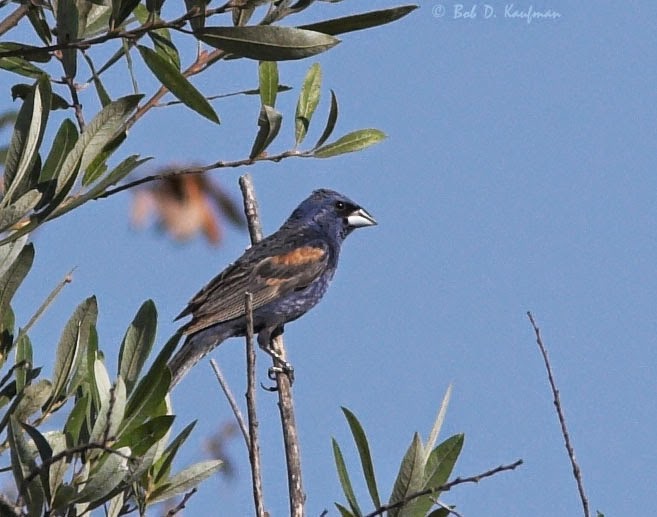
an Acorn Woodpecker to my list of birds photographed that day. The crowning
glory of our visit to Malibu Creek was - at last! - a decent picture of the
Blue Grosbeak (yes, it's that bird again), a male and a female to boot!
At about 10:30 am, we came upon a sight that would break
any birder's heart - a group of noisy (and loud) picnickers (including not a
few overweight women in bathing suits!) Bear in mind, this was a creek that we
have here, that is so shallow even a tiny bird will not drown in it.
Maybe these ladies know something we don't? hmmm. Not desiring to
witness what could be a miracle in the making, we decided to pack up and head
for our original destination - Malibu Lagoon.
Part II - Highway Ride
PCH, which stands for Pacific Coast Highway is a stretch
of road that runs through California and at various instances comes close to
the Pacific ocean.
As I mentioned in Part I, our original destination for
this day was the Malibu Lagoon which is right by PCH. We were stunned when we
arrived there. The parking lot was full and the place was teeming with
people! We should have known better not to go to a beach on a sweltering
weekend.
We vented our somewhat dashed enthusiasm over a
footlong cheesesteak sandwich at Subway. We resolved not to let this
little setback ruin our birding day. There is still Bolsa Chica which was also
along PCH but unaffected by the throng of beach-going heliophiles. Now in going
to Bolsa Chica from Malibu, we had to pass thru various cities in the southern
part of the Los Angeles megalopolis. Note: PCH is not a freeway and on certain
spots becomes a normal thoroughfare complete with traffic lights and all the
denizens that come with an urban street.
And so with this in mind, we began our trek of the
50-odd miles to our new destination. Cruising PCH we passed by some
affluent neighborhoods where a condo would cost anywhere between $600,000 to a
million and then just a block away the scenery would change so abruptly and we
would see squalor and very palpable poverty. There were cities where it seemed
that we were in a Mexican town complete with billboards and signs in Spanish
and not a single Caucasian in sight, whether in cars or on the streets. As we
passed by Long Beach, Cynthia saw Ken Malloy Regional Park (a supposedly good
birding area) but when I was about to pull over I noticed that the people using
the park at the time were the kind that I wouldn't want to be seen toting
$3,000 worth of photographic equipment even in broad daylight e.g. half-naked
tattooed men basking in the sun (and they were not even close to the beach!)
About an hour-and-a-half later, we saw the familiar
sights of Bolsa Chica. Inasmuch as it was already past noon, we took a break
and had a sandwich and a shake at Jack in the Box. Being the only fast food
restaurant nearby. There is also a public beach in Bolsa Chica but PCH
separates it from the Ecological Reserve thus sparing the nature area from the
beachcombers and the traffic.
The place was packed. Once again satiated with food, we
proceeded to bird Bolsa Chica. If Malibu Creek had its phainopeplas, Bolsa
Chica had its terns. Everywhere you turn, there were terns. It wasn't very
productive photography-wise because terns do nothing but fly it seems like, and
the peeps (a generic term for those shorebirds that appear to all look alike
even if they belong to a dozen species or so) were all so far to be
photographed even by my 300mm lens.
We called it a day at around 4 pm. It turned out not to be too
hot after all - Malibu Creek had some tall trees which offered shade and a
cool soft wind every now and then, and then Bolsa Chica of course had
its ocean breezes to give relief from the unshaded glow of the afternoon sun.