skip to main |
skip to sidebar
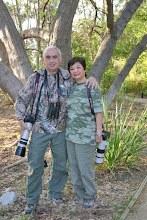
I wish it was that simple when it comes to photography, especially bird photography, to keep the photos of the birds Cynthia and I just saw and had taken pictures of. Of course, in reality, that is rarely the case. Even if we had all the settings correct, the odds of getting that perfect image are still in the hands of fate. But then we consider ourselves only so-so bird photographers and definitely not in the league of those who do these things for a living. Still, in one of the workshops my wife and I attended way back in 2006 held by Bob Steele, one of the best bird photographers in the United States, what he said stuck to our minds. His advice was to "spray and pray" - meaning to shoot as many pictures as you can of that particular bird and pray that at least one of your photos would be acceptable enough. Very practical advice, if I may say so. Despite doing this practice of "spraying and praying" there were still times when Cynthia and I could not keep some of the photos we had just taken. It was either too dark, there were so much foliage covering the bird, it was a bit blurred and a thousand other reasons. Another thing is that I am not that good at "photoshopping" (Cynthia leaves this aspect of photography to me). I could make minor adjustments to the photo and even clone out a distracting branch here and there but to be able to alter an image is totally beyond my abilities.
By and large though, our photographic adventures had been fruitful. We had gotten some pretty decent pictures of birds, sometimes even during adverse conditions. One such occasion was on our recent trip to Antipolo. In open situations, the lighting was a bit harsh, and in other circumstances, it was too dark under the shade of tall trees. In spite of these, we were able to keep most of what we saw. Here are some of them:
 |
| Pied Triller |
 |
| Collared Kingfisher |
 |
| Golden-bellied Gerygone |
 |
| Grey Wagtail |
 |
| Long-tailed Shrike |
To clone or not to clone - that is the dilemma being faced by bird photographers all over the world. That out-of-focus branch that becomes a distraction from the subject - should it be cloned off or let it remain?
Making "changes" from the original photograph using such tools as Adobe Photoshop has been and continues to be the subject of seemingly endless debates. Cropping, adjusting the saturation, brightness and even sharpness are considered acceptable primarily because they don't alter the "natural" quality of the image. Many adhere to the WYSIWYG (what you see is what you get) position. After all as a nature photographer, one should present his subject in its natural environment, right?
Then there are those who prefer a more "aesthetic" view - where the photograph must be as clean as possible, removing (or cloning out) any object that will distract the attention from the subject bird.
As to this second group I must confess:
I. Am. Guilty.
Not always - but only in very, very few occasions. For one thing I am not that good at Photoshop. Clone-oscopy is not my strong point. If the distracting objects are all over the image, then forget it, I'll stick to the wysiwyg principle.
Below is an example of a photograph of Blue-throated Bee-eater that I took in Subic. The original shot had some branches that touch the bird's belly. After cropping, lightening and adjusting the contrast and saturation, I decided to clone off the obtrusive branch. On the left is the original. On the right is the "photoshopped" version.
So which one is better?
Another change that I also do sometimes is blurring the background. Again, not being an expert in Photoshop, I only do this to my photographs where I can easily separate the bird from the background. For me this is also another way of minimizing the distracting objects from the main subject. The sample below was a photo of a Lesser Coucal taken by my wife, Cynthia. By blurring the branches and leaves behind the bird, the viewer will tend to focus more towards the subject. Again, on the left is the original and on the right is the cropped and cleaned version.
My stand is that when major changes like these are done on a photograph it must be declared accordingly when publishing or posting it for public viewing. Don't you think so?