Showing posts with label colasisi. Show all posts

Monday, July 02, 2018

Thanks to the Parrots

It was a short unproductive trip to Infanta last Saturday. The skies were gloomy and the birds were scarce. Despite that we still had some good encounters. There was this Sulphur-billed Nuthatch that kept on creeping and hopping all over the branches looking for insects.


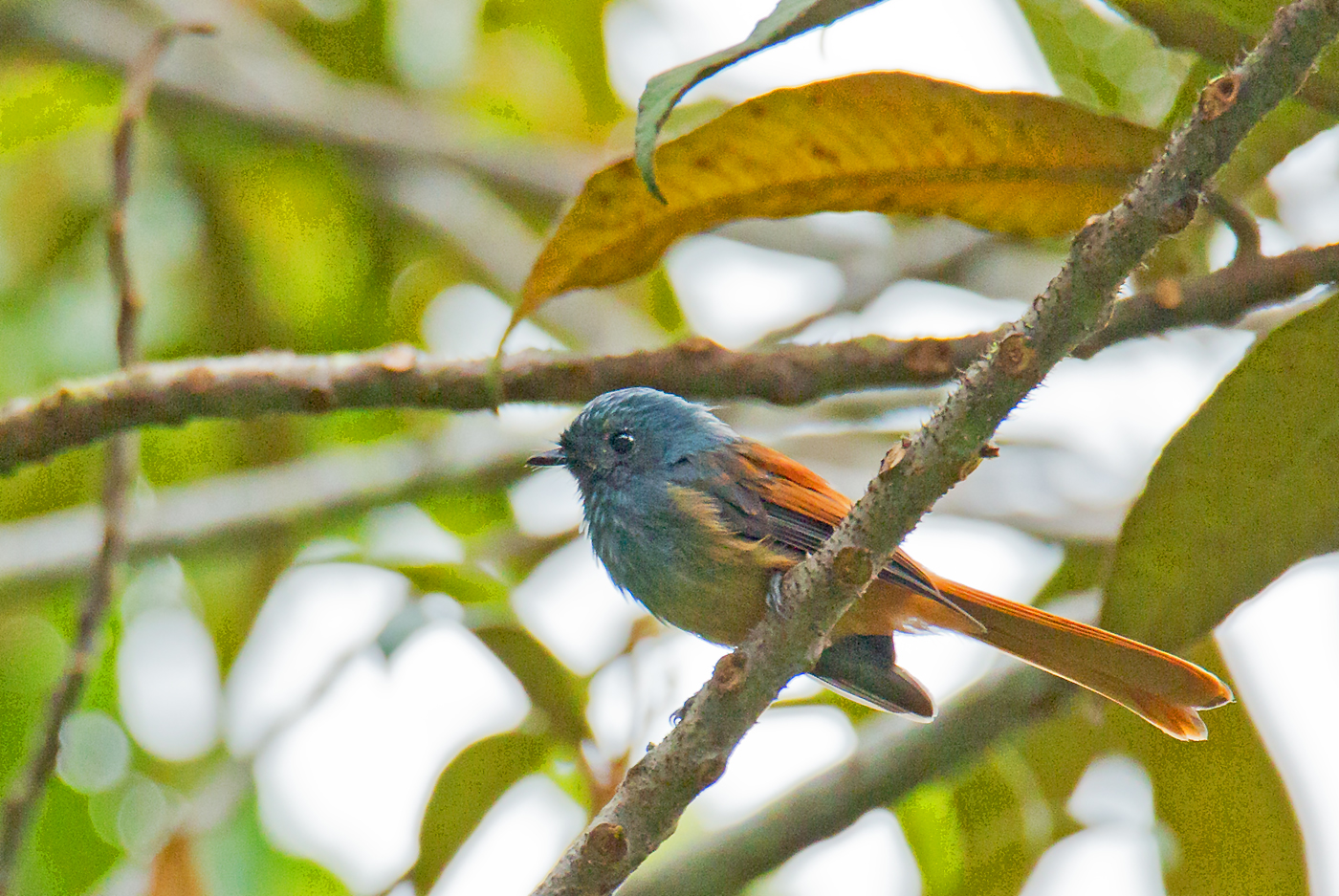
Then a mixed flock flew by but we only had a good shot of the Blue-headed Fantail. The Elegant Tits and Yellowish white-eyes were just so quick or behind the leaves most of the time.

We finally got to the place where the hagimit tree was fruiting. I set up my tripod and waited for the birds to come. It seemed that the Orange-bellied Flowerpecker bullied the others because it was the only flowerpecker we saw.


A flash of green and a Colasisi flew in and feasted on the red berries.


Cynthia then waved at me and pointed to another green bird on her side of the tree. It was a guaiabero also enjoying the bountiful fruits.


Then rain fell. We stood under an umbrella hoping it would soon abate. After 30 minutes it even became a heavy downpour. It only made sense to call it a day. It was still raining heavily when we reached the town of Tanay so we both agreed that we made the right decision.

It would have been a disappointing birding trip but thanks to the bright green colors of two endemic parrots that saved our day.

Tuesday, September 13, 2016

A Date with the Colasisi

"Colasisi" is another name for the Philippine Hanging Parrot (Loriculus philippensis). It was derived from the Tagalog word kulasisi which, interestingly, also had a different connotation: It means "mistress" or "the other woman". Inasmuch as the kulasisi was (and sadly, continues to be) a favorite cage bird because of its beautiful colors, the name was applied to a woman other than the wife. She was considered as a "pet".

Our birding friend from China, Wenxing, still did not have a good picture of this species. When our other birding friend and frequent companion, Peter, informed us that these colorful endemics were a sure find in a park within their subdivision, we all accepted his invitation to go there. We set Monday, September 12, as our date with the Colasisi.

At 6 am, as if on cue, three colasisis feasted on the trees with yellow flowers. For about an hour-and-a-half Wenxing and I had our fill at photographing these tiny gems. It was an enjoyable experience photographing them in this urban environment.

Here are some photos taken there.


Sunday, March 01, 2015

So Dip

We thought it would be a good birding day for us. As soon as we got off the car, we were greeted by a trio of Colasisis (Philippine Hanging Parrots) flying back and forth to the trees surrounding the parking lot of the Kamia Residence Hall in the campus of the University of the Philippines.


Add to that a friendly Black-naped Oriole calling not far from the tiny, green parrots.


It was all downhill after that. The hoped-for Cuckoo at the "frogs" area was a complete no-show. Our stake-out at the Main Library was also an exercise in futility because the migrant Ashy Drongo decided to relocate nearer the Beta Way. We went that way only to be greeted by the loud cheering and yelling of the spectators to a nearby sports competition.

It was a dip so bad that you can not dunk chips on it. And to think that I even brought my humongous 500mm lens and endured carrying it on my aching shoulder with the hope that I could get better pictures of the drongo and document the existence of the cuckoo. The cuckoo whose presence had been confirmed by our friend and university professor, Doc Mando, who had seen said bird a few days ago. We met him as he, himself, also wanted to take a better shot and establish the correct identity of the cuckoo.

To make matters worse, as I was loading my gears back into our car I noticed that one of the rubber edges of my tripod was missing! We quickly returned to the grounds in front of the library and scoured the area. Nothing. 

"I remember my tripod being caught in a crack in the steps at the "frogs", I told my wife.

We returned to that place and the first thing I noticed was that Doc Mando was no longer there. Very likely he didn't see the cuckoo either, I thought to myself as I searched the steps. It was like searching for the proverbial needle in a haystack. I was about to give up when I saw something embedded at a gap in the cement. I heaved a sigh of relief and offered a prayer of thanks and returned with a bounce to my walk to where my wife was waiting.

We may have dipped on our target birds but finding a tiny piece of rubber in a place covered by dead leaves was something we were thankful for. Now to go for a different kind of dip - the one that makes lumpiang shanghai taste better.


Tuesday, November 18, 2014

Pine Birding - Part II of our Baguio Trip

Once again the enticing aroma of pine trees greeted us as we parked by the "landslide" area along the road to the summit of Mt. Santo Tomas. Our friend, Jho, assured us that the Crossbills come to this area early in the morning. So far, nothing but the ubiquitous Pied Bush Chats frolicked in the morning sun.


Then I saw a silhouette of a bird perched on an electric wire. I walked slowly towards it. Blue Rock Thrush! I only managed to get a few backlit shots before it flew off and completely disappeared from view.


Cynthia detected some movement in the brush. The brown bird popped up and promptly returned back into the dense foliage. The only feature that we both noticed, aside from its color, was its long tail. Could it be the furtive Long-tailed Ground Warbler? Sadly, it never reappeared for us to confirm our suspicions. I even tried to get near the bush where it hid itself hoping it would reappear. Something appeared alright but not the long-tailed skulker but rather a curious Siberian Rubythroat. Just a few feet from me! I was so surprised and excited that I got my camera settings all wrong and managed just a "documentary" shot.


I was about to join my wife when out of the blue, a small bird alighted on the electric wire above us. "Crossbill!" I shouted. We both took pictures and to our delight it flew down to the "landslide" area just as Jho had predicted. Soon it was joined by its less colorful mate. Cynthia and I were surprised and even amazed at the cooperativeness of this pair of Red Crossbills. They just fed on the tiny plants growing besides the rocks as if a couple of human beings holding cameras were not there.


Past ten in the morning and it was us that got tired of photographing these uncommon montane species. We checked out the summit but failed to encounter either the Mountain Shrike or the Fire-breasted Flowerpecker. We were about to board our vehicle when I saw a raptor gliding below us. It was my wife who was better at BIF (birds in flight) shots who got a few photos. It was another puzzler, made even more difficult to identify because of the great distance between the bird and the photographer. It turned out to be an Eastern Buzzard, another lifer for us! (Thanks, Jho, for the ID)


On the way down, the only species we encountered were a flock of Mountain White-eyes and (now I'm quite sure) a Paddyfield Pipit.


We were at the eco-trail a little before 11. It was not long after when Cynthia alerted me. "I can hear them!"she said. First came a huge flock of Mountain White-eyes. Then a solitary Grey-streaked Flycatcher stopped by. A totally unexpected sighting was that of a Colasisi or Philippine Hanging Parrot! 


While I was enjoying my colasisi, my wife was photographing a mystery bird. Unfortunately it was behind a patch of greenery and totally backlit that her shots were all too dark. I can only figure out that it had an orange breast and a blackish head with a tiny strip of white behind the eye. It was while we were comparing the results of our photographic endeavors that another lifer appeared. We added Turquoise Flycatcher to our list.


Happy with our encounter, we broke off for lunch. Past one pm and we were back this time at the eco-trail by the paintball area. Jho told us this was where the mixed flock "wave" passes through. True enough as soon as we were among the pines that the flock came. First was the Sulphur-billed Nuthatch (too far, too dark) then a Citrine Canary-Flycatcher dropped by. It was followed by the Chestnut-faced Babbler (a lifer but no good photo), then a Blue-headed Fantail and finally, an Elegant Tit.


Citrine Canary-Flycatcher 
Blue-headed Fantail 
Elegant tit
After that exhilarating experience, the forest became quiet again except for an occasional Arctic Warbler passing by. We agreed to call it a day. We just had a light snack that evening and were fast asleep by 8 pm.

We had a wonderful time in Baguio - thanks to our friend, Jocelyn Alberto-Floresca, for showing us the birding places in the area. Because of that, we added five lifers to our list: Island Thrush, Red Crossbill, Chestnut-faced Babbler, Eastern Buzzard and Turquoise Flycatcher. We thought about planning a return trip, perhaps stay longer so we can don our tourist hats too. Or just concentrate on birding again. Who knows?

Sunday, December 29, 2013

Subic, Day 2 - Oldies and Newbies

Our second day at Subic turned out to be more about birders than birds.

A very early trip to Orica gate was a heartbreaker - hearing but not seeing the hoped for lifer, the White-fronted Tit. We also heard at least two kinds of owls. We could not even identify them! So we decided to take our chances at the Nabasan trail again. At the entrance we saw a foreigner with binoculars and a camera. "Birder!" my wife and I both exclaimed. We approached the guy and introduced ourselves. His name is Jens (pronounced "Yens") Hansen, a Danish guy who had been birding all over the world. Although young - probably in his late thirties - he is an "oldie" when it comes to birdwatching. We asked him to ride with us since we will be going to where he intends to go anyway. 

Along the way we saw some Blue-throated Bee-eaters where there were Treeswifts yesterday. Just like yesterday, Nabasan trail turned out to be a complete dud. However, it was here that met Jorge and Tetch Garcia. Binoculars and camera was a give-away that these couple were also birders. When asked if they saw any birds, "A lot!" Jorge replied. We wanted to know what and he said, "Flycatcher!" and then showed us a photo of a Bee-eater. Obviously, they are still newbies, I thought. We suggested they try the area around Crownpeak Hotel and even offered to take them there. Along the way we stopped to look for the Green Imperial Pigeon. It was still there and this time it was joined by a Bar-bellied Cuckooshrike.

"Minivet!" Jens suddenly blurted.

"Where?"

"I don't know, I just heard it."

It was Cynthia who eventually found the Ashy Minivet peeping from a tree top.


At another stop we encountered first a single Grey-streaked Flycatcher. Eventually two more turned up to join their friend.


Finally we all got some very good looks at the Blue-naped Parrot, much to our new friends' delight.


Having shown Jorge and Tetch the birding place we described to them, my wife and I together with Jens returned to the Botanical Garden road. Nothing there. We need to return to our hotel before 10 am so we can avail of their free breakfast so we dropped off Jens to where we first saw him.

Another foray into Nabasan trail and Botanical Garden after breakfast yielded nothing but a White-throated Kingfisher.


We were about to give up birding Cubi Point, seeing only the Philippine Bulbuls and Large-billed Crows,  when Cynthia heard the unmistakable screech of a Colasisi. Finally after much searching I saw it among the yellow flowers.


And then it was time to go. Our second day was not quite productive bird-wise but we did gain three birder friends. For my wife and myself that is still a plus.

Sunday, May 27, 2012

Oh nest to goodness

Recent posts by fellow bloggers and birder friends Maia and Trinket about wild bird's nests found in urban areas piqued my interest. But I didn't do anything about it. Constant  prodding by another birder friend, Adri, to see the nests at the University of the Philippines (U.P.) campus - a few minutes drive from home - also failed to lift my butt from being glued to my computer chair. Friday night my wife and I still have not finalized any plans to go birding on Saturday. The Wild Bird Club of the Philippines (WBCP) group were going to Palay-palay but the meet-up time being three in the morning (which means we have to wake up at two) sort of hosed down any enthusiasm we had to go birding with them. Then came a text message from another friend, Bong, who asked if I wanted to see the nests at U.P. I texted back asking him what time he planned to go (not when it is still dark, I prayed). Seven am, he replied. Well, I certainly can live with that! So we arranged to meet along Magsaysay Street on Saturday morning.


My wife and I arrived early - about 6:30 - and started driving along the street where the nests were. Magsaysay St. is not long, probably not more than 10 blocks from end to end. And for the life of me, Cynthia and I could not locate the nests of the White-breasted Woodswallows and Crested Mynas. A frantic text to Maia. We get an immediate reply saying the nests were just across the Alumni Center. We found the building quite easily (it's not like we haven't been here before) and at once we saw the Woodswallows. I parked the car, took out my equipment and as soon as I had it ready, the Woodswallows flew away. My Kainis Poreber character was starting to surface when Cynthia pointed to the wooden electric pole to our right. "Crested Myna!" she exclaimed.


The adult birds were flying back and forth bringing food to what we assumed to be several chicks inside the top of the pole. Cynthia, meantime, joined her friends whom we met earlier at the Chocolate Kiss cafe at the next building for some girl talk. I on the other hand, stood, waited, photographed, then waited again for the Crested Mynas. 


A text message. It was from Adri apologizing for not replying earlier (I asked him for the nest location the night before). He also said that the Woodswallow chicks were now fully fledged and therefore no longer stays at the nest area. But the Mynas are still there he assured me. I thanked him and told him that I saw the Mynas already.


Another text message. It was Bong this time. He wanted to know where the nests are. I gave him the directions. After exchanging several more texts, he asked where I was. Standing at the sidewalk I told him. Apparently he already drove by a couple of times and still did not see me. My camouflage must be very effective. And I'm not even wearing one. Frustrated, he texted Cynthia instead. She promised to meet him in front of the cafe. A minute later both of them were parking next to my car.


Not long after Bong arrived, we were joined by Eve, his better half. For the next couple of hours, Bong and I watched and photographed the diligent parenting duties of the Crested Mynas while our wives engaged in some heavy conversation.


First the entree
then comes the dessert
and clean up afterwards
During one of the lulls, both our wives were alerted by some shrieking overhead. Colasisi! Cynthia yelled. A flock of about 4 or 5 birds landed in the tree across the street. Bong and I grabbed our gears and rushed beneath the said tree. It was a challenge. We only saw one individual and it was perched in the darkest part of the leafy tree. All I got were some "documentary" shots.


By now the weather was getting hotter by the minute. There weren't anything new happening around us bird-wise so we decided to call it day.


Brunch at the Cafe Via Mare was good. Somehow food tastes even better when shared with good friends.


Sunday, May 06, 2012

Antipolo Shown

The heat was becoming unbearable. Smog and pollution were pervading the valley. In an attempt to escape these, Cynthia and I went to the hills. Of Antipolo. 


Initially we just saw the usual suspects: a Barred Rail, White-breasted Wood Swallows, Yellow-vented Bulbuls, Golden-bellied Flyeaters, and Pied Fantails. Then Cynthia heard a melodious song. A colorful song coming from a black-and-white bird. We've gotten glimpses of the Philippine Magpie Robin here before but this was the first time I was able to take a picture of it.


Things began to look-up (I am tempted to say that you can interpret that word almost literally - the birds were high up in the trees, beginning with that Magpie Robin). Again, it was Cynthia who heard the repeated "twick" "twick" of a Colasisi (Philippine Hanging Parrot). There they were raiding the red flowers of the African Tulip tree. This was a first time sighting for this species here in this village. At a distance a Bright-capped Cisticola was also enjoying the morning. Another first time sighting!


Later on we witnessed an immature Lesser Coucal trying (and, thankfully failing) to locate a Pied Fantail's nest much to the aggravation of the parent birds. That was also the first time we've seen a Lesser Coucal here although we've been hearing their calls quite regularly.


But the highlights of that morning were the conversations we had with two different ladies who witnessed our birding activities. The first came after we saw the Magpie Robin. An elderly couple were hiking when they saw us, cameras and all. The lady approached us and asked if we were residents (which I'm sure she knows that we're not; it's a small subdivision where everybody knows everybody).  We introduced ourselves and told her that we were guests of our friends from church, John & Vivette Webb. She smiled and then asked curiously what we're doing. We gave her a glowing report on the joys of bird watching and bird photography. We even enumerated the various species that we have seen and photographed here in their very own community putting emphasis on the very uncommon Slaty-legged Crake that we saw last year. To our surprise, she asked, "is that bird more expensive?" That had some sort of discombobulating effect on us. Did she mean a photograph of a rare bird would be more expensive that than of a common one? or (hopefully not) if it would be more expensive as a caged bird?


I hastily drew our calling card from my wallet and handed it to her explaining that we do this thing as a hobby, not as a business nor a sport. Cynthia told her to go to our Smugmug website and look for the Birds of Antipolo Gallery. Maybe when she sees those photos, she and her husband might have more appreciation for the birds around them.


Our second encounter was with Mrs. Linda Co. We've met her before. As a matter of fact it was at her yard that the Slaty-legged Crakes decided to build their nest 9 months ago. Since then she had become more aware of the birds in their area. She even related to us that three weeks ago she saw an albino Coucal! She and Cynthia were in the middle of a conversation when suddenly my wife stopped in mid-sentence and started shooting at something from across the street. That something turned out to be a White-eared Brown Dove - another first time sighting in Antipolo!


We resumed our bird talk with Mrs. Co until it was time for us to go. She promised that she would call should the albino Coucal or any other interesting bird should show up in their neighborhood.


Oh, before we got into that conversation with Mrs. Co, I had a serendipitous encounter with a lovely lady - a female Mangrove Blue Flycatcher.


Now back to the valley. And everything that goes with it.

Wednesday, November 09, 2011

Long tale sighs

It all came down to sessions of telling tales and photographing shrikes.


Early morning found Cynthia and myself at the Main Library grounds of the University of the Philippines in Diliman. Already there were Tonji and Sylvia Ramos and Tina Mallari - friends and fellow bird photographers. Soon Rey Sta. Ana and his buddy, Rocky Sison joined us. Professor Gerry de Villa showed up briefly and gave a short, albeit very informative lecture on the whys and wherefores of our target species. Then came Gabs Buluran. The catalyst, if you may, of our being there. It was Gab's photograph of a male Narcissus Flycatcher - taken at the very spot where we are now gathered - that precipitated this event. Later in the day we were joined by Maia Tanedo and Jops Josef, friends and birders as well.


For about three and a half hours we waited patiently for the black and yellow-orange bird. Those long, lingering hours were spent in recounting birding experiences punctuated here and there by sighs of frustration as our longed-for flycatcher decided to forage elsewhere. Every so often our conversations would be interrupted when a Long-tailed Shrike or a Brown Shrike or a Pied Triller would fly in and land in a closer-than-usual perch.


Sometime in the midst of this seemingly interminable wait, we were briefly entertained by a dramatic staging of a lover's quarrel by a pair of Colasisis (Philippine Hanging Parrot). Unfortunately this intriguing scenario was held high up in the canopy of a fruiting tree.


At around 9 am Gabs left for work. One hour later, Cynthia and I had to call it quits inasmuch as she has a lunch appointment with her childhood friends. 


Later that day we learned that the Narcissus did a total no-show attitude even to those who decided to remain behind.


Well then, allow me to show you a Long-tailed "Narcissus" Shrike:


And Cynthia's Brown "Narcissus" Shrike