Showing posts with label mangrove blue flycatcher. Show all posts

Saturday, April 13, 2019

Show us no Pitta

For more than two hours we waited. Two hours of being drenched in sweat and enduring the humidity of a summer. We were at the Mini Forest of the La Mesa Ecopark for a particular purpose: to  photograph the Hooded Pitta and the Mangrove Blue Flycatcher. We sadly dipped on both.

But please show us no pity.  The morning was not a total disaster. For one thing a Black-naped Oriole - a species that prefers to stay high among the branches of tall trees - came out in the open and posed for us for a few minutes.


Then a pair of Lowland White-eyes cavorted just above us.


An overstaying(?) Brown Shrike was still hanging around perhaps aware that it was still quite cold in its home in northern Asia.


A surprise was a Philippine Bulbul which have not been seen much in this area.


Also the morning was about people. As we were about to get into the mini forest we met a young guy. He was a campus missionary from our church (Victory Christian Fellowship) in Novaliches. They will be holding a youth ministry at the Ecopark he told us.

While waiting for the Pitta we met an old friend, and fellow birder, Jenny de Villa. We spent some time together catching up and sharing our birding experiences.

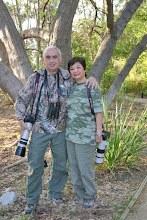
Finally, as we were already driving on our way out, I saw a guy dressed in camp and holding a camera with long lens. "Bird photographer!", I told my wife. I waved at him and parked the car. He came over and introduced himself and we did likewise. We just added a "lifer" to our birding friend list - Rey Ibay.

Sunday, August 24, 2014

Robin's 'Hood

Yes, there were Lowland White-eyes. Scads of them as a matter of fact. But it was the Philippine Magpie Robins that claimed the place as their 'hood.

My wife and I were at the La Mesa Ecopark early Saturday nursing a slim hope of seeing the Rufous Paradise Flycatcher. At the parking lot we met fellow bird photographer Arnel Ceriola. He was the one who posted to Facebook a photo of the said bird last Thursday. He wanted to see it again and maybe get a better shot he told us.

We staked out the place where he last saw the bird. Cynthia, on the other hand, decided to explore the surrounding areas. Almost an hour passed and there wasn't even a twitter from the uncommon flycatcher. I texted my wife and asked if she found anything interesting. "Mangrove Blue Flycatchers" she texted back. I excused myself from the stake out and told Arnel I'd be joining my wife. It was not long after I met up with Cynthia that I saw the Mangrove Blue. "Told ya!" my wife said with a smug smile.


Overhead we could hear the constant "pi-piyaw" of the Black-naped Orioles.


Flocks of hyperactive Lowland White-eyes were constantly moving from tree to tree.


Still, as I mentioned earlier, the day belonged to the Philippine Magpie-Robins. Juveniles and adults were scavenging tidbits from the horse feed that fell on the ground. The bullying tactics of the Yellow-vented Bulbuls never fazed these black-and-white birds. It was, after all, their 'hood.


A little after 10 am, we decided to call it a day. On our way out, we met more fellow bird photographers who were intent on finding the fabled "paradise" bird. Bert and his friend, May, were lucky enough to get a photo of a Cuckoo (ID still to be confirmed). Rocky, Roy and Fr. Auckhs were starting their own stake-outs. Arnel decided to leave earlier satisfied at having photographed the immature Red-bellied Pitta.

Cynthia suggested we do a quick look from the view deck before leaving the park. The waterway was almost completely covered by grass and weeds and there were no birds in sight. We were about to give up when a small flock of Scaly-breasted Munias took a break from their flight and gave us enough time for some photo-ops.


Even though we missed on our "target" birds, we were happy with what we got and especially enjoyed the local 'hood.

Saturday, September 21, 2013

Spotted Would Not….

It wasn't the first time it happened to us. Still, it was a bit frustrating. Seemed like every photographer in town had seen and taken a picture of the male Spotted Wood Kingfisher at the La Mesa Ecopark. Everyone except us, that is. Oh yes, my wife and I saw it. I even pointed it to two visiting Singaporean bird photographers, Simon Quek and Wang Bin. But photographs? Not me. The bird was on a high branch and was terribly backlit (or backlighted. Whatever!)

And sooo, Cynthia and I just contented ourselves with the now dirt common Ashy Thrushes. The Red-bellied Pitta that our Singaporean friends purposely came to this place for was sadly a no-show. 

However, there was a consolation. And what a consolation it was! It definitely more than made up for the disappointments with the Spotted Wood Kingfisher which would not stay on a lower level (like it used to do) nor the Red-bellied Pitta which never showed up at all. This time a very cooperative pair of Mangrove Blue Flycatchers posed close enough and long enough for us to take some really good photos of them.


Male
Female

Sunday, August 04, 2013

Juvenile Detection

"Peter wants to see the pitta," I told my wife. "The Red-bellied one," I further explained.

"Where and when?" she asked.

"Ecopark. Saturday."

"OK!"

Peter was downcast when we met him Saturday at the mini-forest at the Ecopark. "No birds!" he lamented.

We stationed ourselves at the place where local birder, Anthony Balbin, said was the playground of the pittas. Minutes dragged by so slowly like a plodding snail. Cynthia not wanting to be the breakfast of mosquitoes wandered around. Her perambulations were rewarded by the appearance of a Mangrove Blue Flycatcher. 


Then there was a bird she couldn't figure out. When she returned to our stake-out place she showed me a really bad photo of the unknown bird. Striped head, dull brown. I dismissed it as just one of those Yellow-vented Bulbuls. 

Humidity intensified to an unbelievable degree. Not wanting to drown in my own sweat. I asked Peter to forget about waiting for the pitta for now and check-out the surrounding areas. As we rounded the trail we received a relentless scolding from a Grey-backed Tailorbird - berating us perhaps for not being patient enough.


Silence once again. Even the resident Ashy Thrushes seem to have taken a vacation that muggy Saturday morning. I told Peter that I'll do some trail-trekking. He opted to stay put. My wife, once again, was doing her own exploration.

Not finding anything of the avian variety, I went back to where Peter was. As soon as he saw me, he place his finger over his lips then pointed towards a bunch of leaves. I looked and voila! a nest! 


"Ashy Thrush," he whispered. I looked again and saw the nest. I looked at Peter with raised eyebrows. "Just wait," he advised me and then showed me the image he took while I was out meandering. Indeed there was an Ashy Thrush on the nest. Soon a flutter and one adult came and sat on another future addition to the Geokichla cinerea population of Ecopark. Joining us was Reuel Aguila who also documented another Ashy Thrush nest about two months ago.

Note: To protect the welfare of the nesting Ashy Thrush, no photos of the nest will be shown.

Having had my fill of nest photos, I looked for my wife. I met her near the purportedly pitta place. She was peering into the undergrowth and beckoning me with her hand. Apparently she detected something exciting. I looked at where she was looking and I gasped audibly. A juvenile Red-bellied Pitta was feeding nonchalantly about 3 meters away. My brain assessed the situation and immediately came to the conclusion that I need a more portable gear. I practically wrested Cynthia's camera with the 300mm lens from her. Reuel also came and joined me as I crouched like a tiger at the semi hidden dragon of a bird. Meanwhile, my wife went to inform Peter of her discovery. For about 20 minutes or so all of us feasted on freshly delivered pitta.


That, of course, was the highlight of our birding day. Maybe not the adult Pitta that Peter was hoping for but detecting a juvenile and getting some pictures of it was definitely worth the sweating and the waiting.

Wednesday, June 12, 2013

Nest Quick

It was a quickie birding trip at La Mesa Ecopark.  My neighbor and fellow birder, Chin Fernandez, wanted to go to this place. It will be his first time. Our friends, Jops and Maia, joined us to help introduce Chin to this birding refuge so close to the city.

Surprisingly, it wasn't a very productive outing that morning. We did catch a glimpse of the Red-bellied Pitta but the supposedly more common Hoodeds were nowhere to be seen.

To expand our coverage of the place we decided to go separate ways. It was when I was all by myself that a female Mangrove Blue Flycatcher darted across the trail and hid in the underbrush. 


A little while later a Common Emerald Dove nonchalantly fed by the edge of the trail just a few feet away from me.


The highlight of the day was when Chin and I staked out the Ashy Thrush's nest. It was fellow bird photographer Reuel Aguila who showed it to us. We were enduring the high humidity and the mosquito attacks waiting for some action when we were joined by another bird photographer, Steve Albano.

Suddenly there were some movement. The female thrush landed on the nest and the heads of a pair of nestlings popped into view!


The mommy bird then sat down and began brooding on its offsprings. That was the sign for Chin and myself to call it a day.

Sunday, August 19, 2012

Sweat Indulgences

My wife and I were bathed in sweat. Salty, sticky sweat. The sun was shining brightly and the morning humidity was surprisingly high. It seemed incredible that just a few days ago Metro Manila had experienced a devastating flood and continuous heavy rainfall for about ten days straight.

But this gloriously sunny Friday morning we were able to relieve the birding itch that hounded us during those wet monsoon days. The number of birds we saw made the perspiration that deluged our bodies more bearable.

Aside from the usual suspects like the Golden-bellied Flyeaters and Pied Fantails we also saw both Kingfishers - the White-throated and the Collared. Pied Trillers and Philippine Magpie Robins represented the black-and-white group.

As the hours passed and getting soaked in sweat, Cynthia and I both agreed to just stand still under the shades of the trees along the street and enjoy the refreshing breeze that occasionally blows by. In front of us was a copse where we encountered some interesting species in our previous visits to this place.

"Wait and they will come" I assured my wife as I drank heartily from the bottled water that we brought to alleviate the onset of dehydration while visions of Kevin Costner building a ballpark played before my eyes.

And come they did. A glimpse of orange at first. Then a full frontal view of the colorful female Mangrove Blue Flycatcher.


After the adrenaline rush caused by the flycatcher sighting subsided we once again settled into our semi-torpid state as the gentle wind provided a much needed comfort. Then a flash of brown. Question marks popped above our heads. We were going cuckoo trying to figure out what it was. Then..enlightenment! Could it be a cuckoo? Finally we got a better look albeit a little too steep as it chose to perch on a higher branch. As Cynthia was photographing it, I saw another movement farther back. Same size but much lighter in color. An immature methinks. Both disappeared as quickly as they appeared.


ho-hum, these guys are boring
Mom, are those weirdos gone?
The real story however focused on the feeding habits of birds. There was a huge fruiting tree where several species were feasting. My wife and I had the pleasure of observing how different the way one species eat from the other.


The Yellow-vented Bulbul
pick -em up off the street..that's the best way
Lowland White-eye
you have to nibble and savor each bite
Philippine Bulbul
first, grab the fruit in your beak
then...flip!

Sunday, May 06, 2012

Antipolo Shown

The heat was becoming unbearable. Smog and pollution were pervading the valley. In an attempt to escape these, Cynthia and I went to the hills. Of Antipolo. 


Initially we just saw the usual suspects: a Barred Rail, White-breasted Wood Swallows, Yellow-vented Bulbuls, Golden-bellied Flyeaters, and Pied Fantails. Then Cynthia heard a melodious song. A colorful song coming from a black-and-white bird. We've gotten glimpses of the Philippine Magpie Robin here before but this was the first time I was able to take a picture of it.


Things began to look-up (I am tempted to say that you can interpret that word almost literally - the birds were high up in the trees, beginning with that Magpie Robin). Again, it was Cynthia who heard the repeated "twick" "twick" of a Colasisi (Philippine Hanging Parrot). There they were raiding the red flowers of the African Tulip tree. This was a first time sighting for this species here in this village. At a distance a Bright-capped Cisticola was also enjoying the morning. Another first time sighting!


Later on we witnessed an immature Lesser Coucal trying (and, thankfully failing) to locate a Pied Fantail's nest much to the aggravation of the parent birds. That was also the first time we've seen a Lesser Coucal here although we've been hearing their calls quite regularly.


But the highlights of that morning were the conversations we had with two different ladies who witnessed our birding activities. The first came after we saw the Magpie Robin. An elderly couple were hiking when they saw us, cameras and all. The lady approached us and asked if we were residents (which I'm sure she knows that we're not; it's a small subdivision where everybody knows everybody).  We introduced ourselves and told her that we were guests of our friends from church, John & Vivette Webb. She smiled and then asked curiously what we're doing. We gave her a glowing report on the joys of bird watching and bird photography. We even enumerated the various species that we have seen and photographed here in their very own community putting emphasis on the very uncommon Slaty-legged Crake that we saw last year. To our surprise, she asked, "is that bird more expensive?" That had some sort of discombobulating effect on us. Did she mean a photograph of a rare bird would be more expensive that than of a common one? or (hopefully not) if it would be more expensive as a caged bird?


I hastily drew our calling card from my wallet and handed it to her explaining that we do this thing as a hobby, not as a business nor a sport. Cynthia told her to go to our Smugmug website and look for the Birds of Antipolo Gallery. Maybe when she sees those photos, she and her husband might have more appreciation for the birds around them.


Our second encounter was with Mrs. Linda Co. We've met her before. As a matter of fact it was at her yard that the Slaty-legged Crakes decided to build their nest 9 months ago. Since then she had become more aware of the birds in their area. She even related to us that three weeks ago she saw an albino Coucal! She and Cynthia were in the middle of a conversation when suddenly my wife stopped in mid-sentence and started shooting at something from across the street. That something turned out to be a White-eared Brown Dove - another first time sighting in Antipolo!


We resumed our bird talk with Mrs. Co until it was time for us to go. She promised that she would call should the albino Coucal or any other interesting bird should show up in their neighborhood.


Oh, before we got into that conversation with Mrs. Co, I had a serendipitous encounter with a lovely lady - a female Mangrove Blue Flycatcher.


Now back to the valley. And everything that goes with it.