Showing posts with label hummingbirds. Show all posts

Wednesday, May 03, 2017

Birding in Ecuador - Day 2 - Luis' Lane

On our second day we will be checking in at the Sachatamia Lodge which will be our "home" for the next three nights. Mercedes, the owner of the Puembo Birding Garden where we stayed the first night, suggested we should go birding on the way to Sachatamia. "I know the perfect guy who can drive you to your destination and even take you to the birding spots along the way," she offered. Early morning of our second day, the said driver, Luis, was already waiting for us.

"Our first stop would be at the Alambi," he said. Alambi Cloud Forest Reserve was indeed a must-see place for birders. It is a hummingbird heaven!

Fawn-breasted brilliant
Purple-bibbed Whitetip
Purple-throated Woodstar -female
Booted Racket-tail
Brown Inca
Brown Violetear
From there we did a short stop at Bellavista Lodge - another famous lodging area in the Tandayapa valley.

Buff-tailed Coronet
Blue-winged Mountain Tanager
After lunch at the town of Mindo, we proceeded to another birding stop-over - the San Tadeo Birdwatching. Whereas Alambi was noted for its hummingbirds, San Tadeo, on the other hand, was famous for its tanagers.

Black-capped Tanager
Golden-naped Tanager
Flame-faced Tanager
Black-chinned Mountain Tanager
Golden Tanager
Lemon-rumped Tanager

Finally, we arrived at Sachatamia. We settled in our cottage and then surveyed the surrounding area. And got good looks at a Masked Trogon.


We said goodbye to Luis. He was technically a guide because he is familiar with the roads, trails, paths and lanes of the birding spots. He even knew the owners of those places personally. Not only that he is an expert on local birds. Before leaving he said, "Look for the owl at the parking area at night."

However, we were so exhausted that as soon as we returned to our cottage, we were out like a rock. 

Saturday, September 05, 2015

The Hummingbirds of Southern California

Although not really a hummingbird haven like southeast Arizona, southern California still hosts six species of the Trochilidae family. 

The most common is the Anna's Hummingbird (Calypte anna), which can be seen even in urban gardens. As in all of the these species, the male is the one that has the more colorful gorget, especially given the proper light and angle. Male Anna's have an iridescent magenta or reddish pink crown and gorget. By the way, it's name was derived from Anna Massena, duchess of Rivoli, by Rene Lesson, an 18th century French Ornithologist and Herpetologist.


Arguably just as common as the Anna's is the Allen's Hummingbird (Selasphorus sasin) which can also be easily seen in parks. It is generally rufous in color, the male having an orange-red gorget. It's forehead and back has a green color. The name commemorates Charles Andrew Allen, a collector and taxidermist of the early 19th century. 


Similar looking and often confused with the Allen's is the Rufous Hummingbird (Selasphorus rufus). The male Rufous can be best distinguished from the Allens, by having a lesser amount of green on the crown and back. Rufous Hummingbirds are also migratory and can be more commonly seen in Southern California in spring.


Another migrant, seen only during the summer months is the less colorful Black-chinned Hummingbird (Archilochus alexandri). It's dark chin becomes iridescent deep purple at the right amount and angle of light.


The following two species are less common than the previous four. It was just sheer luck that I was able to photograph both at the Eaton Canyon Park in Pasadena not far from where I used to live. 

The Costa's Hummingbird (Calypte costae) is a resident of arid and semi-arid regions of California and Arizona. However, in summer, it seeks shelter from the heat and inhabits chaparral and woodlands. It is similar to Anna's in terms of the color of the male's throat. However, the Costa's gorget extends out to the sides.


The smallest bird in North America is the Calliope Hummingbird (Selasphorus calliope). It is also a migrant and can be seen in southern California during its spring and autumn passage.The male has wine-red streaks on its throat instead of the usual gorget.


Information derived from wikipedia and allaboutbirds.org

Sunday, March 22, 2009

The Hills are alive...

One nice thing about Pasadena is that it is close to a variety of avian habitats – well if you consider an hour’s drive close. Anyway with the onset of spring, we thought it would be nice to head for the hills. Nestled amidst the San Gabriel Mountains about 30 miles east of us is Placerita Canyon. Not a lot of people go there, as it lies sort of off the beaten track. And that could be a good thing.

Of course, little did we know that there was a school outing there yesterday. Thankfully, they stayed at the ampitheater and we were able to explore the trails undisturbed. The highlight of our day came when we were at the picnic grounds where there were always a variety of birds to be seen. Dark-eyed Juncos were just about everywhere and the Western Bluebirds were constantly swooping down on some insect. I was taking some pictures of the Juncos when my wife almost nonchalantly said, “Look, a sparrow!”

Sparrows weren’t really that unusual here, White-crowneds and an ocassional Golden-crown were regulars. But when I looked at the object of my wife’s comment, I was speechless for quite a while. Cynthia, after a few minutes of waiting for me to identify the sparrow, finally asked, “Well, are you going to tell me what kind it is?”

“White-throated Sparrow!” I finally announced breathlessly.

White-throateds are very rare in California and to serendipitiously find one here can make one lose one’s speech faculties.


Per suggestion of the local docent, we proceeded to the Walker Ranch area where not far from the parking area, a hillside of yellow flowers were in full bloom. Here we saw our FOS Hooded Oriole.
Rufous Hummingbirds were competing with the Anna’s for prime feeding territory.

We saw a lot of birds that lovely Friday morning and it even seemed like the canyon was bursting in song. Even to this slightly hearing-impaired birder.

Tuesday, October 03, 2006

Whirr Am I?


We followed Mel & Elaine's advice and decided to go along with the bird walk to be held at 7 am at the San Pedro Riparian Area. The motel offers free continental (read: cheap) breakfast, so we partook of their cold cereal and hot cocoa before embarking on our adventure.

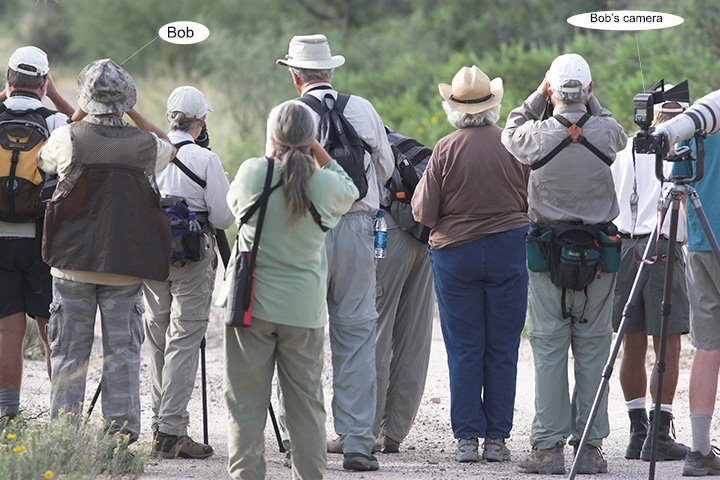
We arrived at the SPRA and found a gathering of birders. As I was setting up my gear, Mel (the tall guy with a hat in the middle of the picture) approached me and asked, "Did you see it?"


"See what?" was my curious reply.


He pointed to the top of the tree right beside the parking lot and there perched a Red-tailed Hawk enjoying the early morning sun.


Soon everybody started hitting the southbound trail. Not good, I whispered to Cynthia, most birds we will see will be against the light. Not discouraged by such prospects we ambled along with the group, stopping every now and then to watch the birds pointed out by Alan, a Bureau of Land Management(BLM) volunteer.


Thr circuitous route covered about 3 miles and as we trudged towards the San Pedro House (the visitor center), my left shoulder was already bruised from the more than 10-lb load hefted onto it. The walk added Vesper and Brewer's Sparrows to our life list. Blue Grosbeaks which we found to be very skittish in California are much more friendly here. At the San Pedro House, while everybody was discussing the birds they saw, we lingered a while near the feeders close by. David, another BLM volunteer, suddenly shouted, "White-breasted Nuthatch!", as he pointed to a black and white bird foraging near the base of a tree. Strangely enough, nobody paid attention to David. I, on the other hand, kept clicking away.

It was about 11 am when we left SPRA. We had lunch at Arby's where Cynthia finished off a Chicken Salad sandwich before I could even say "sandwich". Blame it on the 3-mile walk she explained.


After lunch we went to the Huachuca Canyon. According to my reference books there are four canyons that are great places to bird. The first, Ramsey Canyon, we learned, was pretty dead as far as birding was concerned. The 8 mile unpaved road to Carr Canyon is precipitous with numerous hairpin turns so Cynthia and I, acrophobics that we are, agreed not to take that route. We chose Miller Canyon first. It was a 2.5 mile drive of rocky road (not the ice cream) without any zigzag. At the end of the road was Beatty's Ranch and B & B. This place is famous for its hummingbirds (14 species were found in one day!). The hummingbird feeders around the Beatty store did not show much promise but we were told by a couple of birders who were on the way out, that there are more feeders, and consequentially, more birds, further up the trail.

Ignoring the pain on my shoulder, I once again carried my camera gear up a steep slope and finally ended at a relatively flat, albeit small area with chairs and a roof. There we met Lisa Williams, a local, who is also into bird photography (see her work at arizonabirder.com). The place was soothingly quiet that we can hear the whirr of hummingbird wings as if only inches away from our ears. The three of us spent about 2 hours enjoying and photographing the tiny winged wonders of the avian world. (Trivia: Hummingbirds are the only birds that can fly backwards). Here we met the Magnificent Hummingbird, arguably the largest hummer found in the United States.

Having had our fill of Beatty's hummingbird corner, we decided to check out the last canyon in our list. Ash Canyon is about 4 miles south of Miller and has a better (and even shorter) road. The road ended at the front gate of Mary Jo Ballator's B & B and like Beatty's she also had feeders in her yard. Lisa joined us here as well and we had a great time once again with hummingbirds. Our life list was now augmented by Broad-billed and Lucifer Hummingbirds and Mexican Jays. In between shots, we just sat on the patio chairs and took in the beauty of the multi-colored feathered jewels and the serenade of whirring wings that only the Huachuca Canyons can offer.


Monday, August 14, 2006

Man of Steele


The Kern County Birding Group in Yahoo announced that they are having a "Hummingbird Festival" on Saturday, August 12th. Part of this program is a workshop on photographing hummingbirds which will be conducted by Bob Steele. Bob is a foremost bird photographer in the country and have had his photographs featured in all Birding and Nature magazines around. He is also the moderator of the Avian section Nature Photographers Network of which I am also a card-carrying member.

I emailed Bob earlier in the week asking him for the better route to get to the Kern River Preserve (KRP). We've been there before and we took the longer way through Bakersfield and came home using a different way through the Kelso Creek Road. This was where we got into a lot of trouble because the road is unpaved and traverses a across the mountains. We were still driving the Saturn sedan at that time and although we got home in one piece, it was the most nerve-wracking trip we have undertaken. So when Bob suggested to take Route 14 and then Hwy 178, and with our Jeep thoroughly checked-up and maintained (costing me $680.00), we decided to give it a try.

We got up early - around 4:30 am and were on the road by 5:20. We arrived at KRP at around 9:00 am after a short pit stop at McDonalds in Rosamond, a city on Route 14 just before the turn off at Hwy 178.

There were already a lot of people gathered for the festival, all of them white and many of them senior citizens. Bob Steele was already there setting up flowers next to a hummingbird feeder explaining that that is the way of getting hummingbird pictures in a "natural" setting. So I attended his workshop along with a dozen or more photographers which lasted for a little over an hour.

All this time, Cynthia was regaling the other non-photography-oriented birders with tales of our birding/photography adventures and even showed them my "portfolio".

After the workshop, Bob and I talked shop and I am just awed at how friendly and knowledgeable he is. We shook hands as he hauled his equipment and prepared to leave. Cynthia and I ate our "baon", loaded up some gas in town and headed home.