Showing posts with label white-bellied munia. Show all posts

Monday, May 21, 2018

When Dove has Gone

We were met at the gate by the husband-and-wife caretakers of the property. "The Cream-bellied Fruit Dove is gone" the husband informed us, "because the young ones have fledged." That was sort of expected. Before I could even ask about the other dove, he said, in an apologetic manner, "the Yellow-bellied is no longer there. There was heavy rain with thunder and lightning the other night and when we looked the following morning, the nesting dove had already left." "It never came back," he added.

As they say, when it comes to dove, there is no forever. So we did what anyone who lost their dove had done - we moved on. 

Was it by chance that we found redemption at a place not that far from a chapel? We were waiting for the hoped for Grand Rhabdornis - which was once again a no-show - when Cynthia saw a small bird perch on a tree at some distance from where we were. "What is it?" I asked my wife. "I don't know," she answered, "but it looked like a munia."

"A munia??" I exclaimed doubtfully. "In this kind of environment?"

So I looked though my long lens and my face reddened from extreme embarrassment. It was indeed a munia. A White-bellied one even. I mean who would expect a bird that prefers lowland forests and ricefields to be this high up on a mountain. This was the first time that this species had been seen here, as far as I know.


After almost an hour of waiting and no other birds showing up, we both agreed to return to our car. As we approached the chapel, there were some bird calls emanating from a fruiting tree. It didn't take long for one of those sources to come into view. A black bird. Philippine Fairy Bluebird was my guess. But wait, the eyes are not red. I hoped that it would be the uncommon Blackish Cuckooshrike. But...I was right the first time! The reason for the eyes not being red was because it was a juvenile! (Thanks to Rob and Mhark for the confirmation).


As if that wasn't enough, the mood changed from blue to green as a pair of Guaiaberos posed for a few minutes for us. Again, this was another first time sighting of this species for us in Infanta.


Then, a Coppersmith Barbet came in full view, at eye level, offering us our best shot of the day.


Back at the roadside, we chanced upon a fruiting hagimit tree. And where there are fruits, there will be birds. Although not as many this time. Two kinds of Flowerpeckers were feeding on it - the Orange-bellied and the Bicolored.


Orange-bellied Flowerpecker
Bicolored Flowerpecker - male
Bicolored Flowerpecker - female
A family of Philippine Bulbuls also came, the parents feeding their young ones.


At around 11 am we decided to call it a day. As we delighted in our sumptuous lunch, we both agreed that even in the absence of dove, there can still be happiness.

Sunday, July 28, 2013

Ting Wai is Waiting

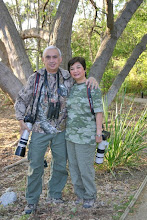
Our birding buddy, Peter (aka Ting Wai), wanted to get a photo of the Indigo-banded Kingfisher in Villa Escudero.  He had photographed it before but he wasn't happy with the results. Now that he is better "equipped" with the 600mm lens that Canon Philippines loaned him, he wanted to give it another try.

The key to photographing the resident kingfisher was waiting. We set up our gears in the middle of the shallow river and waited. Every now and then the tiny blue-colored bird would zoom past us teasingly. Still we waited. There were times when it would perch but it would do so on a branch too distant even for our long lenses. So we waited some more.

Almost three hours later and bingo! It came at just the right distance at just about the right ambient light. We fired away. The waiting was finally over.


After a sumptuous lunch - how can you not enjoy such delicious Filipino cuisine while the cool river waters flow over your feet? - we headed towards the tree popularly known as the Red-keeled Flowerpecker's home. As soon as we got there we were already rewarded by the presence of the immature flowerpecker yelling for food. 


One of the parents was busy feeding on the red fruits which it eventually shared with its offspring.


Soon raindrops started falling on our heads. We boarded Peter's car and drove to nearby Hacienda Escudero where we discovered to our delight that it was a place where munias weren't hard to come by. As a matter of fact, three kinds were busily enjoying the bountiful fruits of the grass: Chestnut (aka Black-headed) Munias, Scaly-breasted Munias and surprise! White-bellied Munias.


Rain began to fall in earnest. The effects of rising early in the morning were beginning to creep on us. As we drove along the superhighway with raindrops pelting the windshield, pictures of warm cozy beds waiting for us in our respective homes danced in our heads.